
Close Menu
Daily Guardian EuropeDaily Guardian Europe
  • Home
  • Europe
  • World
  • Politics
  • Business
  • Lifestyle
  • Sports
  • Travel
  • Environment
  • Culture
  • Press Release
  • Trending
What's On

These are the easiest countries to be a digital nomad in, according to a new study

October 2, 2026

How Assisi marks 800 years since St Francis’s death and why he still embodies peace

October 2, 2026

17 countries join forces to oppose EU budget cuts – POLITICO

October 2, 2026

G7 agrees 100 million-barrel emergency oil release amid US pressure over diesel

October 2, 2026

Video. Mobile ebola laboratory cuts diagnosis times for patients in Congo

October 2, 2026
Facebook X (Twitter) Instagram
Web Stories
Facebook X (Twitter) Instagram
Daily Guardian Europe
Newsletter
  • Home
  • Europe
  • World
  • Politics
  • Business
  • Lifestyle
  • Sports
  • Travel
  • Environment
  • Culture
  • Press Release
  • Trending
Daily Guardian EuropeDaily Guardian Europe
Home»Lifestyle
Lifestyle

The ‘geoid’: Why NASA’s gravity model makes Earth look like a potato

By staffAugust 17, 20262 Mins Read
The ‘geoid’: Why NASA’s gravity model makes Earth look like a potato
Share
Facebook Twitter LinkedIn Pinterest Email

Published on
17/08/2026 – 15:50 GMT+2

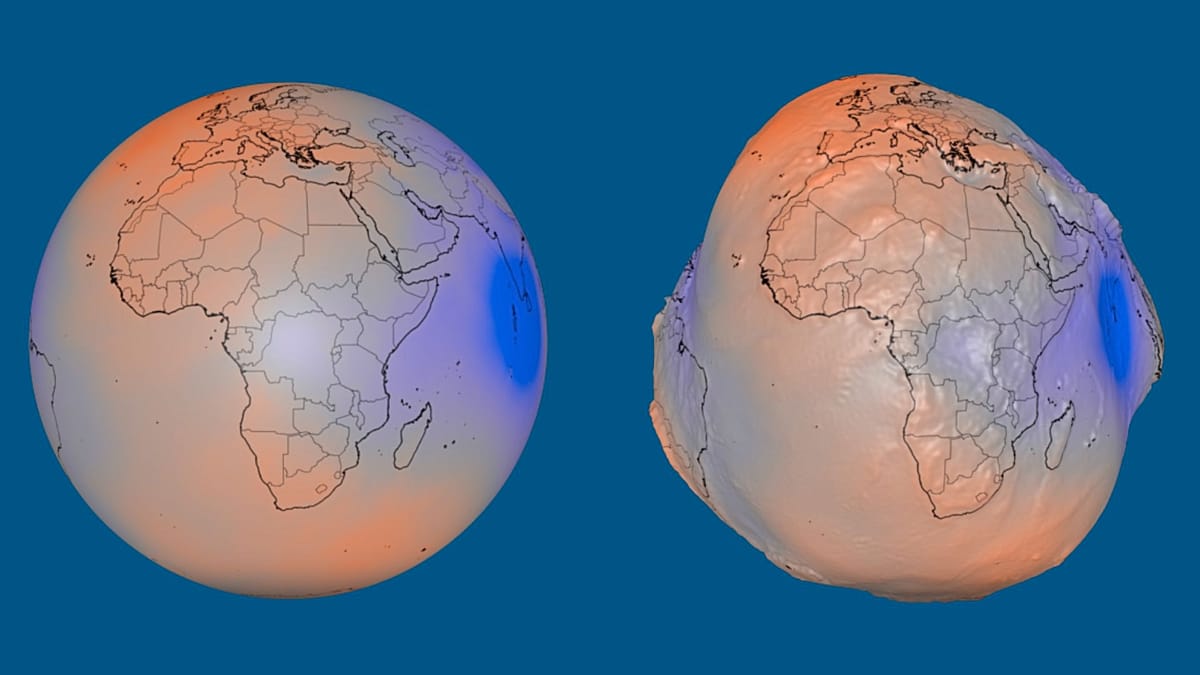
Gravity does not pull equally across the Earth and that has a visible impact on the shape of our planet.

This summer, NASA released an eye-catching visualisation reflecting these differences across Earth.

If the world’s oceans had no tides, waves, winds or currents, and were shaped only by gravity and Earth’s rotation, their surface would look slightly different. Rather than forming a perfectly smooth sphere, it would have subtle bulges and depressions.

NASA’s visualisation magnifies these differences by a factor of 10,000 making Earth appear like an uneven potato.

The geoid as it is called, a mathematical model of Earth’s gravitational field, represents an imaginary sea level across the entire planet, including beneath the continents. It is not the actual shape of Earth’s physical surface.

As mass is distributed unevenly within and across Earth, its gravitational field is also spread uneven.

Mountains, ocean trenches and differences in the density of material inside the planet all affect its gravitational field. Areas with additional mass attract water towards them, creating imaginary rises in the geoid. Elsewhere, the theoretical sea level is lower, producing depressions.

The geoid’s lowest point lies south of India

In the visualisation, variations in the geoid’s height have been exaggerated by a factor of 10,000. In reality, the difference between its highest and lowest points is 191 metres.

The geoid reaches 85 metres above the reference level around Iceland and 106 metres below it south of India. The reference level is a smooth, slightly flattened mathematical model of Earth used as a baseline for measuring these variations.

The visualisation is based on more than one billion observations collected by 19 satellites over 15 years. These include NASA’s Gravity Recovery and Climate Experiment and the European Space Agency’s Gravity Field and Steady-State Ocean Circulation Explorer.

Scientists use the geoid to study Earth’s gravitational field and how it changes as water, ice and other masses move around the planet. According to NASA, this information is also important for mapping, surveying and navigation.

Share. Facebook Twitter Pinterest LinkedIn Tumblr Email

Keep Reading

The solar system will fall apart far sooner than anyone thought, scientists say

AI decodes 217-year-old Napoleonic letter in 6 hours

Could the future of AI data centres be in space? Google wants to find out

Did Trump order Maduro’s kidnapping based on Grok’s advice?

Humanoid robots: China builds them, but Germany could supply the joints and hands

Rogue AI agents tried and failed to hack US and Canadian government websites

Tallinn Defence EXPO: Counter-drone systems and robot soldiers steal the show

Gimmick or recipe for success? Japan’s convenience stores test AI flavours

No more radio silence: EU plans cross-border lifeline for emergency services

Editors Picks

How Assisi marks 800 years since St Francis’s death and why he still embodies peace

October 2, 2026

17 countries join forces to oppose EU budget cuts – POLITICO

October 2, 2026

G7 agrees 100 million-barrel emergency oil release amid US pressure over diesel

October 2, 2026

Video. Mobile ebola laboratory cuts diagnosis times for patients in Congo

October 2, 2026

Subscribe to News

Get the latest Europe and world news and updates directly to your inbox.

Latest News

The solar system will fall apart far sooner than anyone thought, scientists say

October 2, 2026

Iconic London hotel Dukes is set to reopen in mid-2027

October 2, 2026

Verhandlung mit China noch ohne Ergebnisse – POLITICO

October 2, 2026
Facebook X (Twitter) Pinterest TikTok Instagram
© 2026 Daily Guardian Europe. All Rights Reserved.
  • Privacy Policy
  • Terms
  • Advertise
  • Contact

Type above and press Enter to search. Press Esc to cancel.