
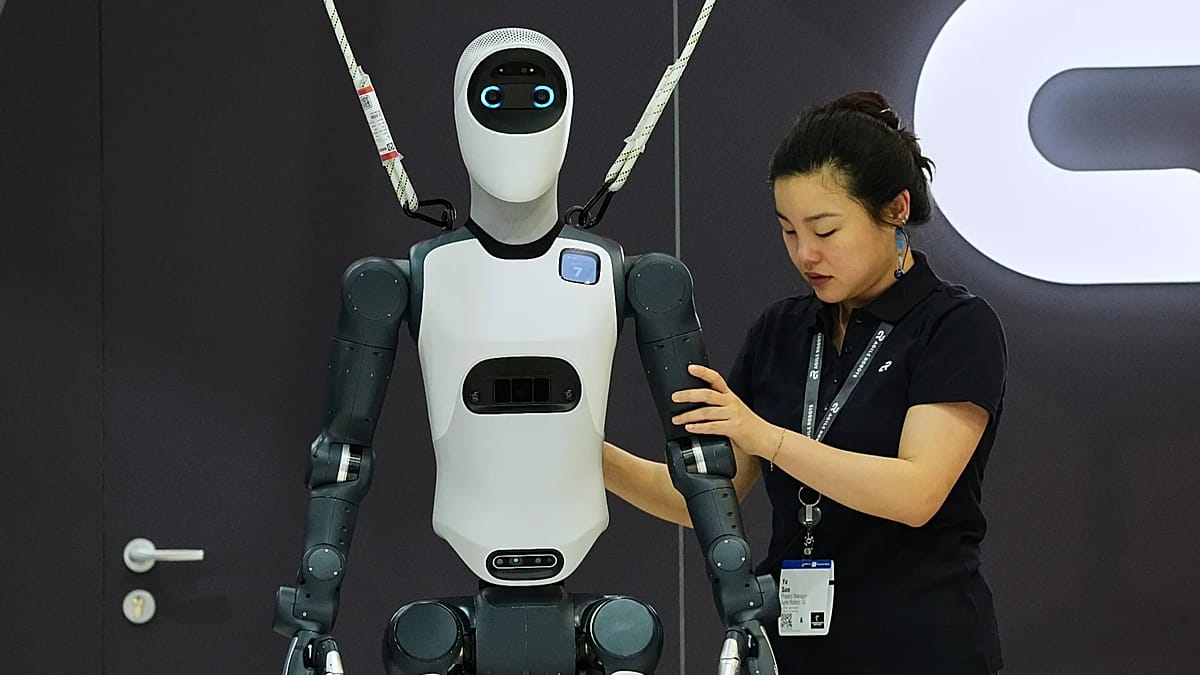
At first glance, humanoid robots look like a field dominated by the big tech corporations: artificial intelligence, cameras, sensors, software.
But beneath their casing lies a great deal of traditional industry.
Every leg, every arm and every hand contains motors, gearboxes, bearings and sensors — components European companies have been producing for decades.
German research is still at the starting point in the race to develop humanoid robots, but industrial suppliers are already far ahead when it comes to specialised parts.
Researchers are now asking whether Europe even needs to build humanoid robots itself in order to benefit from a potential boom in the technology.
Could conventional industrial companies simply become suppliers to a new robotics sector? Or will this value creation also relocate to China or the United States?
Europe so far plays hardly any role in finished machines
China currently dominates deliveries by a clear margin and has overtaken the United States. Europe so far plays hardly any role in finished machines. Yet German companies could still profit from their potential march to victory.
An unusual strategy could emerge for Europe: not building the robot itself, but supplying the parts it is made of.
According to a specialist report by the Fraunhofer Institute for Manufacturing Engineering and Automation IPA, this component business could be much easier for Germany in particular to capture.
“In principle, the potential along the German and European supply chain is very large,” says the author of the paper, Vincent Bezold, head of the Automated Manufacturing Systems business segment at IPA.
Together with consultancy P3, IPA has examined what opportunities this opens up for industrial suppliers.
They already have the expertise and production facilities for the components humanoids urgently need — and, according to recent comparisons, a specific advantage over Chinese parts of this kind.
IPA expects the market to be worth around 30 billion dollars by 2030.
China dominates global deliveries of humanoid robots
Around 19,100 humanoid robots were delivered in the first half of 2026. A huge share of them — 97 percent — came from China, according to data from research company Smart Analytics Global (SAG) published in August 2026.
For the whole of 2026, researchers expect around 60,000 robots to be shipped, rising to half a million by 2030.
According to SAG, China is currently winning the race to develop AI-powered humanoids. Agibot, a company based in the greater Shanghai area, alone has delivered 8,400 robots. US firms such as Tesla, Figure AI and Agility Robotics are lagging behind.
However, the number of humanoid robots in commercially productive use is still low. Mass production off the assembly line has not yet been reached, and despite China’s high shipping volumes the market is far from settled.
With government backing, China’s industry is working hard to accelerate the rollout of humanoid robots into widespread use.
The goal is clear: humanoid robots in manufacturing, logistics and warehousing. In these areas, robots could perform clearly defined tasks, SAG notes.
Their profitability and productivity can be easily compared and optimised here. Even so, the leap from “robots that can put on a show” to “robots that can work reliably” has yet to be made, SAG adds.
Humanoid robots need more than 40 joints
Behind every AI robot sits a classic mechanical engineering industry. Before the software can link all the components together, they have to be mechanically and technically sound.
Conventional industrial robots manage with seven joints, while humanoid robots need more than 40. Each joint means a motor, gearbox, bearing and sensor.
While Chinese companies such as Agibot are already shipping thousands of humanoids, several of the firms producing crucial components for these machines are based in Germany.
Gearboxes, motors, sensors and grippers are part of the traditional business of German and European automotive suppliers. These include German companies such as Schaeffler, Bosch, Schunk, Wittenstein and Neugart. They could also sell these parts to robot manufacturers.
China is producing these components as well, but so far with significantly shorter lifetimes.
“They don’t happen to run, as recently in Beijing, a half marathon as a PR stunt by chance. They do it because they wouldn’t withstand a full marathon,” explains Sebastian Reitelshöfer, head of robotics research at the University of Erlangen–Nuremberg, in an interview with the ARD-Finanzredaktion.
According to Reitelshöfer, some components in these flagship models would only last “one or two weeks”.
In his assessment, some showcase models developed in China still have durability problems in certain parts: individual components can only be operated for a few weeks under heavy load.
By contrast, some European designs from the automotive sector would last far longer.
That, however, is precisely where one of the difficulties lies, Bezold tells Euronews. Supply chains are primarily developed locally around the original manufacturers.
“As a large proportion of humanoids currently comes from China, corresponding supplier structures are likely to form there as well, just as they did in Germany around the automotive industry,” Bezold estimates. There are particular gaps in specialised components.
Not all components are competitive yet
In August, Schaeffler unveiled a new gearbox developed specifically for humanoid robots. The company’s name also appears in the white paper by the Fraunhofer Institute for Manufacturing Engineering and Automation.
The automotive supplier based in Herzogenaurach specialises in motors and drive technology. Its new strain wave gear – a high-precision specialist gearbox for industrial robots – is designed to transmit movements as accurately and powerfully as possible in the smallest installation space. According to the company, the new gearbox meets the core requirements of humanoid robot joints.
A new production method could also cut manufacturing costs by more than 25 percent and reduce material consumption by over 75 percent. That makes the strain wave gear competitive.
“The re-shaped strain wave gear is another example of how we are industrially advancing core robotics components and preparing them for high-volume series production,” says Schaeffler’s President Humanoid Robotics, David Kehr. The company is creating solutions “designed for quality, cost-effectiveness and scalability”. Series production is expected to start in mid-2027.
At the Hannover Messe in April 2026, the company received the Hermes Award for its development of humanoid robot joints. The prize underscores Schaeffler’s key role as a component supplier in the field of humanoid robotics, the company said in a subsequent statement.
The award specifically recognised the actuators platform used in shoulder, elbow and knee joints in robots. According to Schaeffler, actuators account for around 50 percent of the total cost of a humanoid. They are therefore a central lever for competitiveness.
Schaeffler is thus not simply trying to sell a single part for a robot. The company is looking to define part of the robot’s architecture.
Robot hands from Germany
How far this approach can go is illustrated by a partnership between Bosch and Schunk, two other German firms. Since June 2026, the two companies have been working together on a robot hand that can be integrated into different humanoid robot systems. This moves beyond individual parts such as gearboxes or motors to a complete key component of the humanoid robot.
Schunk has spent around 20 years developing robot hands and specialises in gripping technology. Bosch contributes precision mechanics, electronics and software, and is expected to manufacture the hand in series later on.
“Robot hands are a key component in advancing humanoid robotics in production and enabling more flexible and precise work than with conventional gripping systems,” said Mathias Pillin, Chief Technology Officer at Robert Bosch GmbH, when the collaboration was announced.
The hand is particularly crucial for industrial use: it has to grip different workpieces, modulate force and operate reliably over long periods. At the same time, it should be compatible with as many robot platforms as possible. Hands are also among the hardware elements that most strongly influence the cost of a humanoid robot.
Supplying parts does not mean controlling the whole production
But a strong components business does not in itself amount to a robotics industry. The key question, therefore, is how much value creation remains in Europe if Chinese or US companies control the robot platforms, the software and access to customers.
For Fraunhofer IPA and P3, the crucial issue is not only whether Europe produces its own humanoid robot, but also where the industrial value chain takes shape. This is the core business of many European suppliers, who could reap substantial profits by entering the market.
From Bezold’s perspective, “access to manufacturers of humanoid robots” is the biggest shortcoming, because there are relatively few manufacturers in Europe and, as things stand today, only a small number of humanoid robots are actually built there. “That makes it harder for European suppliers to become part of the relevant value chains at an early stage.”
According to the specialist report, hardware is just as decisive as software development for the economic viability, scalability and industrial impact of humanoid robots. IPA and P3 see an opportunity here for European suppliers and call for coordinated action by industry, policymakers and researchers.
“Suppliers who engage early with actuators, gearboxes, batteries, dexterous hands and lightweight structures can help shape future reference architectures and secure long-term positions in emerging supply chains,” the study says. IPA considers the opportunity tangible if action is taken immediately. The authors criticise funding policies that focus exclusively on artificial intelligence.
The humanoid robots that will one day work in factories do not necessarily have to come from a single European plant. Europe may instead be hidden in their joints, hands and drives.
The crucial question is who sets the technical standards
Whether this will develop into an industrial strength of its own, or whether Europe will simply become a supplier of parts for robots from China and the US, is still unclear. What is likely to be decisive is who not only delivers individual components, but also helps define the standards and architectures of the next robot generation.
In its study “Humanoid Robotics 2040”, Germany’s mechanical and plant engineering association VDMA argues that the entire production and supply chain should also be brought to Europe.
Over the coming years, VDMA expects a mass market for humanoid robots. Its study (source in German) “Humanoid Robotics 2040”, published in April 2026, considers annual sales in the millions to be possible by 2042.
If Europe wants to help shape these markets, the study says it will need “far more capital, stronger support for start-ups and bolder industrial steps”. Bezold also argues: “We ourselves need more manufacturers of humanoid robots in Europe.” The industry association recommends treating humanoid robots as a priority and getting involved in the supply chain as early as possible. “That also means telling users that they should not be afraid to back projects even if the precise outcome is not entirely clear at the beginning,” Bezold explains.