
By Euronews Roma
Published on
Mars has long been seen as hostile and unfit for life — despite being the planet in the solar system most similar to Earth.
New research, backed by the latest findings from NASA’s Perseverance rover, suggests the planet may once have had conditions suitable for life.
It’s one of the biggest open questions in astronomy today and was a key topic at COSPAR, the world’s leading space research conference organised by Italy’s National Institute for Astrophysics (INAF) and currently underway in Florence.
“The combination of several lines of evidence, such as the discovery by NASA’s Perseverance rover of minerals that on Earth are produced by micro-organisms, and of complex organic matter, is increasing the likelihood that Mars may have been inhabited, at least in the past,” Teresa Fornaro, a researcher at the INAF Arcetri Observatory and professor of astrobiology in Florence who collaborates on the Perseverance mission, told ANSA.
Fornaro said any life on Mars would most likely have taken the form of micro-organisms living underground, shielded from radiation bombarding the planet’s surface and drawing energy from the rocks themselves.
“So far, we’ve only gathered indirect evidence. The organic matter we’ve found, for instance, has a structure that’s heavily altered, so it’s difficult to trace back to its origin. We’ll only have a definitive answer once we can analyse the samples here on Earth,” she continued.
On the Red Planet: the ExoMars and Mars 2020 missions
That’s why the results from upcoming missions to the Red Planet could prove especially significant.
Chief among them, according to Fornaro, is ExoMars, run by the European Space Agency (ESA), with its Rosalind Franklin rover taking centre stage. Launch is scheduled for 2028, with touchdown on the Martian surface expected in 2030.
The mission is already under way: an initial probe, the Trace Gas Orbiter, was sent in 2016 to study the Martian atmosphere.
The rover itself will follow in 2028, aiming to gather direct evidence to answer one central question — has life ever existed on Mars?
“Until now, rovers have only been able to explore the surface. Rosalind Franklin will be able to drill up to two metres into the ground, carrying the most advanced instruments ever sent to Mars,” Fornaro said, highlighting the mission’s innovative scope.
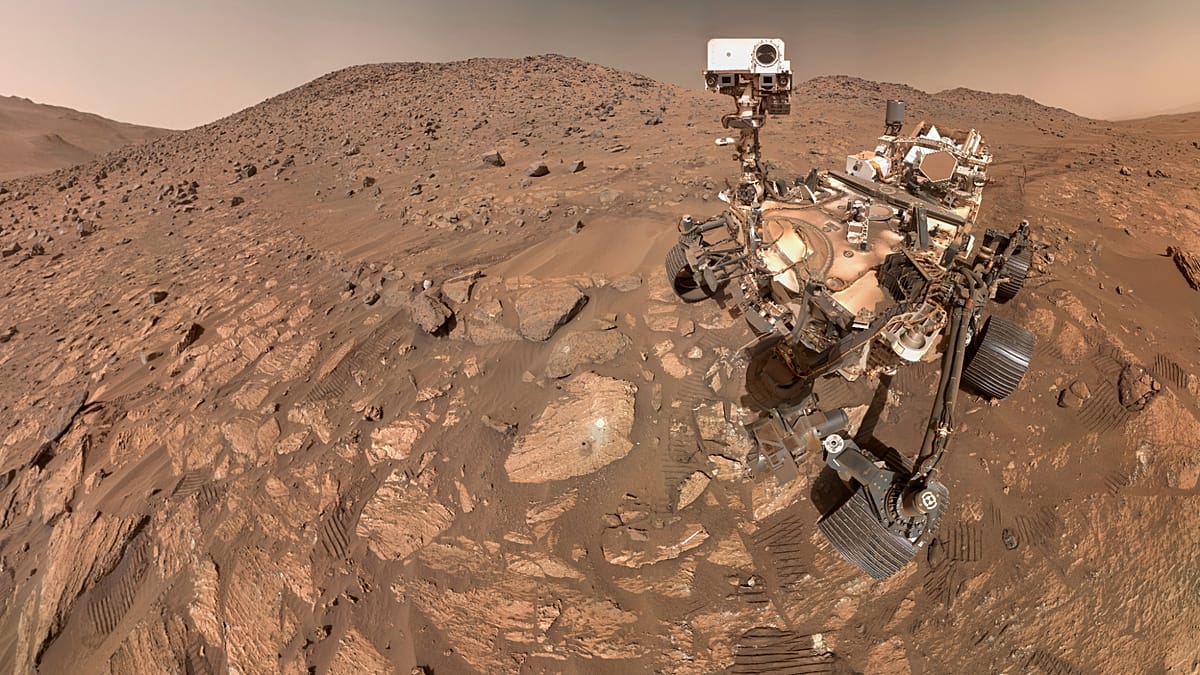
Meanwhile, NASA’s Perseverance rover, which began exploring the Martian surface in 2021 in search of traces of ancient organic life, is still active on the planet.
The Mars 2020 mission was originally designed to last one Martian year — around 687 Earth days — but has been extended indefinitely. The rover remains fully operational and its ongoing collection of rock and regolith samples continues to drive major advances in space research.
A sample collected in the summer of 2024 — the same one referenced by Fornaro — contained potential biological traces.
Though these still require further analysis to confirm, NASA administrator Sean Duffy described the find as “the moment when we have come closer than ever to life on Mars”.