
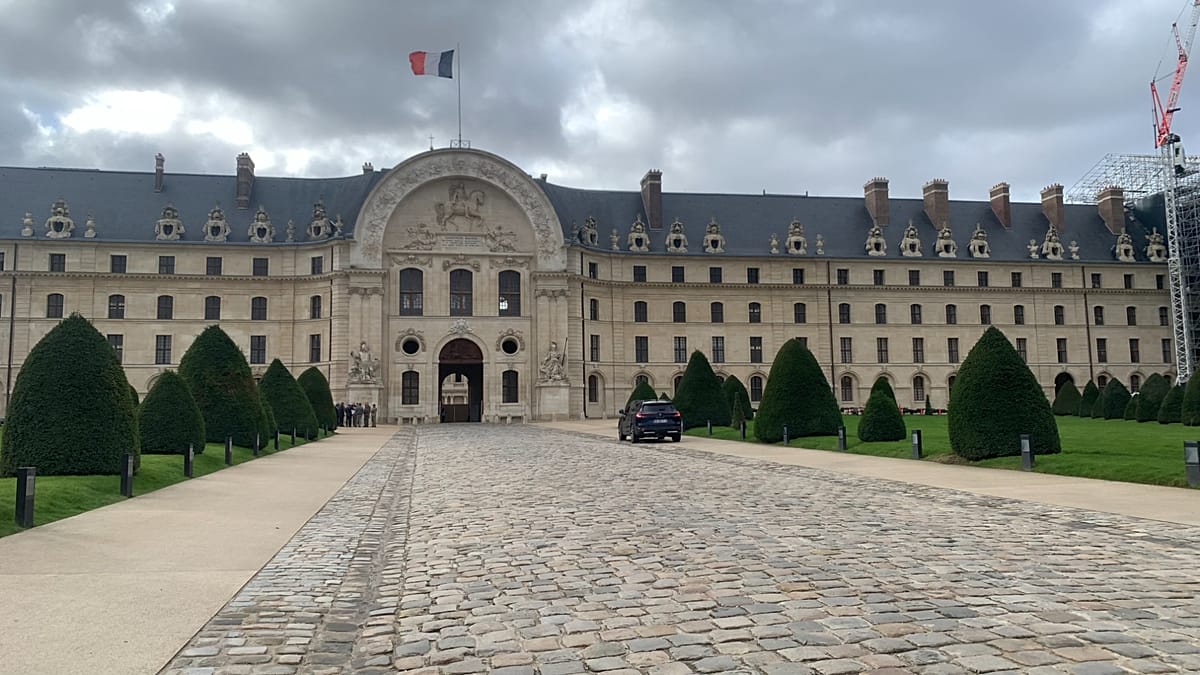
Every year, more than a million people visit Les Invalides, its impressive gilded dome and Napoleon’s tomb. But behind the grand façade of this iconic building lies a much lesser-known mission: to serve as a home and hospital for wounded soldiers and war victims.
A mission initiated by Louis XIV in the 17th century – the National Institution of Invalides welcomed its first former soldiers in 1974 – continues 350 years later.
“Les Invalides is a unique place, a magical, incredible and grandiose site for two reasons_,”_ says General Christophe de Saint Chamas, a military officer who serves as governor of Les Invalides. “The first is that King Louis XIV had it built, and as the king’s tool, it had to be magnificent. It was a communication tool for the whole world, so that they would know that Louis XIV was building something for his old soldiers,” he explains.
The second reason is that it was built “for people who deserved it“, says the general. Christophe de Saint Chamas adds: _”_So it was a gesture of gratitude on the part of the State. In fact, it was the State’s first social initiative, because before that, it was the religious communities that took in the wounded. Here, the State said: ‘I’ll look after them for the rest of their lives, until they die'”.
Tranquillity after the horrors of the Holocaust
The ageing facilities are now undergoing a major renovation funded by the State and estimated to cost €100 million.
But the facility continues to fulfil the founding mission of the Sun King. Today, 64 people reside within its walls, including Holocaust survivors and civilian victims of conflict or attack, all of whom receive highly individualised long-term care requiring complex logistics.
Among the residents of Les Invalides is Ginette Kolinka, 101, the famous survivor of the Auschwitz-Birkenau camp.
At 98, Esther Senot has also made this building her final resting place. Born of Polish Jewish parents, she was arrested at the age of 15 in Paris and deported in September 1943. Alongside some 1,000 other people, Esther Senot was taken to the Mauthausen camp in Austria. “Only two of us came back_,”_ she says today.
When she returned to France 17 months later, she weighed just 32 kg. In the camps, she lost seventeen members of her family, including her parents and six brothers and sisters.
In addition to the death of her husband and her health problems, Esther Senot chose Les Invalides to follow in the footsteps of her brother, who fought in the 2nd French Armoured Division that helped liberate France. He lived there for ten years in the 2000s. “I used to visit him regularly, and at the time, of course, it was wonderful. As I got older and found myself alone, since I already knew quite a few people… I came here,” she explained.
A home for wounded soldiers
The tranquillity that reigns within the walls contrasts with the hustle and bustle of the courtyard. The medical team works alongside officers in military uniform, reflecting the special status of the institution.
Master Corporal Mikaele Iva, who was injured in a parachuting accident in Gabon in 2021, is also one of the 64 residents. Over time, he has forged links with other residents. “This really has become our second family_,”_ he says.“We share happy and difficult times.”
Mikaele Iva, who uses a wheelchair, practises fencing, archery and golf with the Invalides sports club. He represents the institution at national ceremonies.
A spirit of solidarity that helps him remember his military life. “We support each other in difficult times, because we have to get back up despite our injuries. We have to keep helping each other no matter what. That’s part of being a soldier,” he explains.
The man who served in a medical regiment and took part in several French operations abroad said he was moved by the recognition the nation shows through the care it gives him.
A view shared by the carers. “We devote ourselves to them body and soul,” assures Mustapha Nachet, nursing coordinator at the resident centre since 2014. “It’s the nation’s way of giving thanks for everything they’ve done.”
Higher-level facility for severe disabilities
The facility also operates as a specialist hospital for severe disabilities, with expertise in prosthetics and rehabilitation. It conducts research aimed at improving the mobility of amputees and wheelchair users.
Its medical teams treated some of the victims of the Bataclan attacks.
But today, the medical teams face a new challenge.
“Each conflict leaves its own mark, and none ever erases the previous one_,”_ explains General Sylvain Ausset, Director of the Institution nationale des Invalides.
“In 1914, the “gueules cassées” (broken limbs) appeared. They already existed before that. They just didn’t survive. During the Second World War, people with spinal cord injuries, paraplegics and quadriplegics began to survive. During the recent conflicts in the Middle East, Iraq and Afghanistan, multiple amputations appeared on a scale that had never been seen before_”, he lists. “The current signature is the psychological wound“,_ concludes General Sylvain Ausset.
The nation has been looking after its soldiers for over 350 years and remains committed to this mission, assures General de Saint Chamas, Governor of Les Invalides. _”_This allows troops on active service to deploy in the knowledge that if something happens to them, France will be there.”