
No Venice Biennale has ever been apolitical, but global affairs have deeply marked this year’s edition already. A week into the 61st international art exhibition, there have been protests against Russia and Israel’s participation, pavilions closing and threats to cut funding.
The atmosphere is strikingly at odds with the late curator’s vision for the event, encapsulated in the theme ‘In Minor Keys’. Koyo Kouoh aimed to reorient the show away from the “anxious cacophony of the present chaos raging through the world” to focus on softer tones of emotion, connectivity and grounding.
Despite the high-profile demonstrations, the pavilions and exhibitions that chime with Kouoh’s core values of nurture, intimacy and reflection are those that quietly steal this year’s spotlight. They may be less splashy (with the exception of one that is literally so), but they’re the ones likely to keep attracting visitors throughout the Biennale, regardless of surrounding political stunts.
A collective act of care at the Japan Pavilion
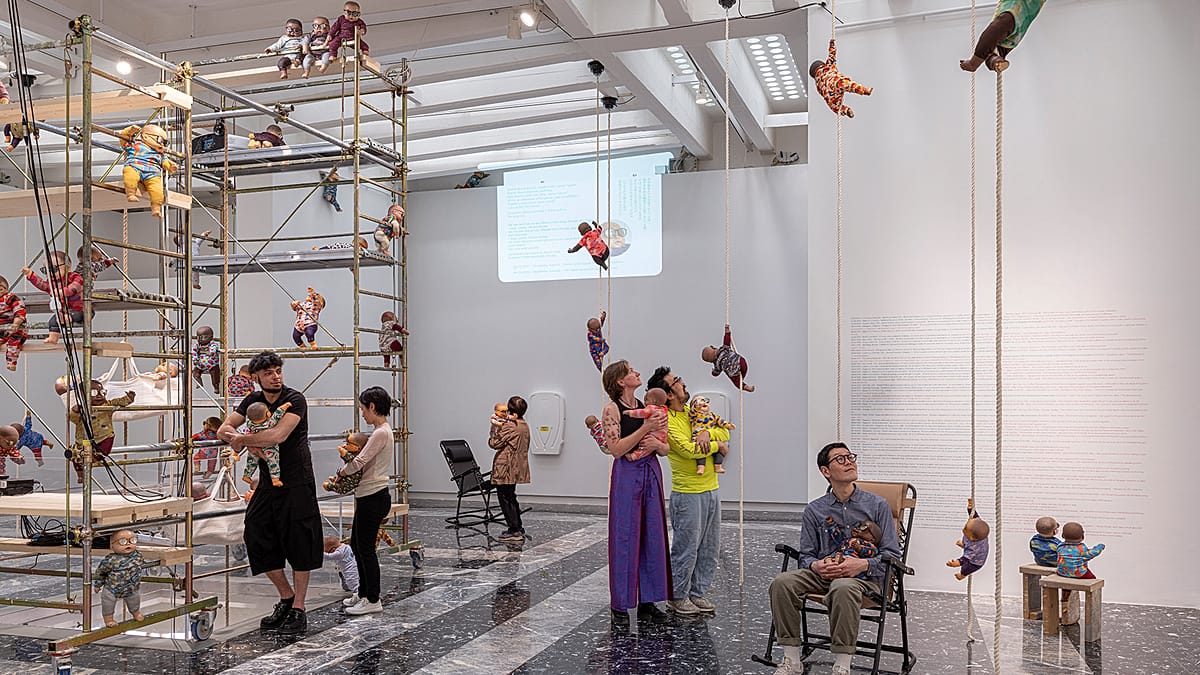
As you approach the Japan Pavilion, shaded by trees in the Giardini, you see other visitors milling around, cradling baby dolls in their arms. There are smiles, laughter and jokes between strangers – not always the kinds of emotions associated with viewing contemporary art.
Grass Babies, Moon Babies by Japanese American queer artist Ei Arakawa-Nash is one of the most subtly profound expressions of Kouoh’s curatorial theme.
Upon entering, visitors are invited to carry one of 57 dolls – in funky onesies and sunglasses – through the Pavilion’s pilotis, gardens and interior spaces. In doing so, visitors participate in an act of collective care, with the option to change the dolls’ diapers and activate a QR code that delivers a “diaper poem” based on each baby’s assigned birthday.
Kouoh, who died in May 2025, wanted this year’s exhibition to focus on the slow and sensory. Arakawa-Nash’s show invites visitors to physically and emotionally engage in an act that is deeply human and personal – not only does participation provoke joy, but also potentially nostalgia, responsibility or grief.
In doing so, it forces us to confront fundamental social issues of raising children for an uncertain future. As the curators write, the pavilion asks, “how can we celebrate a new generation of babies while we, as caregivers, undertake the unfinished work of reparations and amends that shape the world they enter?”
The sound of art at the Polish Pavilion and Holy See Pavilion
Kouoh’s melodic theme has inspired a wealth of sound-based shows in this year’s pavilions. They both literally and figuratively evoke minor keys, inviting visitors to engage with art using an alternative sense as well as to muse on the “lower frequencies” of society: those marginalised or overlooked.
In the Polish Pavilion’s audio and video installation Liquid Tongues, Bogna Burska and Daniel Kotowski delve into disempowered ways of communication.
The atmosphere is mesmerising: giant screens, one mounted on the ceiling so you can lie back on a large cushioned bench to watch, playing a performance by the Choir in Motion of both hearing and Deaf singers who chant and sign in International Sign Language.
The space reverberates with sounds inspired by whale songs, an “unheard voice” like that of the Deaf community. The project highlights efforts to reclaim languages pushed aside by dominant voices, including Hand Talk, the Plains Indian Sign Language used by both hearing and Deaf Indigenous people in North America.
As the curators write, “Based on the idea of Deaf Gain, deafness isn’t seen as a disability. Most of the footage was shot in water. Deaf people can sign freely there, but hearing people can only make muffled sounds.”
The Holy See Pavilion’s The Ear is the Eye of the Soul complements Kouoh’s “archipelago of oases” in the main exhibition, envisioned as spaces rich with memory and emotion that were central to major artists’ universes.
In the case of the Giardino Mistico, a convent garden of the Discalced Carmelite order, visitors are invited to attune to a quieter register. After donning open-ear headphones, you meander around the garden in silence, encountering a series of sound commissions by experimental musicians inspired by 12th-century Saint Hildegard of Bingen’s chants and visions.
In a cacophonous world that races towards novelty and innovation, this retrospective, introspective act of walking and listening feels nothing short of radical.
A sewage seaworld at the Austrian Pavilion
If playing in a minor key describes anything to a tee right now, it’s the city of Venice itself. Its melancholic plight is explored in what is fast becoming the buzziest pavilion of the Biennale this year, Austria.
Titled Seaworld Venice, it’s somewhere between an underwater theme park and a sewage treatment plant – a blunt vision of the city’s future in grim climate change scenarios.
Austrian choreographer and performance artist Florentina Holzinger’s permanent live installation features a naked jet skier zooming in circles, in a nod to Venice’s issues with excess boat traffic, and another nude performer in a water tank that is topped up with visitors’ filtered urine from adjacent portable toilets.
The project makes visitors palpably conscious of their individual impact on Venice and the world’s ecological fragility.
As curator Nora-Swantje Almes explains, “Holzinger depicts humankind’s complicity in collapsing systems, questioning established structures and the apparent order of things – and revealing that order itself is inherently unstable.”