
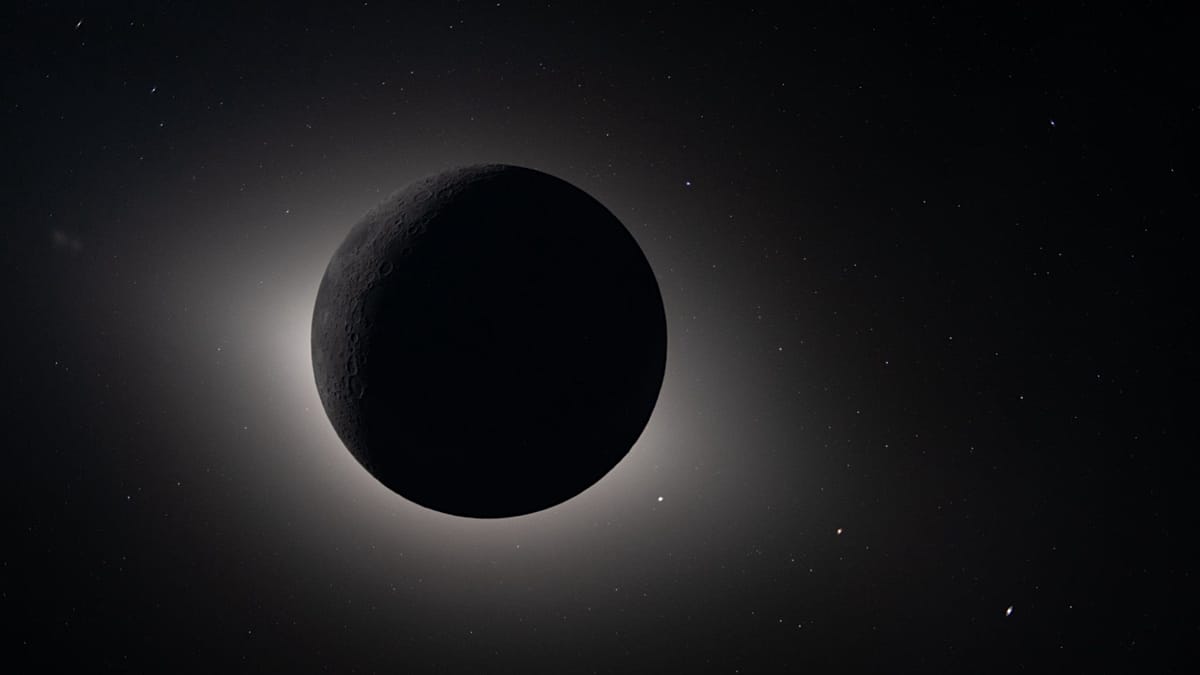
For the first time in more than a century, a total solar eclipse is coming to mainland Spain, with an even longer encore next summer.
It is all the more extraordinary considering Spain’s last full solar eclipse, not counting the Canary Islands, occurred two days before the Titanic sank in 1912.
Because that rare hybrid eclipse was a mix between a ring-of-fire and just a few seconds of totality for Spain, some consider 1905 the country’s last pull-out-all-the-stops solar eclipse.
Add a crescendoing meteor shower and a six-planet parade on the same day, and the heavens will be overflowing with spectacle.
On 12 August, the sky over the Iberian Peninsula will fall dark just as the sun starts to set, with slivers of Greenland and Iceland getting the same treatment as the sun, moon and Earth line up perfectly.
Getting there takes some time, too. The umbra — the moon’s shadow that blocks out the sun — will race across 8,260 kilometres in about an hour and a half, most of it over empty Atlantic waters.
The show starts near the North Pole before working its way south, with totality lasting up to two minutes and 18 seconds. Maximum totality will occur off Iceland’s west coast.
The spectacle will end in the Mediterranean.
Eclipse chasers gear up for the spectacle
Hundreds of millions more on the sidelines are in for a treat as well.
A partial eclipse will be visible as far away as Alaska and Siberia, taking in Canada, the northern US and much of Europe and West Africa.
The closer to the totality’s path, the more of the sun will vanish behind the moon, including 94% coverage in Dublin and 83% in Oslo. Montreal will see an 18% bite taken out of the sun, tapering to 9% in New York and 2% in Norfolk, Virginia.
Special eclipse glasses are essential, even if only a sliver of sun is showing.
Adding to the cosmic wonder, the day begins with six neighbouring planets forming an arc in the sky before dawn and ends with the Perseid meteor shower peaking after nightfall under a new moon.
Who is hosting watch parties and science experiments
The European Space Agency (ESA) will host a live webcast from Spain’s Astrophysical Observatory of Javalambre and a public celebration in León. NASA will provide its own coverage, as will the Italy-based Virtual Telescope Project and others.
“For me, it’s not just a scientific moment. It’s not just an incredible alignment of heavenly bodies. It’s also a very human moment,” said ESA’s director of science, Carole Mundell. “It’s a real human connection between us, with our feet planted on the Earth and the cosmos.”
US college research teams are also pitching in, launching more than 60 high-altitude balloons from Spain and Iceland to study Earth’s atmosphere and other changes during the eclipse, when the temperature momentarily drops.
That is 10 times as many balloons as were launched during the 2024 total solar eclipse that captivated North America.
“A couple of minutes isn’t a lot of time, but it’s still plenty to affect the atmosphere and to make that cold, dark shadow of the moon on Earth,” said Angela Des Jardins of Montana State University, who leads the NASA-funded balloon project.
More celestial shows to come
An exceptionally long total solar eclipse is in store for 2027, offering nearly three times more observation time.
The southern tip of Spain will take centre stage on 2 August 2027, with up to six minutes and 23 seconds of totality extending into Morocco, Algeria, Libya, Egypt, Saudi Arabia, Yemen and Somalia.
Then on 26 January 2028, a ring-of-fire eclipse will round out Spain’s celestial trifecta — “a lucky coincidence,” according to ESA’s Mundell.
The Royal Observatory of Belgium’s Andrei Zhukov cannot get enough of them, regardless of their length or origin.
His Proba-3 science mission has created more than 60 simulated total solar eclipses over the past two years, with the longest lasting five hours and 38 minutes, produced by two satellites flying in formation.
“We’re looking forward to more eclipses,” Zhukov said, “natural or artificial.”