
Europe is not facing an immediate fuel supply crisis despite renewed tensions in the Middle East, but the continent remains dangerously exposed to fossil fuel supply and price shocks and must rapidly electrify its economy while resisting calls to return to Russian energy, top energy leaders told Euronews.
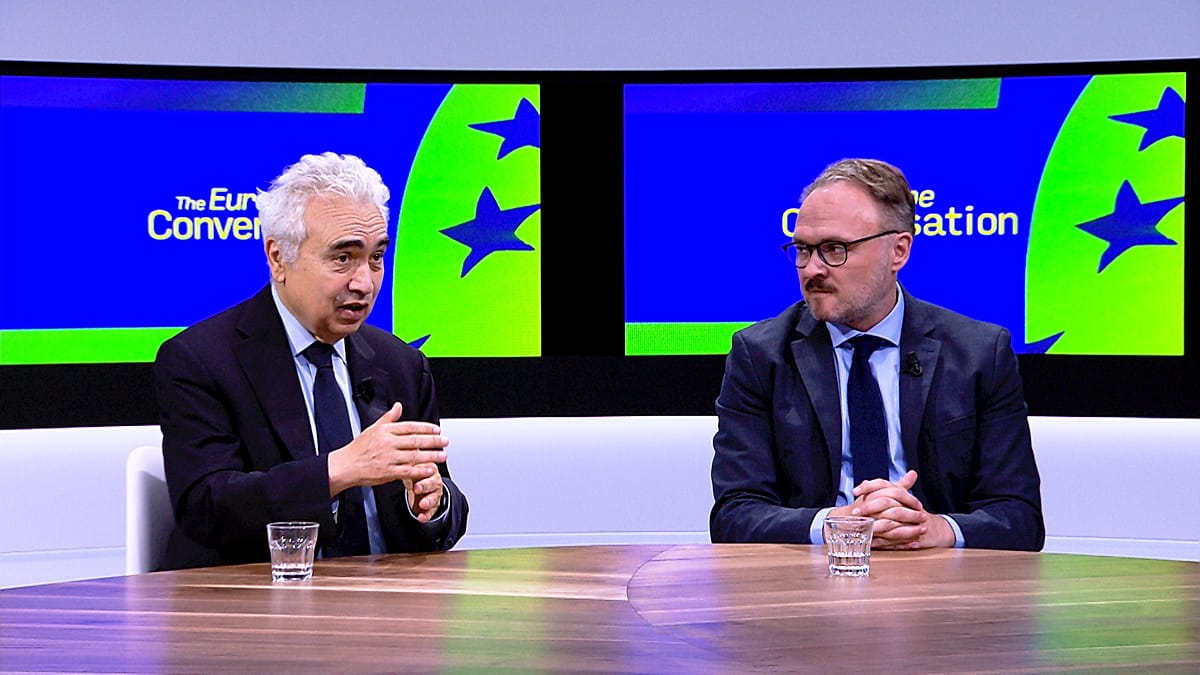
Energy Commissioner Dan Jørgensen and International Energy Agency (IEA) chief Fatih Birol insisted that Europe should not interpret any ceasefire in the Middle East as a return to normal, warning that disruption to the Strait of Hormuz could send oil prices sharply higher and reignite inflationary pressures.
“We are in a very serious situation. I’m not telling people, companies, businesses or decision-makers not to be worried. There is, unfortunately, reason to be worry. But we can act and we will act,” Jørgensen told Euronews on Friday.
Birol noted that if the critical Strait of Hormuz closes again, oil prices may go up, with “significant implications (for) the economies”.
“There are so many uncertainties, but they are not related to the energy sector. It is related to politics and what is happening in the conflict over there,” Birol said.
Recent hostilities in the energy chokepoint have sent jitters through energy markets and left what little confidence remains in the maritime sector hanging by a thread.
Yet despite the strained situation, both men ruled out reopening imports of Russian energy to Europe, describing such a move as repeating one of the continent’s “biggest strategic mistakes”.
Electrification: Europe’s long-term solution
Instead, they argued that Europe’s long-term solution is a programme of rapid electrification: expanding renewable and nuclear power, investing in electricity grids, electric vehicles, heat pumps and making electricity cheaper than fossil fuels.
This would go some way toward addressing industry demands that the EU lower electricity bills while accelerating the bloc’s efforts to electrify transport, heating and industry and removing fiscal incentives toward continued reliance on fossil fuels.
“We should make the electricity prices affordable for the people, so that the consumers, households and industry can go for a cheaper option,” Birol said. “They will not go for electricity because it is clean. They would go for electric because it’s cheap.”
Jørgensen hinted at the EU executive’s upcoming electrification strategy, a draft of which Euronews has seen. Expected to be unveiled on 17 July, it is intended to be the driving force to ultimately reach energy sovereignty.
After several delays, the EU executive is set to propose an electrification target for 2040, arguing that widespread adoption of electric technologies could save roughly €200 billion in fossil fuel imports by the same year, cut fossil fuel demand and greenhouse gas emissions.
Grid bottlenecks
However, for the EU’s electrification plan to become a success story, EU officials are pushing for faster grid investment, lower transmission costs and incentives to accelerate the costly transition, which the European Commission estimated at €1.2 trillion.
“European leaders and the finance ministers need to overcome issues in order to give incentives,” Jørgensen said, conceding that EU funds allocated to revamp the grids alone are insufficient. “If we leave everything to the markets, it will not happen.”
Without a modernised grid, the increasing volumes of clean power produced in the EU can’t be transported, presenting a major hurdle to the bloc’s climate, energy and industrial ambitions.
“We should intervene. We should give incentives, price incentives and subsidies in different cases in order to incentivise,” the commissioner added.
Jørgensen also dismissed potential clashes among EU countries over funding for the construction of new power lines, even though Sweden has been quite vocal about the matter at previous gatherings of energy ministers.
“Of course, there are differences between some countries. Some are focusing on nuclear, some are focusing more on renewables, some are focusing on both. But electrification that we are talking about today is necessary both for nuclear and for renewables,” he said.
The controversy centres not on energy mix, but on infrastructure costs. Portugal recently urged the Commission to recognise it as an “energy island” so it might be eligible for more EU funds, alongside Spain. The Iberian Peninsula faces an historic isolation from the rest of Europe due to a lack of interconnectors with France, which fears that massive power grid investments won’t ultimately bring national benefits.
The European Parliament and the EU Council will kickstart political negotiations to revamp Europe’s power lines after the summer break, following the adoption of a common position among member states in June.