
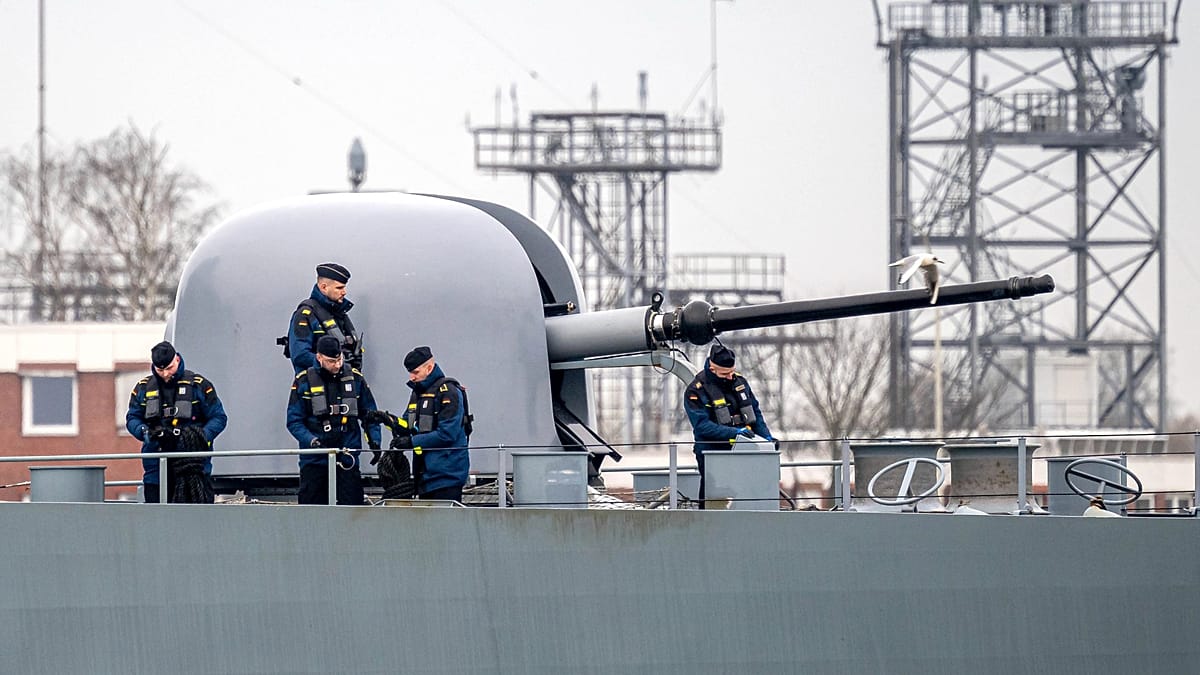
Europe’s militaries are pouring money into the sea. EU defence expenditure rose to €418 billion in 2025, a 20 percent increase from the previous year, and is projected to reach €454 billion in 2026, equivalent to 2.4 percent of GDP. Maritime defence is one of the fastest-growing sectors. Production of naval vehicles and equipment across the bloc has reached €117.8 billion since 2016, with output hitting €13.7 billion in 2025 alone.
Who’s building Europe’s navies
On paper, four countries dominate that output. France, Germany, Italy and Spain account for 87 percent of the EU’s maritime defence industrial base and captured 82 percent of its total output value last year. France alone produced 37 percent of the bloc’s maritime defence vehicles in 2025, followed by Germany and Italy at 19 percent each, and Spain at 8 percent. Together, the four also account for 60 percent of the EU’s total defence expenditure.
For Christophe Tytgat, Secretary General of SEA Europe, the shipyards and maritime equipment association, that pattern is no accident: “the concentration is real and structural, not incidental,” reflecting decades of naval-industrial history and geography concentrated in a handful of states. Submarines are also a growth area, now 27 percent of EU maritime defence output, with the same four countries producing 93 percent of the bloc’s naval exports.
A skewed picture?
But industrial output isn’t the same as military commitment, according to Chris Kremidas-Courtney, senior advisor at the European Policy Centre, who argues the four-country narrative overlooks some of Europe’s most exposed navies. “Industrial concentration is not the same as maritime-defence commitment,” they said, naming Greece and Sweden as “conspicuous omissions.”
Greece runs one of Europe’s strongest conventional submarine fleets and maintains a demanding operational posture across the Aegean, Eastern Mediterranean and Red Sea. Sweden’s smaller navy is purpose-built for the Baltic and backed by a serious domestic defence industry.
The real test, Kremidas-Courtney says, is integration rather than size. “Europe doesn’t need everyone to build a fleet to match Italy or France, but it does need credible distributed forces connected by interoperable systems and a shared maritime picture”, an approach they argue must extend beyond the bloc to include the UK and Norway.
Measured against GDP rather than raw output, the map zooms towards the east. Poland spends the largest share of any EU state on defence at 4.48 percent of GDP, ahead of Lithuania (4.00 percent), Latvia (3.73 percent) and Estonia (3.38 percent), all frontline states bordering Russia or its ally Belarus. Germany has more than doubled its share of GDP since 2021, from 1.27 percent to 2.14 percent, and aims to reach €162 billion in annual defence spending by 2029.
Tytgat argues neither the industrial giants nor the frontline states can carry EU maritime security alone: “only four EU countries cannot substitute for broad-based EU maritime security, because collective security strategy requires interoperable capability, resilient supply chains and genuine burden-sharing across the whole Union.”
What’s driving this spending
Behind all this spending is Russia’s war on Ukraine and the maritime threats that followed. A “shadow fleet” of sanctioned tankers allegedly used for surveillance and sabotage has put the EU on alert. A series of undersea cable cuts in the Baltic Sea, including the BCS East-West Interlink, C-Lion1 and Estlink 2 incidents in late 2024, pushed Brussels to adopt a Cable Security Action Plan in 2025, alongside NATO’s “Baltic Sentry” naval patrol mission.
The EU revised its Maritime Security Strategy in 2023. The previous strategy was built with a focus on “piracy, illegal fishing, migration flows”; the updated one is built to confront state-based threats, Tytgat explains. He also warns the current strategy lacks teeth: “the tools have multiplied, but the financing and governance architecture to actually translate the strategy into tangible action is still lacking.”
How is the EU helping with funding?
A Commission subsea infrastructure package announced in February 2026 carries €347 million, alongside a separate €92 million ocean-observation initiative launched mid-2026. Tytgat calls both “a first step,” but says the sums are “far from enough if the EU wants to face the daily threats it deals with appropriately.”
Brussels is trying to close that gap through other channels: the €150 billion SAFE loan facility under its “Readiness 2030” roadmap, the European Defence Fund, 68.4% of which has gone to France, Germany, Italy and Spain, and PESCO’s joint shipbuilding projects, including the Italian-led European Patrol Corvette.
In March 2026, the EU also launched an Industrial Maritime Strategy, folding shipbuilding into a bloc-wide industrial framework for the first time rather than leaving it to national champions and earmarked €325 million for naval and undersea defence projects.
The real test for burden-sharing will be when the European Commission releases its progress report on the maritime strategy in October 2026. For now, Tytgat says the EU should focus on ensuring it has “the necessary tools and investment to meet the current challenges it faces in its vicinities but also in all global chokepoints that create threats to the EU’s security of supply, trade and economy.”