
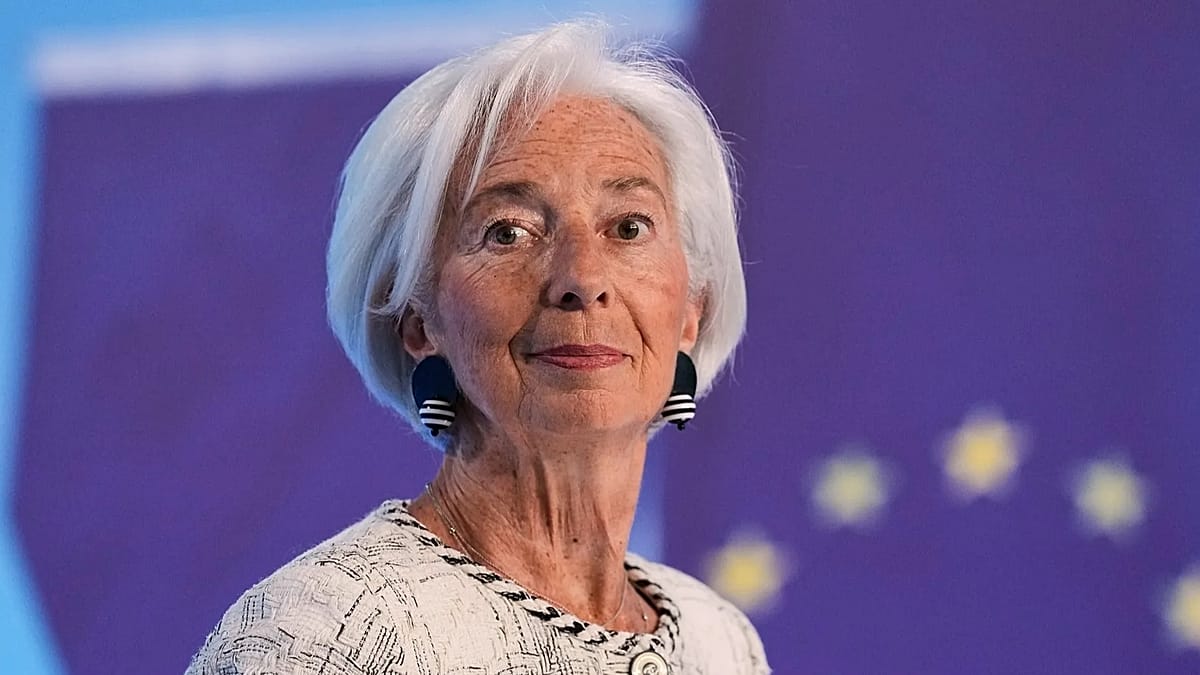
European Central Bank (ECB) President Christine Lagarde has defended a decision to increase interest rates, saying it is “robust across three different scenarios”.
The ECB announced today that it is raising rates by 0.25 percent for the first time in three years due to the ongoing war in the Middle East. It is the bank’s first rate hike since 2023, when it raised rates in response to surging energy prices caused by Russia’s full-scale invasion of Ukraine.
“The war is generating inflation pressures, and the decision to raise rates is robust across a range of scenarios mapping out how the shock might evolve and affect the medium-term outlook for the euro area,” Lagarde journalists at a briefing on Thursday.
The effects of the Middle East conflict that started in February have reverberated across Europe. The on-off closure of the Strait of Hormuz has sent oil and gas prices rocketing, with a huge impact on European importers.
The ECB’s rate hike marks a clear reversal of the easing cycle that had defined the bank’s approach throughout much of 2025. Eurozone inflation hit 3.2 percent in May, its highest reading since September 2023, driven by a 10.9 percent surge in energy prices.
The European Union’s economy shrank by 0.2 percent in the first quarter of 2026, prompting economists to warn of a period of “stagflation”, where weak growth combines with rising inflation and deteriorating consumer confidence.
According to the latest European Economic Forecasts issued at the end of May, the EU’s GDP growth is expected to slow from 1.1 percent in 2026 to 1.4 percent in 2027, while inflation is expected to rise from 3.1 percent in 2026 to 2.4 percent in 2027.
Three ECB scenarios
In her remarks on Thursday, Lagarde made clear that the institution is not following a specific rates path.
“Our interest rate decisions will be based on our assessment of the inflation outlook and the risks surrounding it in light of the incoming economic and financial data as well as the dynamics of underlying inflation and the strength of monetary policy transmission,” she said.
Despite uncertainties, the ECB projected three short-term possible scenario for June 2026: mild, adverse and severe.
The milder scenario involves oil prices “normalising more rapidly than in the baseline, implying a faster moderation in inflation, which would fall below the 2 percent target in 2027 and 2028, while GDP growth would recover somewhat earlier and more robustly than in the baseline,” the ECB explains.
In this situation, GDP growth would go from 0.8 percent in 2026 to 1.4 percent in 2027, while inflation would go from 2.9 percent in 2026 to 1.8 percent in 2027.
The adverse scenario, meanwhile, assumes that energy prices continue to rise with high uncertainty and international spillovers, as well as stronger indirect and second-round effects on inflation. Real GDP growth would reach 0.7 percent in 2026 with a rise to 0.9 percent in 2027, while inflation is predicted to hit 3.3 percent in 2026 and 3.0 percent in 2027.
In the severe scenario, the EU would face a stronger and persistent energy price shock, with realGDP growth slowing to 0.5 percent in 2026-27 before rebounding slightly faster in 2028.
Interest rates, inflation and growth
Lagarde told journalists that the ECB’s number one priority is to contain inflation.
“If you let inflation start running out without control, then it becomes a much more difficult situation to bring it back to the level of price stability that we have to find,” she said.
“The good decision was actually to raise interest rates to commit and to deliver on price stability so that people will make their investment decision, their employment decision, they wage negotiations, decisions in the light of that commitment to restore price stability.”
Critics of Lagarde’s decision say that increasing interest rates will hit Europe’s most productive and innovative sectors the hardest.
“Such a decision will not reduce energy prices. It will, however, make clean energy investments more expensive, slowing the only solution that would bring them down for good. This matters because renewables are not just a climate solution, they are a price stability solution,” Calvin Vella, Researcher at Positive Money Europe, a Brussels-based NGO, said in a statement.
“The rise in the price of borrowing also puts Europe’s competitiveness at risk by making cleaner industries more expensive to invest in, which reduces the ability to provide energy security for Europe,” he added. “The interest rate rise also increases inequality by impacting wages and reducing the availability of jobs.”
Speaking on Thursday, Lagarde mentioned that Europe’s economy would benefit from important structural changes, such as investing in renewables at the expenses of oil and gas.
“Reforms to enhance the euro area’s growth potential and accelerate the energy transition to reduce reliance on fossil fuels are more vital than ever,” she said.