
Published on •Updated
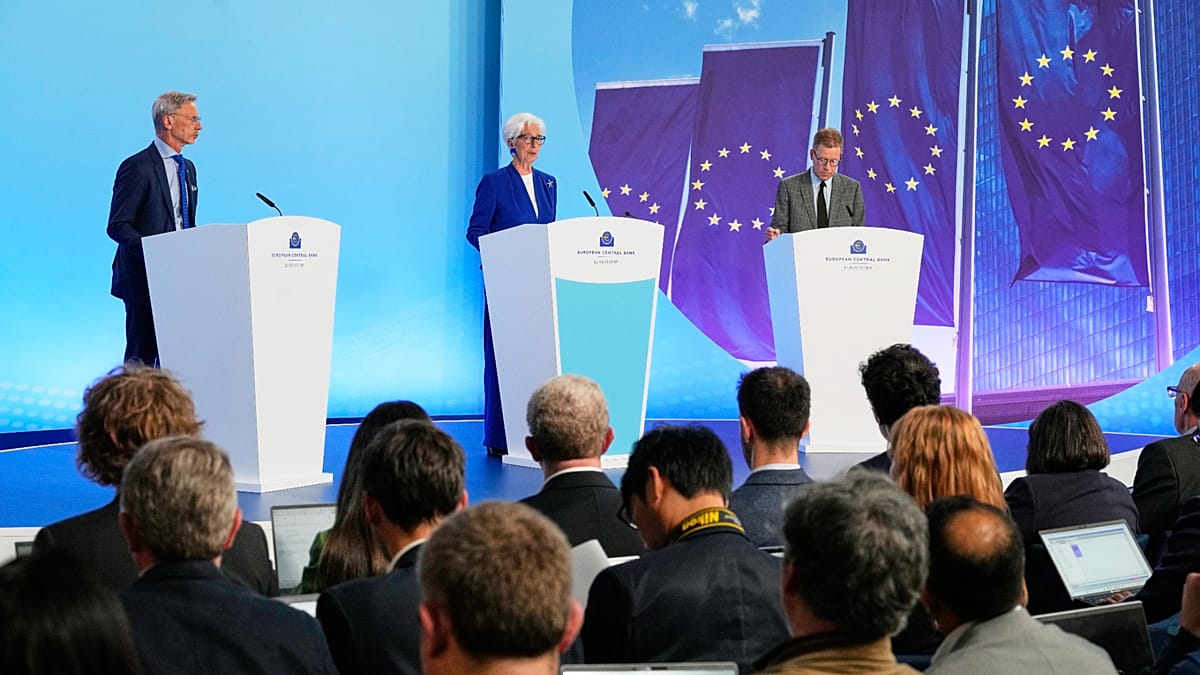
The European Central Bank kept interest rates unchanged on Thursday, holding steady as it waits to see how much of a lingering energy shock from the Middle East conflict will feed through into eurozone inflation.
The ECB’s governing council held the deposit facility rate at 2.25%, with the main refinancing rate staying at 2.4% and the marginal lending facility at 2.65%.
Monetary policy for the eurozone is set through these three key interest rates, with the deposit facility rate serving as the main benchmark.
“The outlook for energy prices, while highly volatile, currently stands close to the baseline of the June Eurosystem staff projections and well above the levels recorded prior to the conflict in the Middle East,” the central bank’s statement read.
“Uncertainty remains high and the full inflationary impact of the energy shock has yet to play out. The Governing Council is therefore closely monitoring the intensity and duration of the shock, as well as its indirect and second-round effects,” it added.
The decision follows confirmation last week that eurozone inflation eased to 2.8% in June from May’s 3.2%, the first decline this year, with core price growth slowing to 2.4%.
The pause comes just six weeks after the ECB raised rates for the first time in nearly three years, responding to a war-driven energy shock that had pushed inflation to its highest since September 2023.
ECB President Christine Lagarde has been careful to keep the door open.
At the central bank’s Sintra forum, Lagarde insisted June’s move was not an “insurance hike” but a response to a genuine inflation problem, with projections showing a return to the 2% target only in late 2027, and only if monetary policy tightened further.
Lagarde also refused to pre-commit to a path, saying “forward guidance is not currently in the cards.”
July is not a forecasting round and economists at ING, for example, had argued the bank would prefer to wait for September’s fresh projections, when they see a second hike as the more realistic outcome.
The complication is that the shock behind June’s hike is back.
Oil neared $120 a barrel in March before sliding to around $72 after an interim peace agreement at the end of June, but the truce has frayed badly this month, with the US and Iran exchanging fresh strikes, attacks on tankers and renewed sanctions pushing Brent back above $90 a barrel.
A prolonged rise in energy prices would feed through to household bills and headline inflation in the second half of the year, precisely the second-round effects central bankers currently fear.
The ECB and its peers
As the chart shows, Frankfurt tightened from previously being far below its peers.
The Federal Reserve’s target range sits at 3.50% to 3.75% and the Bank of England’s rate at 3.75%, while the Swiss National Bank is parked at zero.
Both of the ECB’s larger counterparts decide again next week.
The Fed announces next Wednesday, with futures markets assigning roughly an 89% probability to a hold, according to CME’s FedWatch tool, after June’s unanimous decision and projections signalling no cuts this year.
The Bank of England follows the next day, on 30 July, with new forecasts in tow and economists overwhelmingly expect a hold at 3.75%, although a Reuters poll found nearly 40% see at least one hike before year-end, after two policymakers voted for an increase to 4% in June.
For now, the ECB is the only major Western central bank to have actually raised rates in this cycle.