
Close Menu
Daily Guardian EuropeDaily Guardian Europe
  • Home
  • Europe
  • World
  • Politics
  • Business
  • Lifestyle
  • Sports
  • Travel
  • Environment
  • Culture
  • Press Release
  • Trending
What's On

Video. Latest news bulletin | October 16th, 2026 – Midday

October 16, 2026

These are the most underrated travel destinations in Europe

October 16, 2026

Dinosaur fossil hidden in London’s Natural History Museum for 100 years identified as new species

October 16, 2026

Man arrested as police probe Your Party database dispute – POLITICO

October 16, 2026

Lisbon mayor moves to suspend shared e-scooter scheme

October 16, 2026
Facebook X (Twitter) Instagram
Web Stories
Facebook X (Twitter) Instagram
Daily Guardian Europe
Newsletter
  • Home
  • Europe
  • World
  • Politics
  • Business
  • Lifestyle
  • Sports
  • Travel
  • Environment
  • Culture
  • Press Release
  • Trending
Daily Guardian EuropeDaily Guardian Europe
Home»Culture
Culture

Dinosaur fossil hidden in London’s Natural History Museum for 100 years identified as new species

By staffOctober 16, 20263 Mins Read
Dinosaur fossil hidden in London’s Natural History Museum for 100 years identified as new species
Share
Facebook Twitter LinkedIn Pinterest Email

Published on
16/10/2026 – 11:58 GMT+2

A dinosaur fossil that spent almost a century in the collections of London’s Natural History Museum has been identified as a new species.

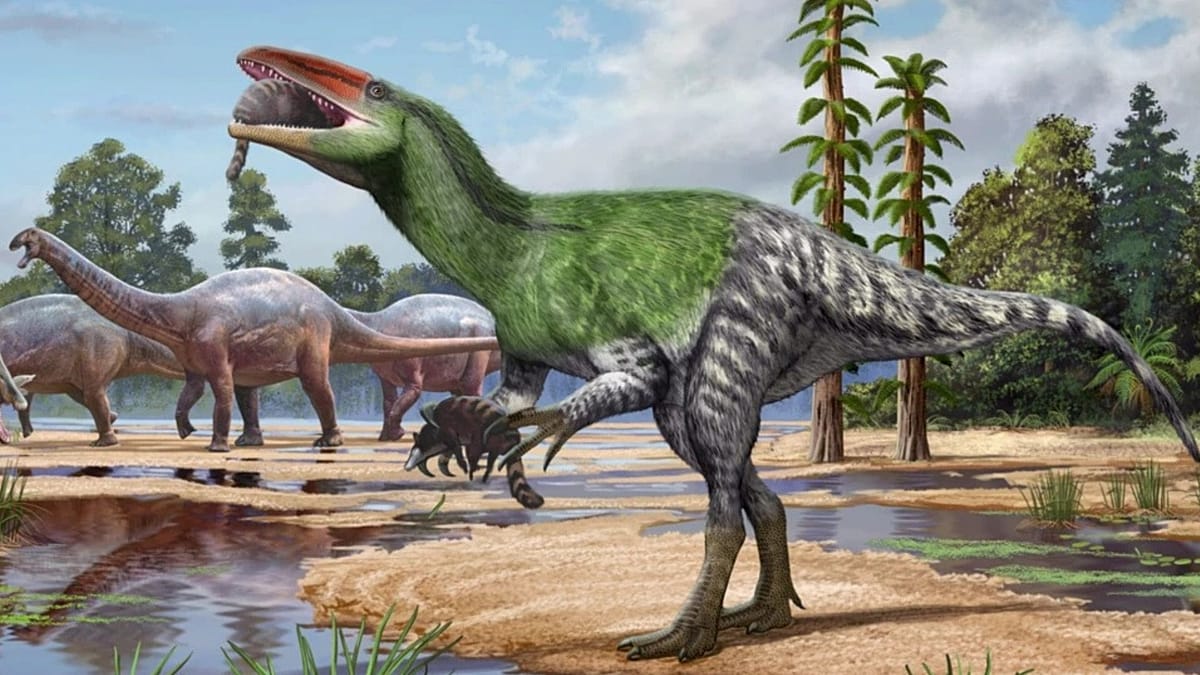
The skull fragment belonged to Invictibellatrix amberina, a previously unknown carnivorous dinosaur that lived around 120 million years ago. It’s also the first confirmed evidence of a megaraptoran dinosaur in Europe.

The fossil was originally discovered at the foot of a cliff on the southwest coast of the Isle of Wight by amateur fossil hunter Reginald Walter Tooley. After his death in 1924, the Natural History Museum acquired more than 1,000 specimens from his collection, including the fragment.

Although scientists knew it belonged to a dinosaur, exactly which one remained a mystery for decades.

Now, researchers have taken another look at the fossil using CT scanning technology, allowing them to examine its internal structure and create a 3D model. Their full findings were published in the journal Royal Society Open Science.

“More dangerous than a T.rex”

Professor Paul Barrett, the study’s senior author from the Natural History Museum, says, “Despite over 200 years of collecting, the Isle of Wight continues to surprise us with new dinosaur species, and finds of carnivorous dinosaurs, such as Invictibellatrix, have been particularly elusive.”

“Work like this shows the exceptional value of working with historical museum collections where there are still many discoveries to be made,” he added.

Despite their name, megaraptorans were not the small, bird-like dinosaurs we commonly associate with the word “raptor”. They were larger predators, more closely related to tyrannosaurs, with “slender heads”, “large arms” and “giant curved claws”, according to the Natural History Museum.

Invictibellatrix amberina is estimated to have measured between 3 and 4 metres (10 and 13 feet) in length and stood around 1.5 metres (5 feet) tall. It lived during the Early Cretaceous period, when dinosaurs dominated terrestrial ecosystems.

Researchers have also suggested that it may have had feathers, although its exact appearance still remains uncertain.

According to Dr Cassius Morrison, a researcher at the University College London’s (UCL) Earth Sciences department, the species would have eaten small dinosaurs, lizards and mammals – similar to the role in the food chain a hyena holds today.

“It was not the apex predator of its time, but for humans this dinosaur would have been more dangerous than a T. rex. We would have been perfectly sized prey, about a third of their body weight. They definitely would have chased us. A T. rex would not have bothered, as we would have been too small,” explains Dr Cassius Morrison, who led the study.

The discovery is particularly exciting because megaraptorans have previously been identified in Asia, Australia and South America, but never conclusively in Europe.

Share. Facebook Twitter Pinterest LinkedIn Tumblr Email

Keep Reading

Social media favourites, Pompeii’s cats star in new photo book

‘Appalling’: Actor Omar Sy joins public figures criticising French authorities’ response to student protests

2027 budget: French cinema fears a catastrophic scenario

New J.K. Rowling documentary set to explore ‘polarising’ Harry Potter author

Sally Rooney forced to withdraw sale of books in UK due to support for Palestine Action

Tsui Hark at Lumière Festival: ‘We don’t know where the future will bring us’

Hidden for 7,000 years: The twisted skeleton baffling German archaeologists

World’s oldest shipwreck off Turkey: 4,700-year-old amphorae discovered

Video. Everything must go: Monsoon owner sales €130 million art collection

Editors Picks

These are the most underrated travel destinations in Europe

October 16, 2026

Dinosaur fossil hidden in London’s Natural History Museum for 100 years identified as new species

October 16, 2026

Man arrested as police probe Your Party database dispute – POLITICO

October 16, 2026

Lisbon mayor moves to suspend shared e-scooter scheme

October 16, 2026

Subscribe to News

Get the latest Europe and world news and updates directly to your inbox.

Latest News

Putin seizes five more European firms, continuing Russia’s hostile asset crackdown

October 16, 2026

OpenAI tries to solve mathematician backlash problem by pledging $5 million to math foundation

October 16, 2026

The world’s best countries to live in for 2026 – and six of the top 10 are in Europe

October 16, 2026
Facebook X (Twitter) Pinterest TikTok Instagram
© 2026 Daily Guardian Europe. All Rights Reserved.
  • Privacy Policy
  • Terms
  • Advertise
  • Contact

Type above and press Enter to search. Press Esc to cancel.