
Published on •Updated
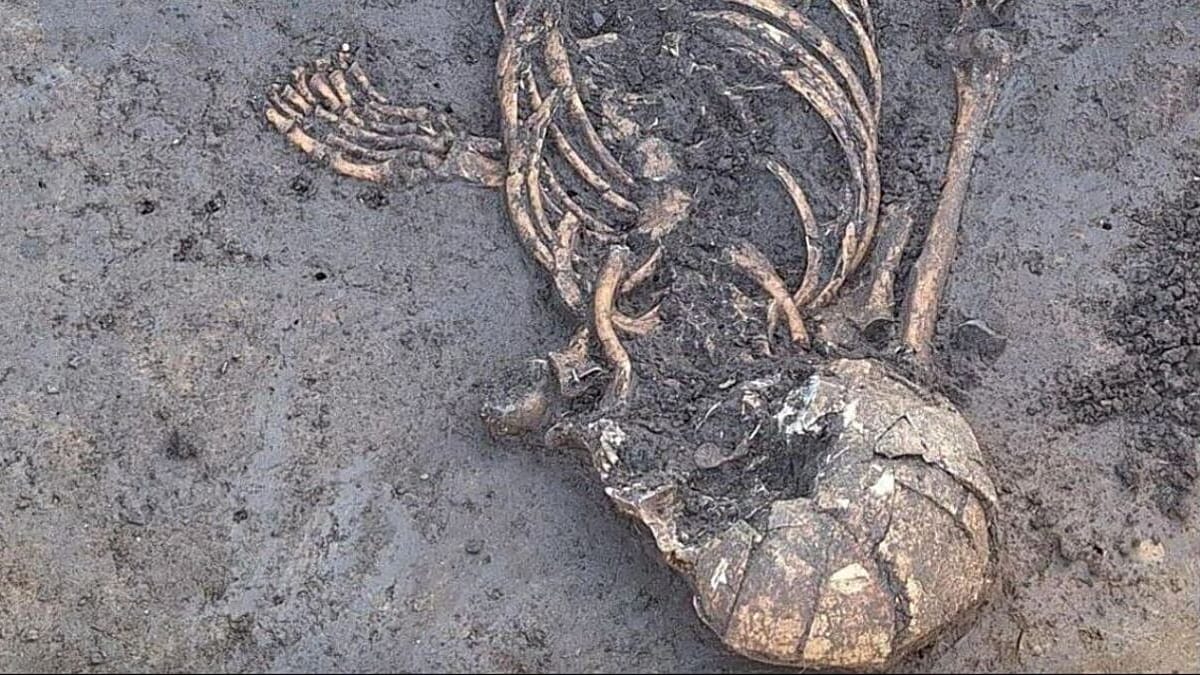
Sometimes a dark discolouration in the soil is enough to open a window onto a long-forgotten world. In the Lower Bavarian village of Großköllnbach (Dingolfing-Landau district) just such a clue led to a discovery that is posing new questions for archaeologists: in a pit they uncovered the remains of a person who lived around 7,000 years ago.
But it is not just the great age of the find that makes it remarkable. Above all, it is the unusual position of the skeleton: unlike the burials that were customary at the time, the body lies in a striking, twisted posture. The condition of the cervical spine is also puzzling researchers.
A burial that breaks the mould
The discovery came to light during archaeological investigations in the future Steigäcker IV development area. The excavation team had been examining the site for five weeks when what initially appeared to be a nondescript change in soil colour turned out to be a pit containing human bones.
For district archaeologist Dr Florian Eibl, it is above all the type of burial that is unusual. The people of the Linear Pottery culture (Linienbandkeramik), one of the earliest farming cultures in Central Europe, often buried their dead in crouched burials. The deceased were laid on their side with their legs drawn up, in a posture resembling a sleeping person.
In Großköllnbach, however, the picture is different: the dead person’s right leg was bent up extremely sharply, while the left leg was angled outwards. This posture clearly departs from the usual burial practices.
The pit itself also raises questions. Its base was uneven and sloping. In the archaeologist’s view, the body may have slipped down the incline after being laid to rest. Individual bones could therefore have shifted or been pressed into the soft clay.
Was the unusual posture therefore intentional? Or did it only arise because of the conditions in the grave?
A young person with striking bones
One thing is clear from the initial examinations: the dead person was an adolescent, as shown by the growth plates on the bones, which had not yet completely fused.
Bones can also provide clues to diseases, injuries and physical strain. The experts are currently paying particular attention to the cervical spine, where a pronounced deformation can be seen. Whether this is due to an illness or a physical peculiarity during life, or only arose because of the position in the grave and after death, still has to be clarified.
A detailed anthropological analysis is expected to provide further clues.
Discovery among clay ovens and age-old longhouses
The skeleton is not the only remarkable find on the site. The excavations are bringing to light an extensive settlement landscape of the Linear Pottery culture. This culture emerged in the 6th millennium BC and marks the spread of the first farming way of life across large parts of Central Europe.
After five weeks of excavation the archaeologists had documented around 150 features. The traces of three large longhouses can be seen in the ground, although at most two of them are likely to have stood at the same time.
Particularly revealing are several preserved hearths and cooking areas, including domed clay ovens whose floors were insulated with tightly packed pebbles. This is where food was cooked, grain was processed and, in all likelihood, an important part of communal life was organised.
Grinding slabs were also discovered. In the archaeologists’ view, the stone used for them may have come from areas beyond the Danube or the Bavarian Forest. If this origin is confirmed, the finds would indicate that even the early farmers were procuring and transporting materials over considerable distances.
What happened 7,000 years ago?
The excavation site is not open to the public. The skeleton has now been completely recovered and taken to the district archaeology department for further examination. There the bones are to be studied anthropologically. Only then will it be possible to say in more detail what traces this young person’s life has left, and which questions may never be answered.
Once the scientific investigations have been completed, the district archaeology service intends to share further findings.
Until then Großköllnbach remains a place where the soil reveals not only the traces of an ancient settlement but also the story of a person whose final resting place still poses riddles even after seven millennia.