
Published on
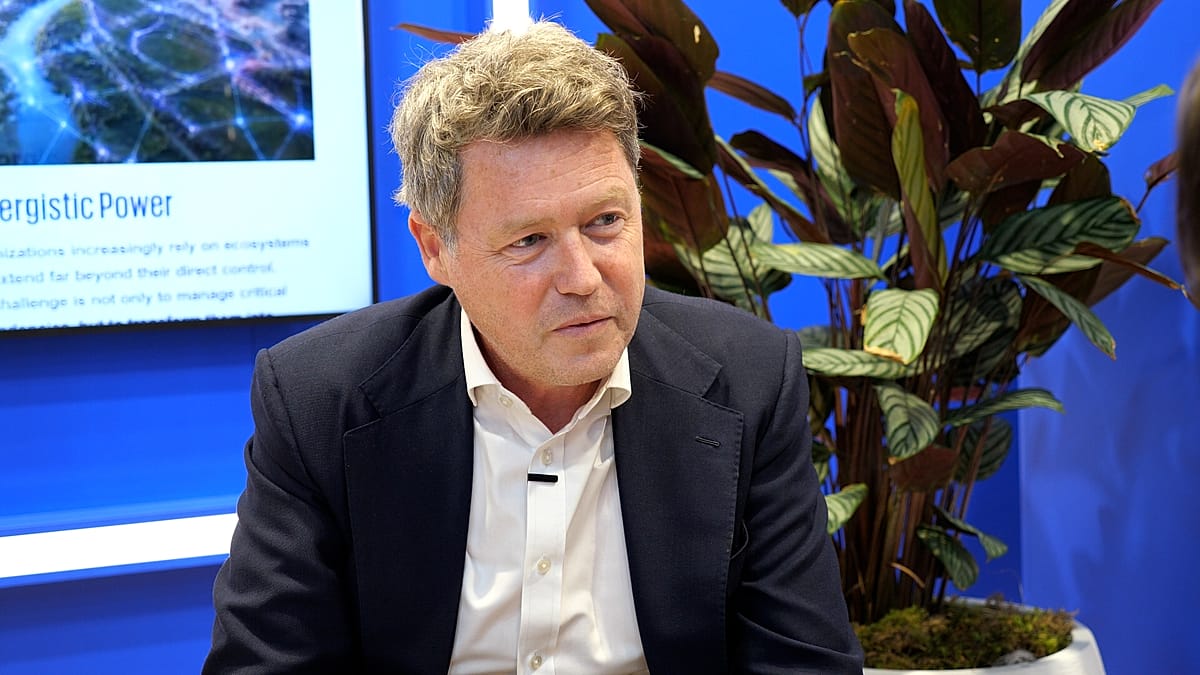
Companies are moving quickly to adopt artificial intelligence (AI), but many still struggle to prove its worth, Mathieu Wallich-Petit, Head of Clients & Markets at KPMG France, told Euronews Next at VivaTech in Paris.
According to the company’s report published in March, 95% of its clients have a strong AI strategy, while 64% have already seen tangible results from the technology.
But only 8% can measure a clear return on investment.
“Our clients do embed a real strategy in AI, but in reality, on the ground, there is still a big lag,” Wallich-Petit said.
Wallich-Petit said KPMG’s role is to help companies bridge that gap, as the technology develops faster than many organisations can adapt.
“What is amazing is that the pace of acceleration of the technology is really exponential,” he said. “And we see the adoption within each company to be pretty much linear.”
According to the survey, only around 10% of KPMG clients are already embedding AI at scale.
In the insurance sector, he said, companies are starting to use AI beyond claims handling.
“Before it was very much about automation of claims, and now it’s very much end-to-end, from scoring new clients, pricing and to customer service,” he said.
KPMG says companies are continuing to increase AI budgets because boards see the technology as a competitive advantage and a way to attract talent. At the same time, businesses are now paying closer attention to whether those investments can deliver clear and rapid returns, according to Wallich-Petit.
Tips for companies
The French executive also said the priority that leaders should focus on when transitioning into AI should be workers.
“My view is that it’s really about people, it’s not a question of technology,” he said. “Upskilling people, training people, is probably the most important strategic angle to make an AI strategy a success.”
For companies still stuck between pilots and wider deployment, Wallich-Petit said the priority is to embed AI into everyday business processes.
“The magic recipe is very much to move from proof of concept, from piloting, to really embed into the process,” he said.
That also means stronger governance, better data management and more training for workers, according to Wallich-Petit.
“We always say it’s having people in the loop. I think it’s more than that. We need to have people driving with AI,” he said.
He also stressed that AI sovereignty is becoming a bigger issue for companies, especially as businesses depend on a small number of powerful model providers.
“The main theme is not to rely on only one model, but to have a diversity of models,” he said.
That question has become more concrete as access to some advanced AI models becomes caught up in geopolitics.
In May, KPMG and US AI company Anthropic announced a global alliance to embed Claude into KPMG’s client delivery platform and give its global workforce access to the AI assistant.
Weeks later, Anthropic said it had been ordered by the US government to suspend access to its Fable 5 and Mythos 5 models for any foreign national.
For more on this story, watch the video in the media player above.
Video editor • Roselyne Min