
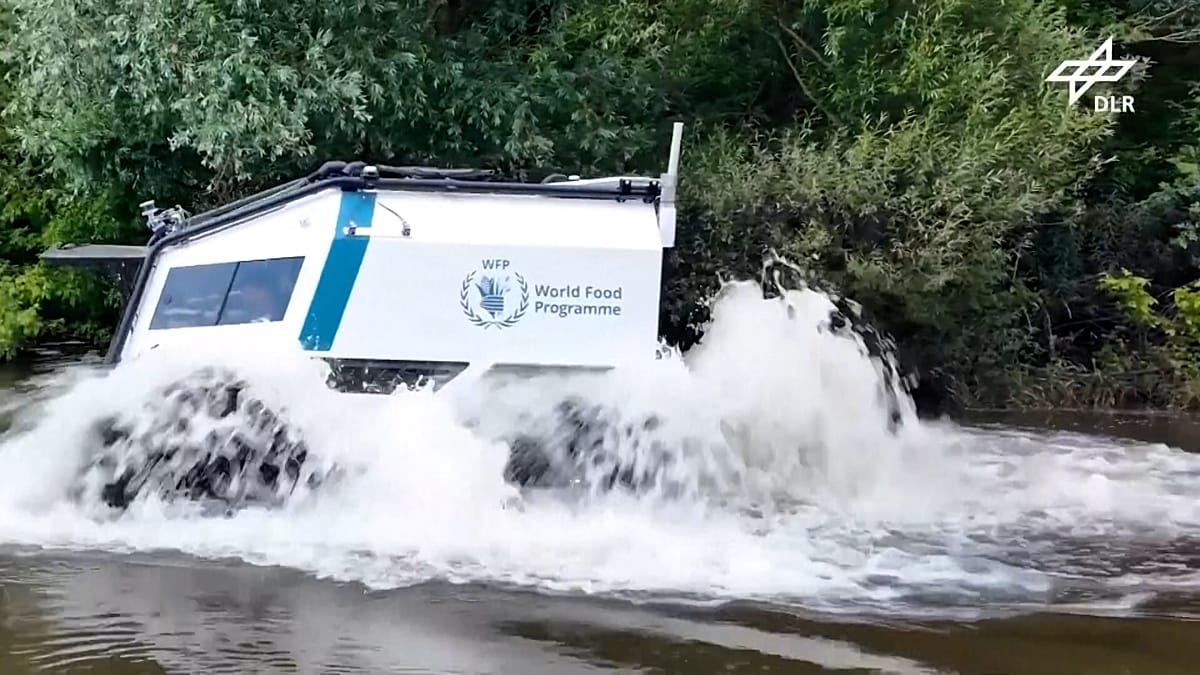
Delivering food through conflict zones, minefields and floods can put humanitarian workers at mortal risk.
Now, technology developed to control rovers on distant planets is being adapted to take aid workers out of some of the world’s most dangerous aid missions.
Project AHEAD, a collaboration between the World Food Programme, Germany’s aerospace research centre DLR, the Red Cross and technology partners, is developing remotely operated vehicles capable of carrying supplies through areas considered too dangerous or difficult for conventional delivery trucks.
Footage from a DLR test site in Germany shows a SHERP all-terrain vehicle wading into open water and climbing over rough ground.
Sensors scan the terrain ahead while an operator controls the vehicle remotely, allowing it to travel without anyone sitting behind the wheel.
The system draws on DLR’s experience developing remotely operated and autonomous planetary rovers, including the MMX rover built to explore Phobos, one of Mars’s moons.
The same push to use emerging technology in humanitarian work extends beyond physical deliveries.
HungerMap Live, a publicly available platform developed by the World Food Programme, uses machine learning and near-real-time data to track food insecurity across more than 95 countries.
It combines information on factors including conflict, weather, climate hazards and economic conditions to help identify emerging hunger crises, according to the organisation.
“Everybody can check it out, HungerMap Live, on the internet. You can get real-time data, and right now we’re even looking into forecasting food security 90 days into the future,” said Bernhard Kowatsch, director of the WFP’s Global Accelerator and Ventures division.
Using AI to map a disaster
Reliable maps are also critical to humanitarian responses. Without information about roads, buildings and population centres, aid workers may struggle to decide where to evacuate people, establish shelters or deliver supplies.
After two powerful earthquakes struck northern Venezuela in June, limited geographical data made it difficult to assess the damage and prioritise assistance.
The Humanitarian OpenStreetMap Team says it used machine learning to extract information about buildings from satellite imagery. Volunteers then reviewed the images through its MapSwipe app, marking areas where structures appeared damaged.
“Within four days after the earthquake, we were able to mobilise more than 600 volunteers that were basically swiping left and right on the mobile app, indicating: yes, this building area is damaged; no, this building area is not damaged,” said Leen D’hondt, director of technology and data at the Humanitarian OpenStreetMap Team .
“And that actually helped early responders to go to the right areas for food delivery and for all the other necessities that we might need right after the earthquake,” D’hondt added.
For all the speed AI can add, D’hondt said the technology cannot yet match the accuracy of detailed work carried out by human mappers.
“Manual mapping still provides the best quality. However, sometimes speed is more important,” she said.
“Sometimes it’s more important to know more or less where the buildings are. They’re not perfectly mapped, but we know how many people are living in that area. And that’s where AI and machine-learning models come into the picture right now.”
Despite rapid advances, insiders say such systems are still far from being routinely incorporated into emergency responses around the world.
“Right now, there aren’t really systems integrated into these emergency protocols in most countries,” said Monique Kuglitsch, innovation manager at the Fraunhofer Heinrich Hertz Institute.
“There are exceptions. In India, they do have an AI-based early-warning system that is operational. Also in Europe, we have an AI forecasting system from the European Centre for Medium-Range Weather Forecasts, which is operational. But in a lot of countries, it’s still experimental.”