
Published on •Updated
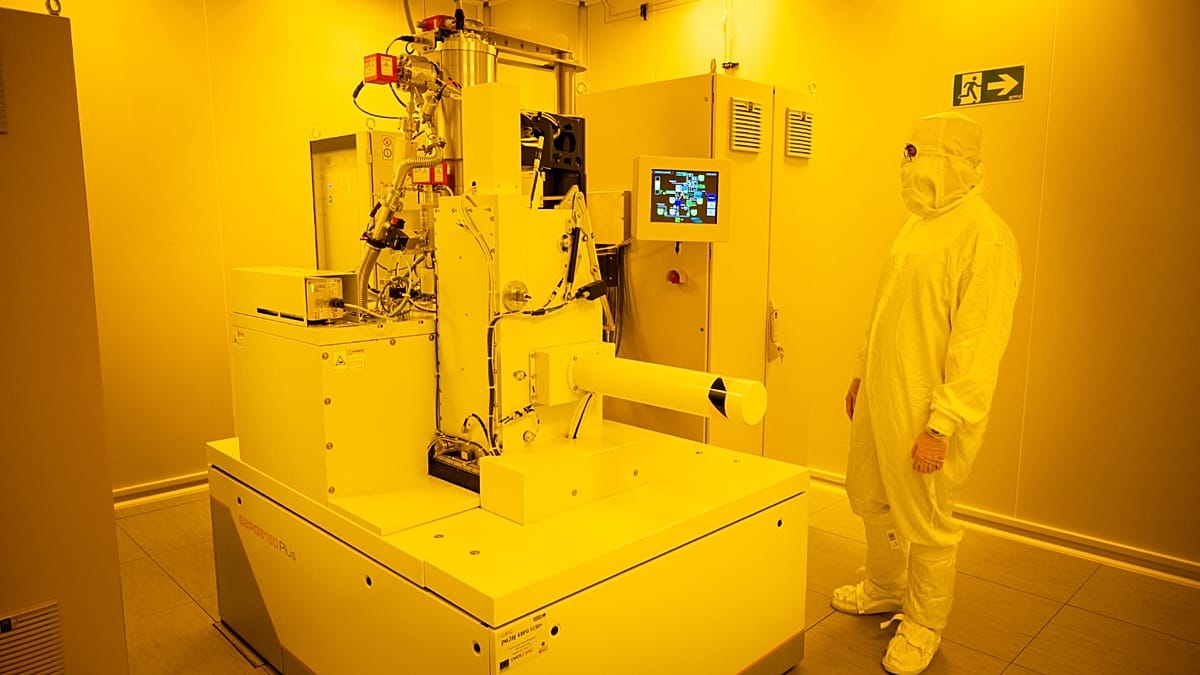
The Spanish National Research Council (CSIC) has inaugurated in Barcelona the new Quantum Nanofabrication Area of the Clean Room at the Barcelona Microelectronics Institute (IMB-CNM), regarded as the largest research infrastructure of its kind in Spain.
The new space will make it possible to manufacture and analyse devices and circuits on the nanoscale for the development of quantum technologies and advanced microelectronics.
The facility, which has involved an investment of more than six million euros, is funded by the PERTE Chip and the Complementary Plan for Quantum Communications, through Next Generation EU funds.
The area includes state-of-the-art equipment, notably the most advanced electron-beam lithography system in Spain, as well as microscopes and metrology tools capable of inspecting structures with nanometric dimensions.
This equipment will be available to researchers and companies, and will help advance the design, manufacture and prototyping of technologies that can be applied in fields such as quantum computing and communications, health, energy and security.
With this new infrastructure, CSIC aims to strengthen Spain’s capacity in semiconductors and quantum technologies and to facilitate the transition from research to industrial development.
The initiative also forms part of the organisation’s strategy to consolidate its position in the quantum field, which includes the creation of the QuARC-CSIC Quantum Science and Technologies Centre.
A new centre to concentrate quantum talent
The Spanish National Research Council (CSIC), a public research organisation attached to the Ministry of Science, Innovation and Universities, has announced the creation of the QuARC-CSIC Quantum Science and Technologies Centre (Quantum Advanced Research Center). The new centre will bring together research groups from different CSIC institutes with the aim of fostering cutting-edge research, attracting talent, opening up new lines of work and strengthening collaboration with other groups, both in Spain and abroad.
CSIC president Eloísa del Pino presented the Quantum Science and Technologies Strategy, the long-term planning document that underpins the launch of the new centre. Del Pino explained that the development of quantum technologies is advancing rapidly worldwide, with strategic investment in Europe, the United States and China that is shaping an increasingly competitive ecosystem. For this reason, she argued for the need for a new organisational model that will allow CSIC to implement a long-term strategy and strengthen Spain’s quantum ecosystem.
According to Del Pino, QuARC-CSIC is an opportunity to consolidate a stable, nationally leading structure devoted exclusively to this field, at a time when the institution is preparing for what she has called “the third quantum revolution”: the shift from laboratory experimentation to the integration of these technologies into industry and society.
A headquarters in Madrid bringing together physics, computer science, mathematics, engineering and chemistry
The new centre will bring together CSIC’s existing capabilities in quantum sciences, with research lines spanning physics, computer science, mathematics, engineering and chemistry. It will have a physical headquarters in Madrid, located in the former premises of the Cajal Institute, now part of the Cajal Neuroscience Centre.
The choice of this location reflects the concentration of leading quantum groups that CSIC has in the Madrid region, 13 research groups belonging to ten institutes, which will make it possible to pool existing capacities and create favourable conditions for interaction among researchers.
The centre will also be strengthened by the recruitment of new staff through competitive selection processes already launched, in which several posts have been reserved for this speciality, and will serve as a hub for research, training and collaboration with other centres.