
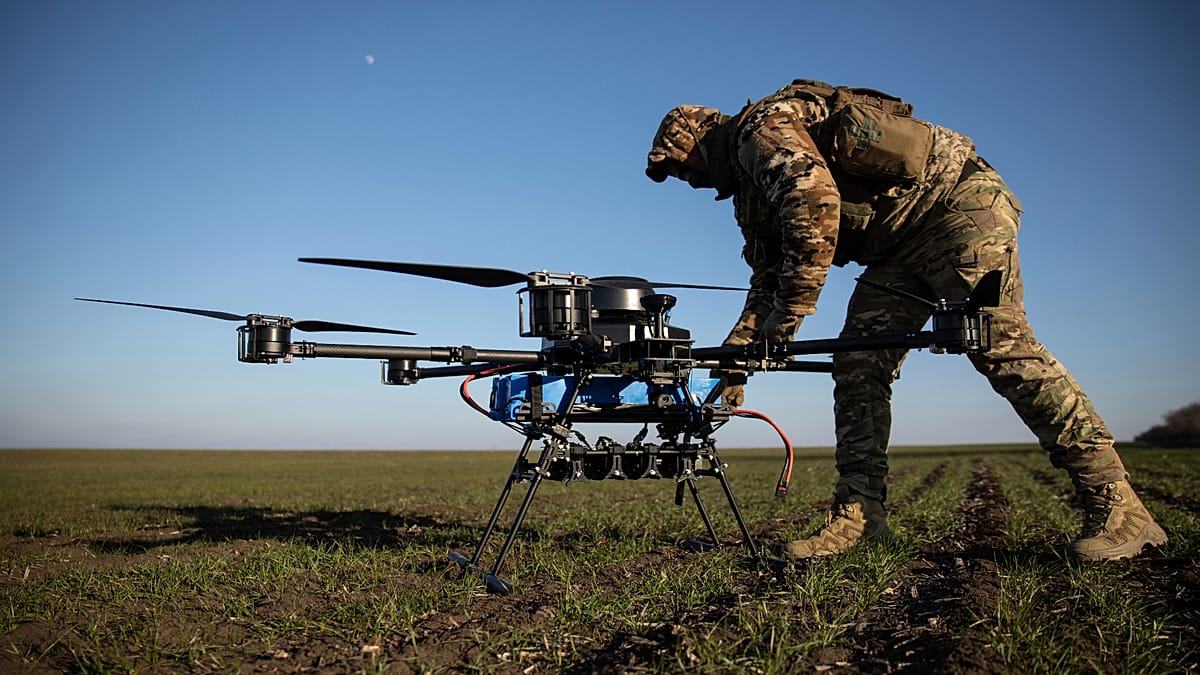
None of the 16 satellites Russia launched on 19 July as part of its Rassvet programme, Moscow’s attempt to build its own version of Starlink to guide the drones and missiles it has used against Ukraine for more than four years, have reached their planned orbit, according to the Institute for the Study of War (ISW), citing data from live satellite tracker N2YO.
Most of the satellites are sitting at altitudes of 300 to 400 kilometres, “well short of the intended 870-kilometer operational altitude for the Rassvet satellites,” the report said.
At least two satellites appear to be heading for reentry into Earth’s atmosphere.
Those flying at lower altitudes face greater atmospheric drag, burn through fuel faster and have shorter operational lifespans than those flying higher, meaning the affected satellites are unlikely to last as long as Russia had planned, even if they stabilise.
Satellite internet has become central to how both sides fight this war.
Ukraine’s access to Starlink has let its forces fly reconnaissance and strike drones, coordinate artillery and stay connected in areas where Russian strikes have destroyed ground infrastructure.
The stakes involved are not abstract. Since Russia’s full-scale invasion began in February 2022, the UN Human Rights Monitoring Mission in Ukraine (HRMMU) has verified at least 16,874 civilians killed and 51,173 injured, as of the end of July.
HRMMU said in a report published on 13 August that July 2026 was the deadliest month for Ukrainian civilians since March 2022, with at least 437 killed and 2,610 injured, driven by a sharp rise in aerial bombardment and glide bomb attacks alongside continued long-range missile and drone strikes on cities far from the front line.
The mission’s monthly reports also recorded successive records for short-range drone casualties near the front in April and May.
A functioning Rassvet constellation would extend Russia’s ability to direct strikes over greater distances and with greater precision, which is why the programme’s repeated failures matter well beyond the technical details.
A troubled launch record
Of the 16 Rassvet satellites launched on 24 March, 12 reached their intended altitude of 550 kilometres and remain there, according to the report.
Those satellites already give Russian forces two daily windows of connectivity with ground terminals, lasting up to 90 minutes in total over Ukraine.
Moscow appears to be rushing the programme to compensate for the loss of Starlink access. Ukraine’s defence ministry said in early February that Starlink terminals being used illicitly by Russian forces had been deactivated after Kyiv and SpaceX moved to a “whitelist” system restricting the network to verified terminals.
“Russia may have been unprepared to accelerate constellation deployment at this pace and will likely face additional delays,” the ISW report said.
But the threat has not gone away. ISW warned that the existing satellites “may allow Russian forces to conduct more precise strikes against Ukraine using remotely controlled unmanned systems” during the windows when connectivity does work — a reminder that Russia does not need a fully functioning constellation to keep inflicting harm, only a partially working one.
Falling short of scale
Bureau 1440, the Russian aerospace firm developing the satellites, has said it plans “dozens” more launches to deploy hundreds more satellites.
Serhii Beskrestnov, then an adviser to Ukraine’s defence minister, said on 31 May that Russia would need at least 200 to 250 satellites in orbit to achieve continuous, stable connectivity, and that Moscow was unlikely to hit that target in the near term.
The report attributed Russia’s bottleneck to its reliance on the Soyuz-2.1b, “a costly and scarce asset.”
The country has carried out only six to eight Soyuz-2.1b launches across all space and commercial missions since 2022, a tempo that ISW said would allow for “a maximum of 128 Rassvet satellites per four years,” and only if every launch succeeded and none were diverted elsewhere.
So far, only 37.5% of launched Rassvet satellites have reached a sustainable operational altitude.
Ukraine targets the supply chain
Ukrainian forces have also gone after the infrastructure behind the programme, in an apparent effort to slow a system that would extend Russia’s ability to deliver deadly strikes in Ukraine.
Ukrainian forces struck the Progress Space Rocket Center, which produces Soyuz-type launch vehicles, overnight between 14 and 15 August.
A further strike was attempted against the Plesetsk Cosmodrome on 23 August, two days before Russia launched a Soyuz-2.1b vehicle reportedly carrying a GLONASS-K1 satellite, part of Russia’s GPS alternative.
Both Rassvet batches were launched from Plesetsk, and the report concluded that Ukrainian strikes “threaten not only Russia’s limited supply and production of launch vehicles but also the scarce launch infrastructure to place satellites into orbit” — infrastructure that, if it succeeds, will make Russia’s war on Ukraine much more lethal.