
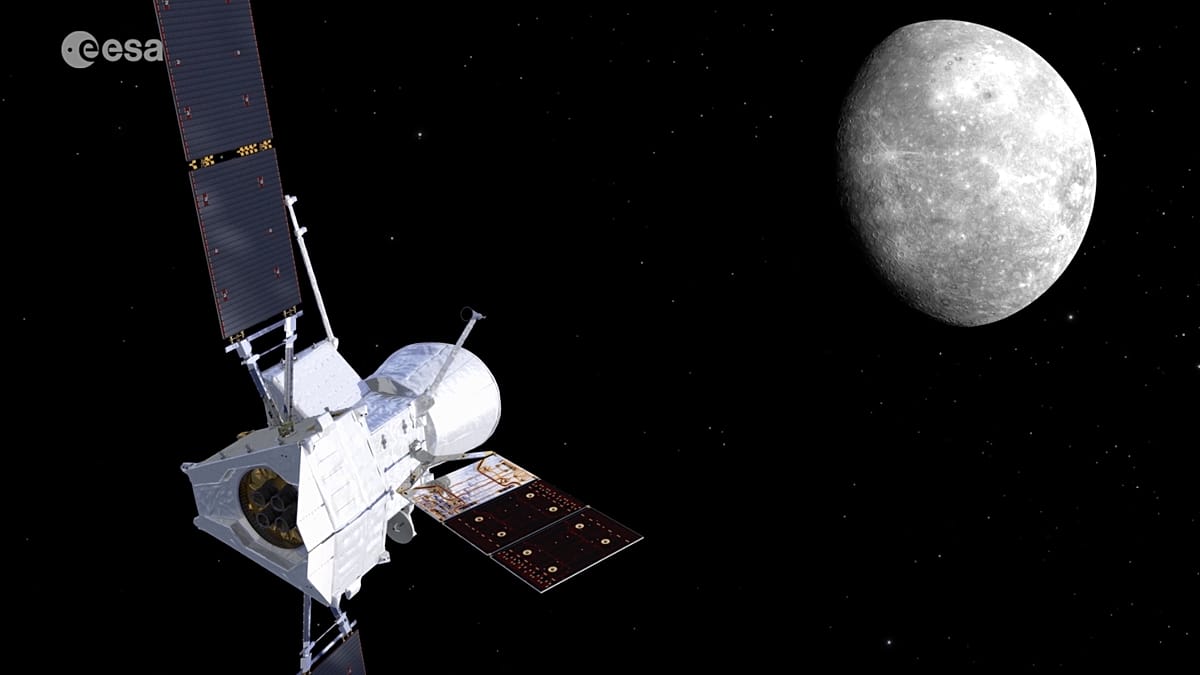
Eight years after it left Earth, BepiColombo is now tantalisingly close to entering orbit around Mercury, a hot and dense ball of metals and silicates with its own magnetic field, considered one of the most difficult planets to observe because the gravitational pull and wild radiation from the Sun are so intense.
“Mercury is a challenging destination. It’s very difficult to reach, it’s very difficult to operate there,” said Santa Martinez, ESA mission manager.
“The main two aspects are really the extreme temperatures that go from -180 to 450°C, and also the solar radiation, which can be up to ten times what we have on Earth.”
Spaceflight engineers at ESA’s ESOC control centre in Darmstadt, Germany say they are ready and prepared for all kinds of incidents and accidents on 3 September, when the spacecraft splits apart and instruments that have been shielded inside are suddenly exposed to an ultra-harsh environment.
Likening the whole spaceflight experience to “operating with a very hot pizza oven running right on your back,” ESA Flight Director Ignacio Tanco told Euronews, comparing it to “working on a knife edge”.
His biggest concern is the solar panels, which are finely tilted. Move them a fraction of a degree too far away from the Sun and you risk losing power, or wind them a tiny bit too much towards our star and they risk getting roasted beyond repair.
“There’s a lot of stuff that is going to be new on Thursday that the teams must prepare for,” he said, comparing the moment to launching an entirely new spacecraft, one that happens to already be orbiting a different planet, with an 11-minute radio delay each way.
What happens next
BepiColombo is Europe’s first mission to Mercury, and it is a complex one.
On Thursday, 3 September, at 2:00 pm CEST the spacecraft will be divided in two. Two probes joined together will set off for the science mission, while the large Mercury Transfer Module (MTM) that has brought them on a circuitous eight-year journey to this point drifts off in the other direction.
The MTM mothership is then in the hands of fate, as it has no attitude control and is no longer needed.
“It’s a fully passive module, so you cannot control it, you cannot manoeuvre it,” explains ESA’s Flight Dynamics Manager Frank Budnik.
Without any way to steer, it will begin to tumble, and its trajectory will carry it past Mercury rather than into orbit. It would spend the rest of its days in interplanetary space.
Meanwhile, for the two probes, it is time to wake up and get to work.
Literally stacked on top of each other on the MTM, they are ESA’s Mercury Planetary Orbiter (MPO), which will study the planet’s surface and interior up close, and the Mercury Magnetospheric Orbiter (Mio), built by the Japan Aerospace Exploration Agency (JAXA), which will focus on the space environment around it.
Martinez was candid about the risks in the seconds, minutes, hours and days after separation this week.
“We know that it’s likely that not everything is going to go according to the nominal plan,” she said. “But we are ready, we are flexible, and we need to be prepared for the unexpected.”
Flying to Mercury is a lot more challenging than flying to Mars. A spacecraft falling towards the Sun does not slow down; it speeds up, pulled by solar gravity.
To be captured into orbit, BepiColombo must match Mercury’s own velocity almost exactly, a far more energy-demanding transfer than reaching even the distant, larger planets.
That is why the mission has spent eight years and nine planetary flybys of Earth, Venus and Mercury itself quietly bleeding off speed with an ion engine, rather than taking a more direct route, and it is why the next few months will see some high-stress moments for the mission team.
For the two probes, Thursday’s separation from the MTM is only the first step of a long arrival sequence.
For the following weeks, the two science orbiters MPO and Mio will remain locked together as a single composite spacecraft, flying free of the propulsion module for the first time, with instruments and cameras previously blocked by the MTM finally getting a clear view of space.
The next major milestone comes in late November and into early December, when mission controllers fire a critical sequence of chemical thruster burns to lower the spacecraft’s orbit and bring it into Mercury’s grip.
Once captured in orbit, MPO and Mio will separate from each other, becoming two fully independent, fully operational spacecraft in their own distinct orbits around the planet, and their own distinct teams on Earth, too.
Engineers will spend the following months commissioning systems and fine-tuning both orbits, a process that runs into March 2027.
Only once that is complete does the mission’s dedicated science phase begin, in April 2027.
Mercury’s unsolved mysteries
Mercury is an absolute headache to study via telescope from Earth because of the burning presence of the Sun in the background. So, as BepiColombo Project Scientist Geraint Jones told Euronews, “to study the planet in any detail, we have to go there with a spacecraft.”
There is a lot we do not know about this fiery-hot planet. Chief among the open questions is Mercury’s density: the planet is unusually heavy for its size, likely because of an oversized iron core which makes up 60% of its volume, but scientists do not yet know why.
Studying that will give us data to explain how the core generates Mercury’s magnetic field. Of our solar system’s rocky planets, only Mercury and Earth have a magnetic field, while Venus and Mars have none.
Other curious aspects of Mercury include the fact that the planet is literally shrinking as the inner core cools, and it rotates on its axis so slowly that a day lasts longer than a year.
One full day and night on Mercury corresponds to 176 Earth days, while a circuit around the Sun takes 88 Earth days.
For Jones personally, one of the most intriguing features of the planet is the surface features called ‘hollows,’ first spotted by NASA’s MESSENGER mission to Mercury.
These hollows are places where the ground appears to be eaten away as volatile materials evaporate in the extreme heat. There is also strong evidence of water ice in some of the permanently shadowed craters at Mercury’s poles, and scientists are keen to know exactly how much there is and why.
Mercury has no atmosphere, but there is outgassing from the planet that Jones is keen to study.
“Both spacecraft will be ‘tasting’ the gases that are surrounding Mercury, being able to tell us what gases are there, whether certain areas of the surface are giving off material and seeing how that changes over time as well,” he explains.
Studying this barren and baking world goes beyond Mercury itself. Understanding how a rocky planet forms and survives so close to its star helps scientists understand the origins of Earth and of many of the odd and unusual exoplanets found in recent decades orbiting other stars in our galaxy.
As ever with this mission, getting answers requires patience.
The mission’s full science campaign will not begin until April 2027, once both orbiters reach their final orbits. For now, all eyes are on 3 September, when a single separation turns eight years of winding around the inner solar system into a final descent into Mercury’s gravitational grasp.