
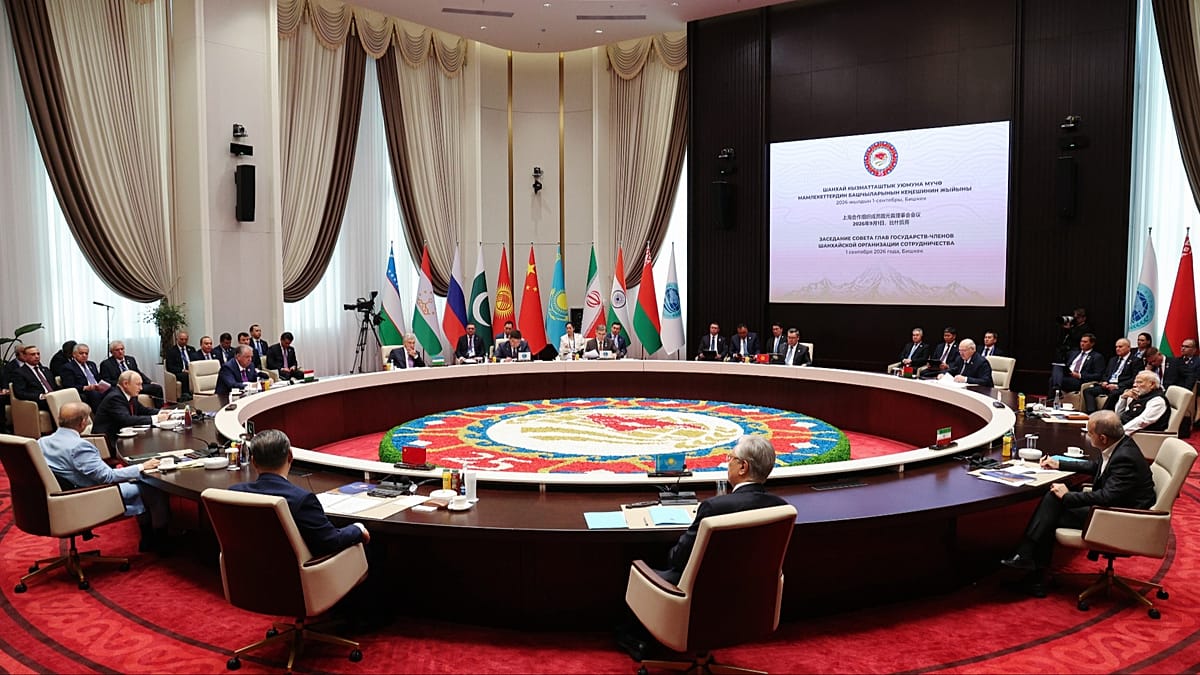
The Shanghai Cooperation Organisation (SCO), a diverse group aiming to balance the West’s global influence, has called for a more representative and fairer multipolar world order as its summit in Kyrgyzstan ended on Tuesday with a run of headlines.
The 25th gathering of the 10 members — China, India, Iran, Pakistan, Russia, Belarus, Kazakhstan, Kyrgyzstan, Tajikistan and Uzbekistan — brought together regional leaders as “dialogue partners” from Central Asia, the Caspian region, the Middle East and wider Asia in a broad forum of meetings to address a rapidly changing multipolar world, even amid significant disagreements and often diverging interests.
The Iran war and Russia’s all-out invasion of Ukraine defined the summit’s focus, with disruptions in global supply lines and emerging alternatives through Central Asia and the Caspian, as well as the rapid geopolitical shockwaves and realignments they have generated.
In a surprise moment with global impact, Indian Prime Minister Narendra Modi told Russian President Vladimir Putin directly, on live television, to end his war against Ukraine.
“Every single day spent in war pushes humanity backwards, ” Modi said unexpectedly to a visibly tense Putin. “We need to move from endless war to the end of war, to the end of hostilities.”
“This is very important for all of humanity,” Modi added.
“We have to move in that direction, which is also essential for the welfare of humanity. It is humanity’s call to resolve all issues peacefully as soon as possible,” the Indian premier told the Russian president.
“This is India’s message — the message from the land of Gandhi, the land of Buddha: a message of peace, a message of humanity.”
Putin did not reply to Modi, but in a speech later at the summit said that “today, 1 September, is the day World War II began.”
“We must do everything to exclude from world practice any provocation of armed conflicts,” Putin added. Russia’s war in Ukraine is now longer than World War II in duration.
In another snub for the Kremlin, a bilateral meeting between Putin and his Chinese counterpart Xi Jinping produced no progress on a Siberian natural gas pipeline that Moscow urgently needs as the country’s infrastructure and economy reel from continuous Ukrainian strikes on key energy targets across Russia.
The Russian president however received the public gratitude of his Iranian counterpart Masoud Pezeshkian, who thanked Putin “for your positions at every stage.”
Putin said that Russia is providing Iran with assistance and “supplying the needed goods,” and that “Russia stands in solidarity with the people of Iran, who are defending their interests. He further said he “admires their courage and steadfastness” in their fight against the US and Israel.
“Today we are experiencing an erosion of the foundations upon which international order is built,” Pezeshkian said.
“If such actions are met with no effective response from the international community, what state can be certain that its sovereignty and security will be protected in the future against the use of force?”
The Iranian delegation pushed for maximum results at the SCO summit, with Pezeshkian also meeting his Azerbaijani, Indian and Pakistani counterparts, while Iranian Foreign Minister Abbas Araghchi met his counterparts from China, Pakistan, Kazakhstan, Uzbekistan, Tajikistan and Russia.
China and Turkey laud multilateralism
China, which sees the SCO as an alternative to Western-aligned organisations like the G7, has recently shown it wants to expand the organisation’s scope and influence, while Russia and Iran joined the summit to build relations with non-Western partners and seek support and recognition.
In his speech at the summit, China’s Xi said the SCO should “foster an environment of universal security,” while criticising “hegemony, unilateralism, and protectionism” which run “counter to the tide of history.”
Xi further urged the SCO leaders and partners to “shoulder the responsibility of the times,” as multipolarity is an “irreversible trend” and that “dominance by just one or several countries, or bloc politics are not true multilateralism.”
Turkey, which holds partner status within the SCO, also seeks to use the platform to strengthen its position in the region, viewing its partnership in the organisation as part of a balanced foreign policy that maintains its traditional ties with the West through NATO while strengthening its influence in Eurasia.
Turkish President Recep Tayyip Erdoğan told the summit that the SCO is “a rising star in every field” and that with its “3.5 billion people and $35 trillion in gross domestic product (it) is an indispensable element of a multipolar order.”
Calling the SCO a “complement to the UN,” Erdoğan said the organisation “has a structure that aligns with our multidimensional foreign policy centred on regional ownership,” adding that “as Türkiye, we are taking responsibility for resolving conflicts around us through dialogue and diplomacy.”
Erdoğan highlighted one of the new thrusts of the SCO summit participants: alternative transport and energy corridors, as the war with Iran disrupted traditional avenues.
“We believe that the organisation can play a role not only in ensuring peace and stability, but also in establishing uninterrupted and secure transportation corridors, which are vital for the prosperity of our peoples, and in areas such as energy supply security,” the Turkish president said.
Billions in Central Asia and Caucasus projects
The leaders of Central Asia and the South Caucasus pushed relentlessly during the summit to maximise the economic opportunities for their regions as the Iran war and wider Middle East disruptions place them at the forefront of new global trade and connectivity solutions.
Azerbaijan’s President Ilham Aliyev and Armenian Premier Nikol Pashinyan held a new round of their peace talks in Bishkek, with Aliyev saying “the South Caucasus is becoming a zone of peace.”
Pashinyan said transport corridors and regional connectivity are now developing toward the Trump Route for International Peace and Prosperity (TRIPP).
Kazakh President Kassym-Jomart Tokayev told the summit that trade among SCO countries has reached $1 trillion and that much more remains to unlock the full potential of cooperation and resource use.
Uzbekistan’s President Shavkat Mirziyoyev proposed establishing a bank for inter-regional projects, natural resource management, digital services and healthcare.
Mirziyoyev agreed with his Chinese counterpart Xi Jinping to raise bilateral trade from $18 billion in 2025 to $30 billion in the coming years through a portfolio of joint investment projects and industrial cooperation.
“The existence of multiple centres of political influence is an important condition for advancing a political pluralism on the international stage,” Tajikistan’s President Emomali Rahmon said.
New security centre approved
Away from the diplomacy, the summit closed Kyrgyzstan’s year as chair with a package of institutional decisions. Leaders signed the Bishkek Declaration and a protocol amending the SCO’s Founding Charter, which Kyrgyz Foreign Minister Jeenbek Kulubaev said would create the basis for a more flexible bloc.
On security, members approved the rules for a Universal Centre for Countering Security Challenges based in Tashkent and an anti-drug centre in Dushanbe.
A unit to fight transnational organised crime will open in Bishkek under that centre, the first permanent SCO body on Kyrgyz soil.
Members also agreed to complete consultations “in the shortest possible time” on a long-discussed SCO development bank, with a view to signing its founding document, although they concluded no deal in Bishkek.
Leaders adopted further documents on artificial intelligence, climate, energy and information security, a declaration on nuclear safety, and a decision to develop cooperation with the African Union.
Kyrgyzstan said it held around 200 events during its chairmanship, more than 50 of them in the country itself, and marked the anniversary by naming a 4,050-metre peak in the Ala-Archa range “SCO Peak”.
Pakistan now takes the chairmanship and will host the next summit in Islamabad.