
Published on
•Updated
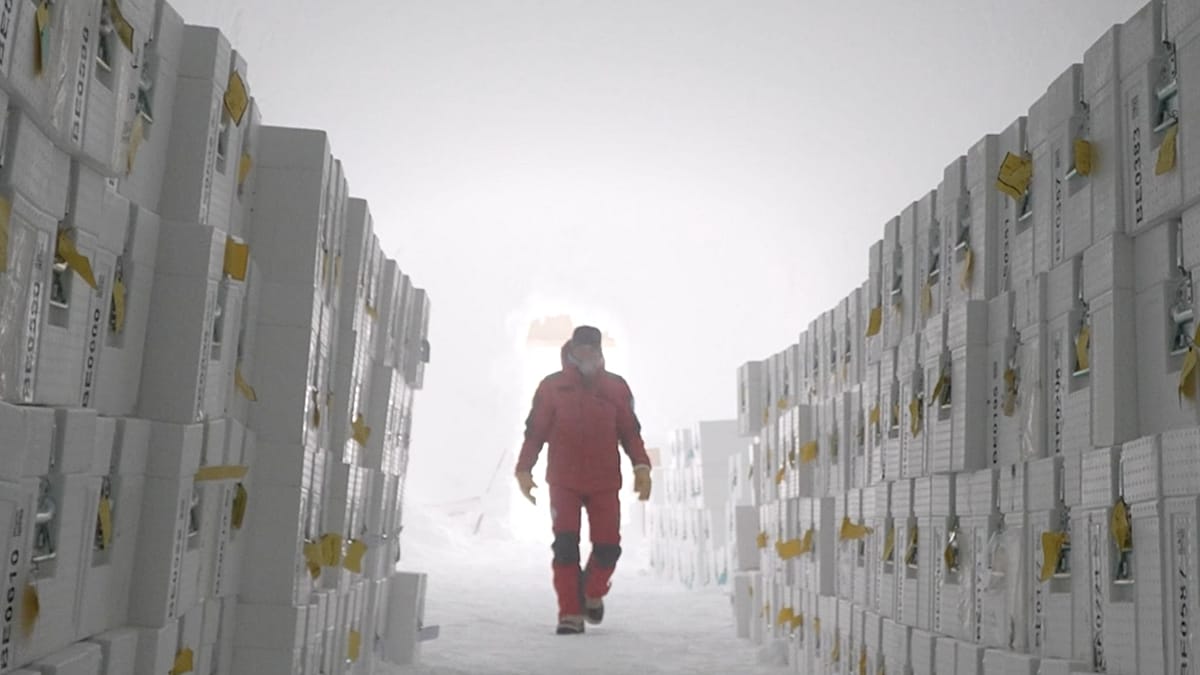
Ice from France’s iconic Mont Blanc and a slice of Switzerland’s Grand Combin glacier have become the first ever samples to be stashed away in a unique Antarctic archive, known as the Ice Memory Sanctuary.
This human-made cavern of ice near the Franco-Italian Concordia research base on the high Antarctic plateau was inaugurated on 14 January.
The first two ice cores travelled in -20°C containers all the way from Europe to the near southernmost spot of the planet, and will now lie in the ice cave nine metres below the surface as a precious record for future scientists to study.
Samples from glaciers from Bolivia to Tajikistan will join them over the following years, as scientists race to preserve this natural record of our planet’s cryosphere before they melt away.
Why are scientists keeping ice samples in Antarctica?
The reason for keeping the samples is simple, according to Professor Carlo Barbante, the Vice Chair of the Ice Memory Foundation.
“The ice doesn’t lie,” he tells Euronews. “All the samples are different – the ice cores from non-polar regions tell us the history of the regional climate they are from.”
His group hopes researchers in the future will be able to use as-yet-to-be-invented techniques to study traces left behind in the ice by events nearby, ranging from dust from combustion to DNA from species, from volcanic eruptions to nuclear bomb tests.
Tiny air bubbles in the ice give hints to atmospheric circulation patterns and long-term weather and climate trends.
The history of many of Earth’s regions, and the history of humanity’s impact on those regions, is preserved in glaciers.
But not for long, and that’s the reason for the creation of the Ice Memory Sanctuary. Climate change projections for the Alps are that the glaciers below 4,000 metres will disappear before the end of the century, and even the ice that survives will be compromised by melt, Prof Barbante explains.
Celeste Saulo, Director General of the World Meteorological Organisation, reminded the crowd at the opening ceremony that our glaciers are already disappearing rapidly.
“Since 1975, glaciers have lost the equivalent of a block of ice the size of Germany and 25 metres thick,” she explained. “Information lost can never be recovered.”
A race against time to preserve the memory of our planet
The opening ceremony was a celebration for the scientists at Concordia, who had made the caverns in the ice using a giant inflatable balloon. But there was also a bittersweet edge to proceedings, as the project represents an admission that our cryosphere is threatened, and that scientists are in a race against time to preserve its memory.
Project founder Professor Jérôme Chappellaz from EPFL in Switzerland told Euronews he felt a sense of “pride, but despair as well, due to the slow answer to the current climate challenge worldwide”.
Prince Albert II of Monaco joined the opening ceremony as Honorary President of the Ice Memory Foundation, and he echoed that message from the glaciologists.
“We are reminded of the fragility and permanence of our planet,” he said. “Glaciers should be recognised as a common heritage of humanity. The memory of our planet matters. Safeguarding it is our common duty and responsibility,” he concluded.
The future does hold certain risks for the Ice Memory Sanctuary. In terms of the physical structure of the ice caverns, the Concordia research team is certain the structures can remain solid for decades, and should the icy arch start to shift, they can re-create another cavern nearby within six weeks.
The Sanctuary is located in an area protected under the 1959 Antarctic Treaty and by the Madrid protocol, yet it still requires sustained diplomatic and political support from France and Italy, and commitment to its legal protection.
This project, which describes itself as ‘an endeavour for humanity’, will need the continued support of humans to realise its promise.