
Published on •Updated
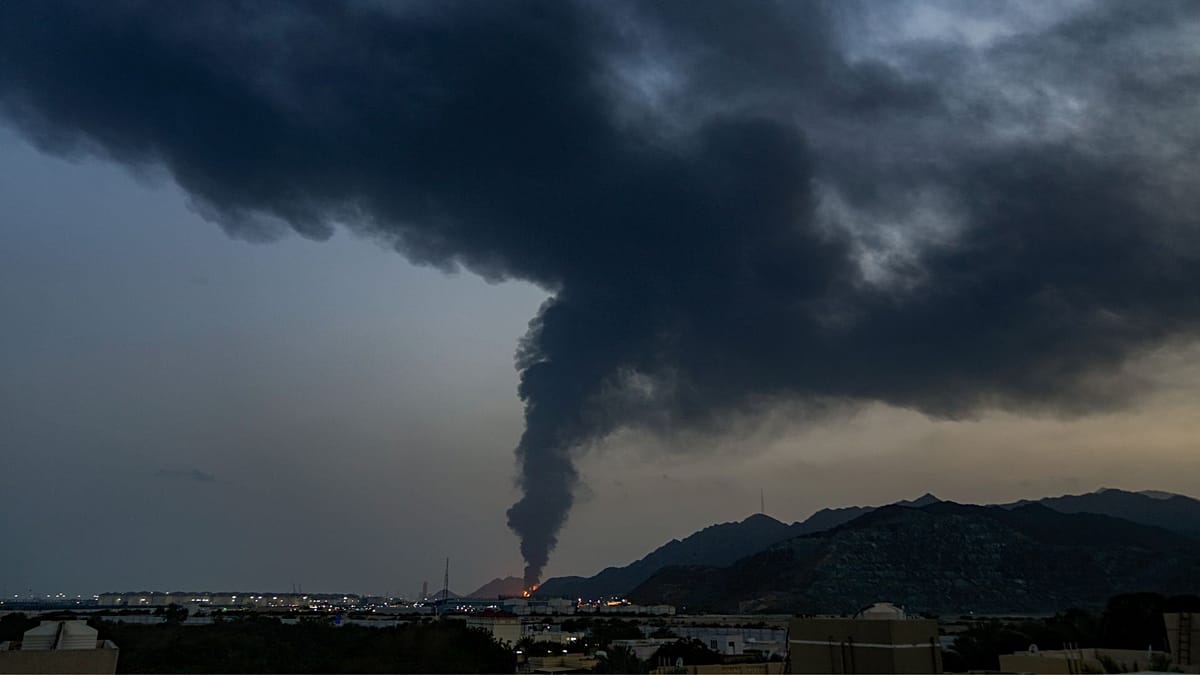
‘Black rain’ fell on Iran over the weekend after US-Israeli strikes hit oil depots.
Alongside acid rain precursors – sulphur dioxide and nitrogen dioxide – the plumes of pollutants are likely to contain a cocktail of hydrocarbons, PM2.5 and carcinogenic compounds, according to Gabriel da Silva, associate professor of chemical engineering at the University of Melbourne. Heavy metals and inorganic compounds from infrastructure caught in the explosions may also be in the mix.
On the ground, people have reported difficulty breathing and burning in their eyes and throats. But the longer term health risks span cancer, birth complications, neurological and heart conditions. As the pollutants settle on buildings and seep into waterways, they could persist long after the fires are extinguished, threatening marine life in an already stressed ecosystem.
Desalination plants make Middle East nations vulnerable
Pollution is just one of many threats to Iran and neighbouring nations’ water supplies. Strikes have hit desalination plants in the Middle East, which produce freshwater from salty seawater and sustain many of the region’s major cities, making them a major vulnerability in times of war.
“Everyone thinks of Saudi Arabia and their neighbours as petrostates. But I call them saltwater kingdoms,” says Michael Christopher Low, director of the Middle East Center at the University of Utah.”They’re human-made fossil-fuelled water superpowers. It’s both a monumental achievement of the 20th century and a certain kind of vulnerability.”
Iran says the US set a “precedent” after an airstrike damaged an Iranian desalination plant, cutting into the water supply for 30 villages.
On Sunday, Iran was accused of damaging a desalination plant in Bahrain. Since many Gulf desalination plants are physically integrated with power stations as co‑generation facilities, attacks on electrical infrastructure could also hinder water production.
‘Serious water crisis’ could be on the horizon
Although Iran is less reliant on desalination than neighbouring states, as it gets most of its water from rivers, reservoirs and underground aquifers, these are depleted after five years of drought.
The country is racing to expand desalination along its southern coast and pump some of the water inland, but infrastructure constraints, energy costs and international sanctions have sharply limited scalability.
“They were already thinking of evacuating the capital last summer,” says Ed Cullinane, Middle East editor at Global Water Intelligence. “I don’t dare to wonder what it’s going to be like this summer under sustained fire, with an ongoing economic catastrophe and a serious water crisis.”
Oil supply disruption and renewable energy
While bombed refineries and disrupted shipping channels are crippling oil-dependent economies, history suggests the immediate instinct will be to reach for dirtier fuel.
After Russia’s invasion of Ukraine, some European nations turned to coal while others paid a premium for US liquefied natural gas shipped across the Atlantic.
With Iran’s closure of the Strait of Hormuz, through which 20 per cent of the world’s oil transits, tankers have been forced to reroute around Africa, spiking shipping emissions and the risk of oil spills along congested alternative routes.
The closure also threatens food supplies. Roughly a third of the world’s fertiliser trade passes through the Strait, and with oil prices surging, the cost of farming and food transport is rising too.
But the crisis is also sharpening the case for food and energy independence closer to home.
“Homegrown renewable energy has never been cheaper, more accessible, or more scalable,” says UN Secretary-General António Guterres. “The resources of the clean energy era cannot be blockaded or weaponised.”
The climate fallout of war
Whatever happens with nations’ energy choices, the war itself will spike emissions.
Russia’s war on Ukraine, now in its fourth year, has so far emitted a staggering 311 million tonnes of CO2 equivalent.
And reports show that, even before the Iran invasion, the world’s militaries are responsible for 5.5 per cent of Earth’s heat-trapping emissions each year, more than any country except China, the United States and India.
Neta Crawford, co-founder of the Costs of War project at Brown University’s Watson Institute for International and Public Affairs, says fighter jets consuming vast quantities of fuel, releasing carbon dioxide and other pollutants, is just one example.
“The consequences of war on emissions will far exceed any incremental offset in emissions due to increased enthusiasm for a green transition,” she says.