
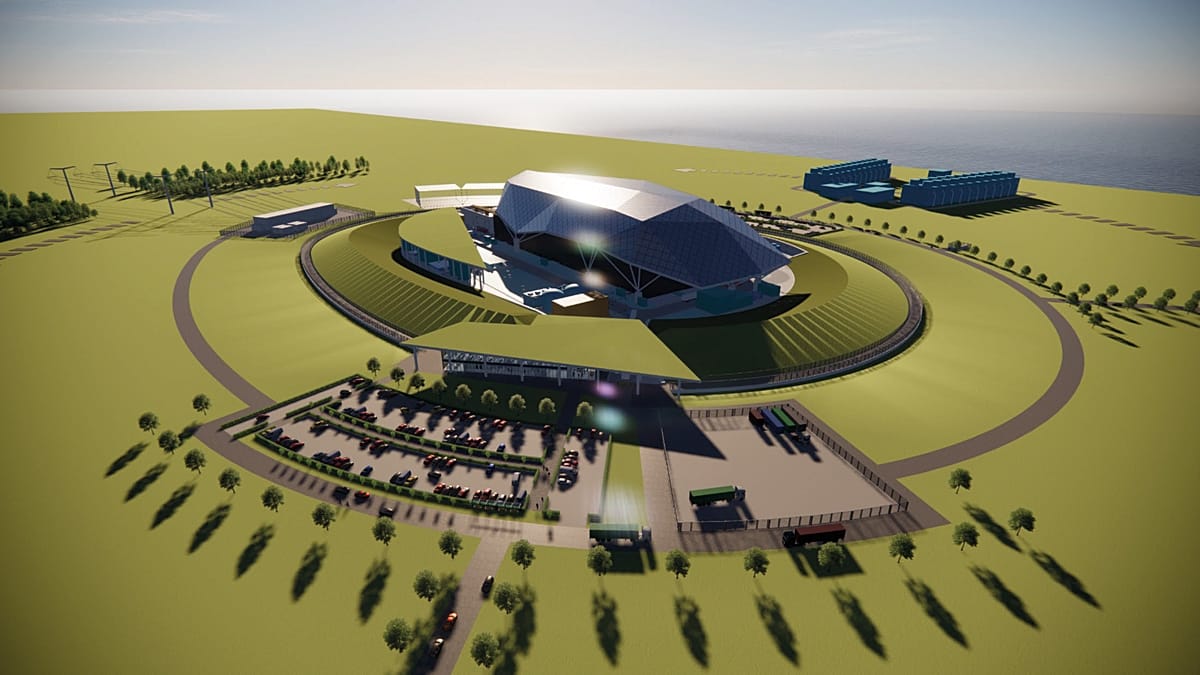
To address the challenges of energy security and greenhouse gas emissions, the Greek government decided to take a step that would have caused strong reactions a few years ago: to open the debate on the possibility of nuclear power generation in Greece.
Twelve EU countries have operational nuclear reactors: Belgium, Bulgaria, Bulgaria, Czech Republic, Spain, France, Hungary, the Netherlands, Romania, Slovenia, Slovakia, Finland, Spain, France, Hungary, the Netherlands, Romania, Slovenia, Slovakia and Sweden.
In 2024, nuclear power plants accounted for 23.3 per cent of the total electricity produced in the EU, according to Eurostat data, registering an increase of 4.8 per cent compared to 2023.
Nuclear power and energy security
Nuclear physicist and president of the Deon Policy Institute, George Laskaris, who has carried out a special study on Greece’s potential to develop small nuclear reactors, explained to Euronews why nuclear power is essential in Greece and stressed that there must be public support for it.
“Nuclear power is necessary for three main reasons: security, security, security. Nuclear energy is necessary for energy security, for economic security and for climate security,” he said.
“When we say climate security, what do we mean? We mean that obviously the climate is changing. All we can do is to help the Earth not to change the climate so fast. Nuclear power offers agreen form of energy and it offers within a very small space a nuclear power plant. The traditional nuclear power plant is one square kilometre – within a very small space it offers huge amounts of energy,” he adds.
When it comes to energy security, the physicist argues that in recent years “all the wars in the Middle East” have been about energy resources.
“For our country, which imports about 80 per cent of its energy either in the form of oil or gas from abroad, it is terribly important to be able to be self-sufficient, so nuclear energy can ensure the country’s energy self-sufficiency,” Laskaris says.
Regarding economic security, he says “all businesses and households alike want to have control over energy costs”.
“Energy for industry is to industry what blood is to man. It is a cost that fluctuates and obviously fluctuates a lot when there are periods of crisis as there are now. The nuclear power plant buys nuclear fuel at a certain price, when it is built, it can keep energy prices stable for both industry and households,” he says.
Nuclear reactor safety
Euronews asked Laskaris how Greek citizens could be convinced that the nuclear option is safe when for years they have been told that as an earthquake-prone country, Greece cannot host nuclear reactors.
“For many years there have been three-to-four generations of reactors. The first reactors that came out in 1950 in the United States and then in the Soviet Union and in England, in Great Britain, were experimental reactors. The second generation of reactors that dominated and perhaps still dominate the world today started in the mid-1960s and lasted until 1990. Then we had the third generation of reactors,” he explains.
The safety systems of the reactors have improved. “Today reactor safety systems include passive systems that in case something happens, not even a human hand is needed to stop the reactor. It stops itself.”
He adds, artificial intelligence tools are used to make reactors safe.
He believes the discussion has been overcome. “Even large ecological organisations understand that nuclear energy is a valuable form of energy that produces huge amounts of energy in an environmentally friendly way. They too have turned, conditionally, to saying yes to nuclear energy.”