
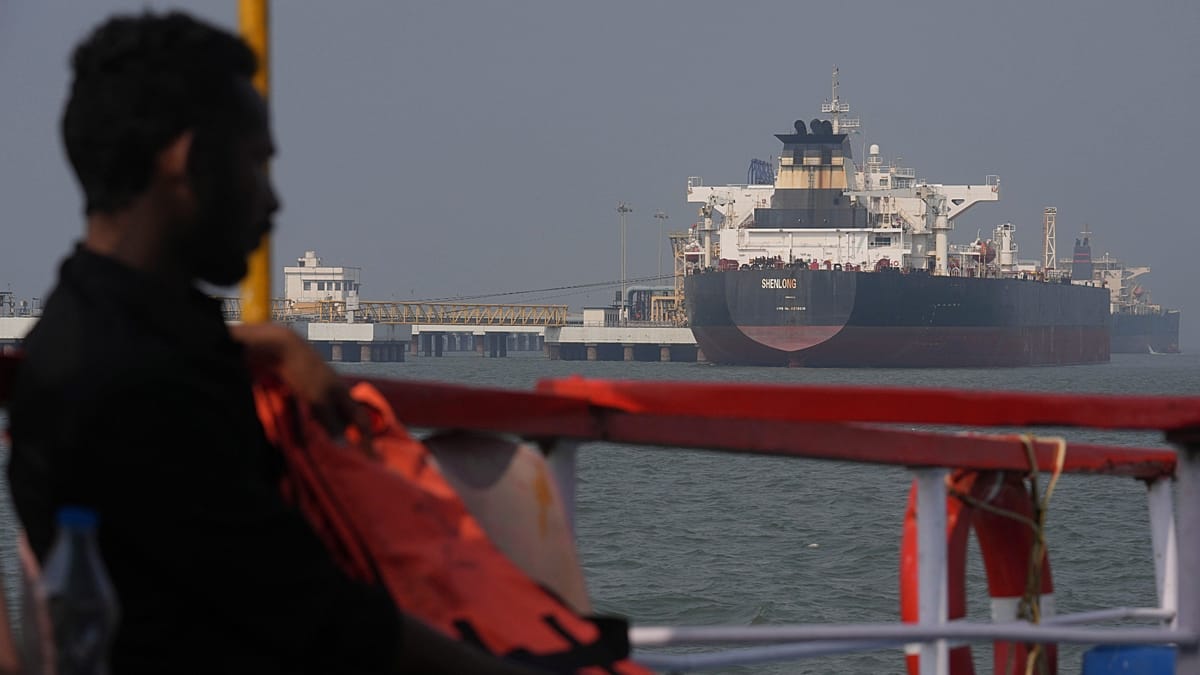
About 90 ships, including oil tankers, have crossed the Strait of Hormuz since the start of the conflict with Iran.
The country continues to export millions of barrels of oil despite the waterway being effectively closed — and Iran claiming it will attack tankers attempting to cross — according to maritime and trade data.
Many of the vessels were engaged in so-called “dark” transits, evading Western sanctions and oversight, and are likely to have links to Iran, maritime data firm Lloyd’s List Intelligence said.
More recently, vessels linked to India and Pakistan have also crossed the strait, as governments step up negotiations.
Oil prices rose above $100 a barrel in recent weeks, prompting US President Donald Trump to urge allies and trading partners to send warships to reopen the route in a bid to bring prices down.
The Strait of Hormuz is a key route for global oil and gas, carrying about one-fifth of the world’s crude oil.
Most shipping traffic has been halted since early March, when the conflict began. Around 20 vessels have been attacked in the area.
Despite this, Iran has exported more than 16 million barrels of oil since the beginning of March, according to analytics firm Kpler.
China remains the largest buyer, reflecting the impact of Western sanctions.
“There has been continued resilience in Iran’s oil exports,” said Kpler analyst Ana Subasic.
Iran has managed to profit from oil sales and also “preserve its own export artery” by using control over the chokepoint, said Kun Cao, client director at consulting firm Reddal.
Iran’s oil export data estimates are largely aligned with maritime traffic data.
Between 1 and 15 March, at least 89 ships crossed the strait, including 16 oil tankers, Lloyd’s List Intelligence said. This is comparable with 100 to 135 daily vessel movements before the conflict.
More than one-fifth of those ships were believed to be linked to Iran, with others associated with China and Greece.
Some vessels continue to pass through
The Pakistan-flagged crude oil tanker Karachi, controlled by the Pakistan National Shipping Corporation, passed through the strait on Sunday, Lloyd’s List Intelligence said.
Shariq Amin, a spokesman for the Pakistan Port Trust, refused to confirm or deny which route the MT Karachi had used, but said the ship would soon safely reach Pakistan.
The India-flagged liquefied petroleum gas (LPG) carriers Shivalik and Nanda Devi, both owned by the state-owned Shipping Corporation of India, also travelled through the strait around 13 or 14 March, according to Lloyd’s List Intelligence.
LPG is widely used as a cooking fuel in India.
India’s foreign minister, Subrahmanyam Jaishankar, told the Financial Times the two vessels were able to pass following talks with Iran.
Iraq was also in talks with Iran to allow its oil tankers through the Strait of Hormuz, the state-run news agency reported.
Vessels may be transiting “with at least some level of diplomatic intervention”, said Richard Meade, editor-in-chief of Lloyd’s List.
So Iran may have “effectively created a safe corridor”, with some ships passing close to the Iranian coast.
Some vessels near or in the strait were found to have declared themselves as China-linked or to have all-Chinese crews to reduce the risk of being attacked, based on an earlier analysis on ship-tracking platform MarineTraffic.
Analysts believe they were taking advantage of China’s closer ties with Iran.
Oil prices have risen more than 40% since the conflict began. Iran has warned it will not allow oil bound for the US, Israel and their allies to pass through the strait.
The US said it is allowing Iranian tankers to pass to help stabilise global supply.
“The Iranian ships have been getting out already, and we’ve let that happen to supply the rest of the world,” Treasury Secretary Scott Bessent told CNBC.
The US bombed military sites on Kharg Island off the Iranian coast, which is key to Iran’s oil network and exports, but President Donald Trump said he had left its oil infrastructure alone for now.
The latest passages through the Strait of Hormuz show the strait was not simply “closed”, Cao said.
“It is better understood as closed selectively against some traffic, while still functioning for Iranian exports and a narrow set of tolerated non-Iranian movements,” he said.
However, if Iran’s plan is to “inflict pain through higher energy prices”, the number of tankers it allows through the Strait of Hormuz may be very limited, Dutch bank ING’s strategists Warren Patterson and Ewa Manthey wrote in a research note.