

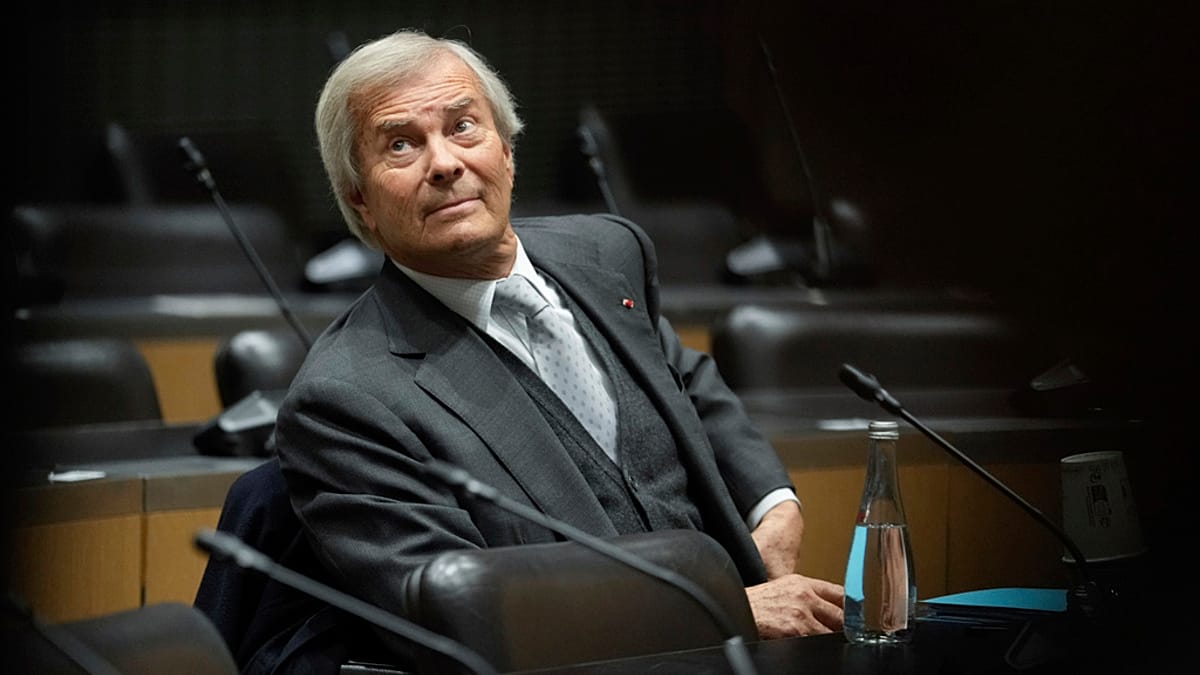
The “Zapper Bolloré” collective has announced that Spanish actor Javier Bardem, British director Ken Loach and American actor Mark Ruffalo have joined the signatories of the open letter expressing concern about conservative businessman Vincent Bolloré’s grip on the film world.
In this text, the initiators of the move denounce what they describe as Vincent Bolloré’s “tentacular and ideological” hold over the French film industry. They warn of the growing concentration of media and cultural power in the hands of the billionaire from Brittany.
Among the first signatories were actresses Adèle Haenel, Juliette Binoche and Blanche Gardin, actors Swann Arlaud and Jean-Pascal Zadi, photographer and documentary-maker Raymond Depardon, as well as director and screenwriter Arthur Harari.
None of the new signatories highlighted by “Zapper Bolloré” is French. Alongside the big Hollywood names, they include other directors: Palestinian filmmaker Annemarie Jacir, Finland’s Aki Kaurismäki, Greek director Yorgos Lanthimos and Brazilian film-maker Walter Salles.
The Canal+ boss’s outburst, a snowball effect from a “two-bit show of pressure”
According to the collective, 3,460 professionals from the sector have now signed the open letter; there were 600 before the statement on Sunday by Canal+ president Maxime Saada. He had said he no longer wanted to work with the signatories of the text, which denounced “the far right’s grip” on cinema via Canal+, of which Vincent Bolloré is the main shareholder.
Maxime Saada’s intervention in the middle of the Cannes Film Festival caused a stir in the film world, with several actors and directors voicing concern over a threat to freedom of expression.
On Thursday, actor Alain Chabat, an emblematic figure of the Canal+ spirit, deplored to AFP what he called the group boss’s “two-bit show of pressure”.
“There were plenty of ways of responding to this thing,” said the actor, who stars in Quentin Dupieux’s Vertige, screened out of competition at Cannes. “But to go as far as adding this two-bit show of pressure on people who are expressing an opinion, or at any rate voicing a concern, whether it’s legitimate or not…,” he went on.
The director of Astérix et Obélix: mission Cléopâtre did nonetheless say he could “understand” that Canal+ staff might have been hurt by the open letter. The group “produces films that are nothing like each other, because there is real diversity there,” the actor explained.
Actor Jonathan Cohen, who shares top billing with Alain Chabat in Vertige, an animated film directed by Quentin Dupieux, told AFP he “understood the legitimate fear” felt by the signatories of the open letter.
Jonathan Cohen, himself co-director of La Flamme, a comedy series broadcast on Canal+, insists that the Canal+ teams, including Laurent Hassid, head of film acquisitions, and Maxime Saada, “protect” and “turn Canal into a kind of haven which, for the time being, produces French films in all their diversity”.
Bolloré, deep pockets behind the worlds of publishing and cinema
Canal+ has in fact pledged to invest 160 million euros in French cinema in 2026 and 170 million in 2027, after 150 million in 2025 (which financed 189 French films). Those sums are nonetheless down on the 220 million euros invested in previous years.
More broadly, the list of Vincent Bolloré’s acquisitions reads like a who’s who of the cultural world.
The group that bears his name manages an investment portfolio (source in French) worth 10.6 billion euros as of 31 December 2025.
This notably includes:
• 18.4% of Universal Music Group, the world leader in music,
• 30.4% of Canal+, a global audiovisual group,
• 30.4% of Louis Hachette Group, a leader in publishing, travel retail and media,
• 30.4% of Havas, one of the world’s biggest communications groups,
• 29.3% of Vivendi, which manages a portfolio of listed and unlisted assets in the content, media and entertainment industries.
The publishing world already up in arms against Bolloré
The billionaire from Brittany is already well used to protest op-eds.
Back in April, more than a hundred writers announced they were leaving the Grasset publishing house after the announcement that its president Olivier Nora was being dismissed. In a joint letter, they denounced – as you might have guessed – Vincent Bolloré’s disproportionate influence, accusing him of “imposing authoritarianism across culture and the media”.
The tycoon bought the Hachette group in 2023, the owner of Grasset and other major publishing houses, as well as the pay-TV channels Canal+ and CNews, the Europe 1 radio station and magazines such as Elle.
Subsequently, more than 300 authors and publishing-industry figures, led by Leïla Slimani, Virginie Despentes and Emmanuel Carrère, called for the creation of a “conscience clause” in their sector.
“It is time to draw a line. That line has a name: the conscience clause. It exists for journalists. It must be extended, not to weaken companies, but to restore a basic balance between the freedom to do business and the freedom not to serve what one finds reprehensible,” the 308 signatories of this open letter demanded on Sunday 19 April.
For his part, the conservative billionaire penned an opinion piece in one of the newspapers he owns and promised, in no uncertain terms, to find new authors for one of France’s most prestigious publishing houses, after the departure of those who challenge what they see as political interference.
Bolloré, a devout Catholic who has invested part of the family fortune in a media empire aligned with his conservative convictions, said he was surprised by the “uproar” within the publishing house, blaming “a small caste that thinks it is above everything and everyone, and that handpicks and supports its own”.
This tone hardly bodes well for any potential dialogue with the French film world which, it bears repeating, relies heavily on Vincent Bolloré’s largesse.