



It was an inconspicuous, green piece of paper. Anyone who received the note in Paris in May 1941 was supposed to report to a gymnasium on 14 May, ostensibly to clarify their residence permit.
What followed was no official formality. It was the first major roundup of Jews in German-occupied France: the so-called Rafle du “billet vert”, the roundup of the green slip of paper.
On the orders of the SS and Gestapo, the French police arrested around 3,800 Jewish men that day, most of them from Poland and the Czech Republic. They were taken to the Pithiviers and Beaune-la-Rolande camps.
Around 700 managed to escape. The rest, around 3,100 men, were deported to Auschwitz-Birkenau in July 1942 and murdered there.
The collaborationist Vichy government had already legally authorised the arrest and internment of foreign Jews shortly after the German invasion in June 1940.
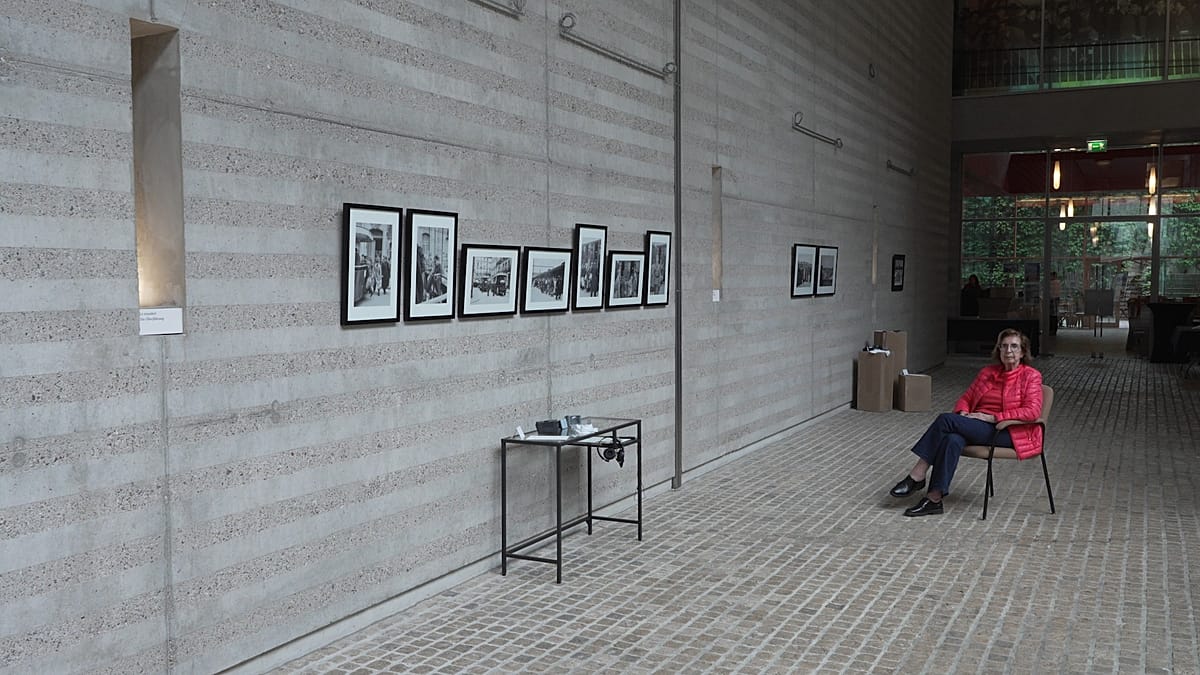
On the 85th anniversary of this roundup, the faces of those arrested, as well as the perpetrators and helpers, can now be seen for the first time in an exhibition at the French Embassy in Berlin, which opened on 11 May 2026.
The lost 98 photos
The pictures show men in suits, with hats, some with suitcases, some without. Some are looking directly into the camera. Others are looking away. The photos do not show an anonymous group, but individual people.
The man behind the camera was Harry Croner, a Berlin photographer who had been drafted into the Wehrmacht in 1940 and was himself of Jewish origin through his father. The head of the Gestapo’s “Jewish department” in Paris, SS-Hauptsturmführer Theodor Dannecker, commissioned him to document the raid.
98 photographs were taken. The pictures then disappeared for more than 80 years.
They were rediscovered in 2020 and purchased, researched and analysed by the Mémorial de la Shoah in Paris.
Lior Lalieu, head of the Mémorial de la Shoah’s photo library, analysed the collection and wrote captions that place the historical and personal dimension of the raid in context. Her book La Rafle du “billet vert”, co-authored with Jean-Marc Dreyfus, was published in April 2026.
On 10 May 2026, the Mémorial showed all 98 images to the public for the first time in Paris, and a day later they were on display in Berlin.
Croner was categorised as “unfit for military service” after 18 months due to his Jewish origins. In 1944, he was interned in a labour camp on the French Channel coast, and in 1945 he was taken prisoner of war by the Americans. After his release, he returned to Berlin and became a press and theatre photographer. He died in Berlin in 1992.
“This raid was the trigger for all my nightmares”
Liliane Ryszfeld is 91 years old and travelled to Berlin from Paris for the exhibition opening. She was six when the raid took place.
She accompanied her mother to the police station in Vincennes, where her father Mosjez Stoczyk had been summoned. He was from Warsaw, loved France, and had volunteered for the army in 1939. He never returned home after the summons. He was interned in Pithiviers, deported to Auschwitz-Birkenau in June 1942 and murdered there.
“The raid of the green note changed my life forever. My father was summoned and never returned home,” says Ryszfeld. “The recovered photos are an earth-shattering event for me. This raid was the trigger for all my nightmares.”
At the exhibition, she also spoke about a memory that only came back a few years ago…
“I had a blue outfit, with smocks and fantasies on a dress, and this memory came back to me 80 or 85 years later.” It was the outfit she wore as a little girl, the last time she went to the police station with her father.
The evening before the opening, Ryszfeld had spoken to Berlin schoolchildren.
“Being in Germany with young people gives me hope for a peaceful future for generations to come. Because I have suffered so much.”
Regarding the exhibition, she says: “All photos have a meaning, and above all they are our memory. Our memory and perhaps also our future.”
A reminder and an obligation
The exhibition also relates to the present.
Rüdiger Mahlo, representative of the Claims Conference in Europe, said at the opening: “It is important to show the exhibition because today we see the beginning of the marginalisation of Jews from society.” He referred to Jewish schoolchildren dropping out of normal schools and Jewish students avoiding universities. “And this is all a beginning that worries us very much.”
For Mahlo, remembrance is part of today’s social life: “What we see here today are beginnings that also existed back then.”
The French ambassador to Germany, François Delattre, also emphasises the importance of archives and research: “While historical falsification is on the rise in Europe and beyond, it is now more important than ever to emphasise that our collective memory must be based on archives, testimonies and independent historical research.”
The Claims Conference: 75 years in the service of survivors
The exhibition is organised by the Conference on Jewish Material Claims Against Germany, or Claims Conference for short. It was founded in 1951 by representatives of 23 international Jewish organisations and campaigns for compensation for Holocaust survivors. It also distributes funds to individuals and organisations and supports the restitution of Jewish property looted during the Holocaust.
Since negotiations with the German government began in 1952, more than $90 billion have been paid out in compensation. In 2024 alone, the Claims Conference paid out more than $535 million to over 200,000 survivors in 83 countries. In addition, it provided more than $888 million to over 300 social aid organisations worldwide. These organisations support survivors with home care, food and medication.
The Claims Conference also sees itself as a guardian of memory.
Mahlo says: “We will not be able to replace it, but we will have to try to find ways to transfer what we know about the Shoah to the next generations so that it does not happen again.”
A European remembrance project
The exhibition “Faces of Remembrance: The Pictures of the Green Paper Roundup” is a project of European co-operation. The Claims Conference, the French Embassy in Germany, the Mémorial de la Shoah in Paris and the French Commission for the Restitution of Cultural Property and the Compensation of Victims of Anti-Semitic Spoliation, CIVS, are involved.
Jacques Fredj, Director of the Mémorial de la Shoah, uses the exhibition to appeal to the public: “Your archives have value, entrust them to us and help preserve the history of the Shoah.”
The exhibition will be on display in Berlin until 9 July 2026.
Liliane Ryszfeld says: “While our generation will gradually disappear, I hope that grieving families will find more documents so that the whole truth can come to light.”