
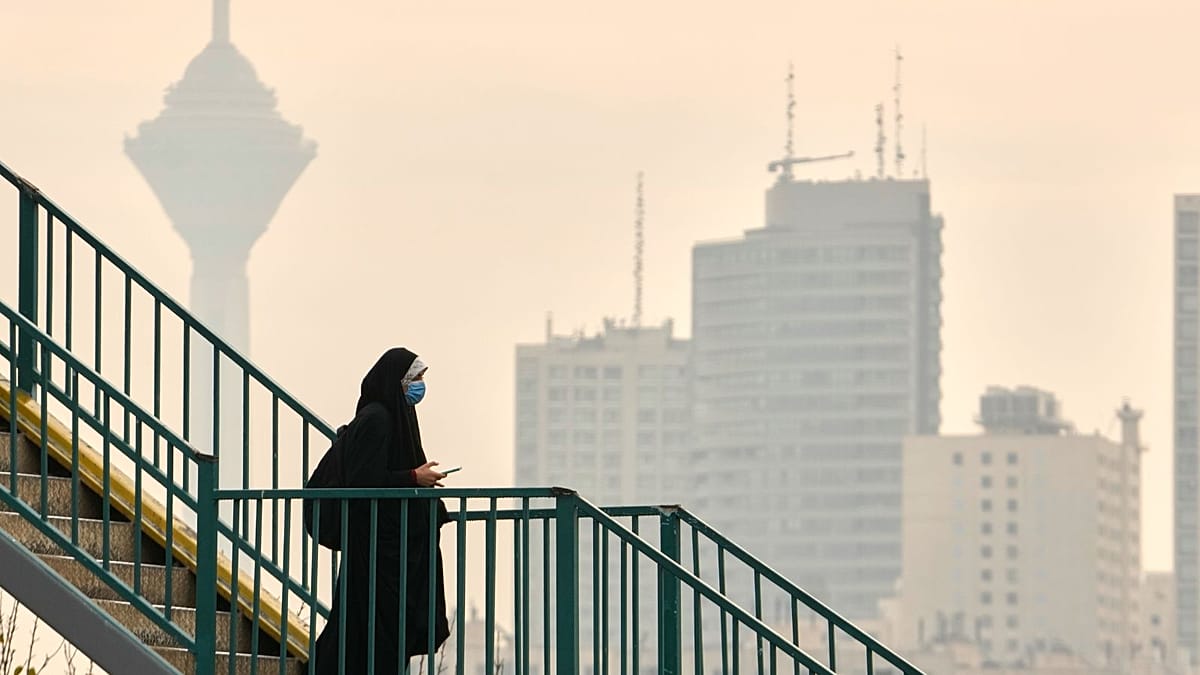
Iran’s 2026 protests erupted after a prolonged period of planned cuts to water and electricity, successive closures of educational and commercial centres, and deadly air pollution in major cities.
Factors such as the surge in the dollar rate, the steep rise in prices of goods and services, and discontent with the political system are frequently cited causes for the unrest – but these don’t paint the entire picture.
This time, the issue goes beyond ‘how to live’ and becomes a matter of ‘how to survive’. What is playing out on the streets today is an alliance between a middle class that has lost its future in the economy and the poor who see their lives at risk in a devastated landscape.
When nature joins the ranks of the protesters
In today’s Iran, geography and the environment are no longer a neutral backdrop: the environment itself has become a threat. Land subsidence in Isfahan and Tehran, the complete drying of wetlands and the onslaught of dust are contributing to visions of a hopeless future.
Iran is confronting multifaceted climatic destruction in which environmental disasters combined with political ineffectiveness are reaching crisis point.
Iran is battling subsidence and water insecurity
According to officials and reports from the National Cartographic Centre, excessive and unsustainable consumption of groundwater has left Iran’s plains in peril.
In some areas, the ground in Iran is subsiding at a rate of 20 to 30 centimetres a year. This is 40 times the average of developed countries and the highest on record worldwide.
Land subsidence has now moved beyond agricultural plains and reached the historic city of Isfahan. Deep fissures in the body of the Imam Mosque and in the bridges over the Zayandeh River signal the physical collapse of Iran’s cultural identity. Subsidence has effectively rendered some parts of the city uninhabitable.
In Greater Tehran and surrounding areas, such as Varamin and Shahriar, subsidence has encroached on international airports, railway lines and refineries.
Official figures indicate Iran’s aquifers face a deficit of 130 billion cubic metres. This means that, even if rainfall returns to normal, water stores will remain insufficient.
Supplies having been siphoned off by industry and inefficient, top-down agriculture, are adding to water insecurity.
Dust storms, fuel shortages and air pollution plague Iranian cities
Cities are also facing worsening air pollution. Despite holding the world’s second-largest gas reserves, Iran faces a gas deficit because of decrepit infrastructure and lack of investment.
The inability to supply clean fuel has led to widespread burning of mazut – a low-quality, heavy fuel oil with high sulfur content – in power plants and industry and.
Households have also been forced to rely on mazut to prevent gas cuts in winter, forcing Iranians to accept toxic pollution in order to stay warm.
Official data show that emissions of sulphur oxides in major cities rise to up to 10 times the legal limit during periods of mazut burning.
But air pollution in Iran’s big cities is no longer just confined to wintertime. In the west and south, dried-out wetlands and lakes have become vast sources of dust storms, creating problems in spring and summer as well. This is compounded by the formation of ozone as a secondary pollutant caused by intense sunlight acting on toxic gases.
According to monitoring stations, the number of ‘clean air’ days in cities such as Tehran, Arak and Isfahan has in some years fallen to fewer than five days in the whole year. That amounts to the removal of the right to breathe for 86 million people.
Health Ministry figures indicate that deaths attributed to air pollution in Iran are approaching 30,000 a year.
The collapse of biodiversity and food security in Iran
The desiccation of thousands of oak trees in the Zagros mountain range and the transformation of pastures into barren deserts have not only driven Iran’s ecosystem towards ruin, but have put the country’s food security on the verge of collapse.
According to natural resources reports, more than 1.5 million hectares (close to 30 per cent) of Zagros oak forests have suffered dieback and decline. This impacts the forest’s natural filtration of water and soil, leading to increased runoff, soil erosion and water contamination.
Each year, around 100,000 hectares of farmland and rangeland in Iran are at risk of becoming absolute desert. Experts also say soil degradation in Iran has now reached a critical level, as the rate of erosion is about three times the global average and the highest among Middle Eastern countries.
Water tensions are escalating in Iran
Although mass population movement towards the wetter northern regions of Iran has not yet occurred, inter-regional tensions over limited water resources have been sparked.
Inter-basin water transfer projects, designed to keep inefficient industries in the central plateau going, have now become centres of friction between provinces.
Beyond provincial disputes, water stress has now infiltrated homes in the metropolises. Citizens face frequent cuts and informal rationing of drinking water, severe drops in pressure and a worrying deterioration in water quality, with higher concentrations of salts and nitrates. This is further eroding trust between citizens and authorities, and risks escalating into local and ethnic clashes.
Power cuts shut off lights, internet and production
Alongside the water and climate crisis, energy imbalance has meant planned, long-lasting power cuts are no longer confined to summertime.
This imposed darkness goes beyond lights switching off. In residential towers in the big cities, power cuts mean water pumps stop, lifts fail and daily life is paralysed. For the more deprived, these blackouts mean the only food stocks in their fridges spoil, imposing heavy financial losses.
For the younger generation who reside largely in the virtual space, power cuts mean loss of access to the internet and VPNs – tools that are their only window to the outside world.
The forced shutdown of factories and production units to compensate for household electricity shortages has triggered a new wave of unemployment and halted production.
How ecological bankruptcy dovetails with class erosion
Ecological bankruptcy is not merely an environmental catastrophe: it is the principal catalyst of the ‘de-classing’ of Iranian society.
Together, land subsidence, water scarcity and city blackouts are prompting the collapse of middle-class living standards and pushing of the poor to the bottom of the poverty pyramid.
When soil erosion annually devours the equivalent of 10 to 15 per cent of Iran’s GDP, national wealth is not lost on international markets but washed away in the soil and buried in silted-up dams.
The landowning farmer, once the backbone of the traditional middle class, has now, with the loss of water and soil, become the foot-soldier of the urban fringes.
Meanwhile, the disastrous energy imbalance and repeated power cuts have dealt the final blow to small-scale production and small businesses. ‘Mandatory blackouts’ of factories and shops are bringing people’s livelihoods to a standstill by gradually whittling away day labourers’ daily income and destroying of the little capital left to middle-class entrepreneurs.
Amid subsidence in the major cities, the white-collar middle class is also facing a drop in the value of their homes, the only asset left after the storm of inflation.
Governance deadlock: The paradox of ideology and survival
This is where Iran’s 2026 paradox is laid bare. Resolving climate crises demands major international investment, water diplomacy and adherence to global environmental standards. But instead of lifting sanctions and deescalating conflict to reconcile with the world and attract investment, ordinary people’s lives are being sacrificed for ideological ends.
Government water handouts or hasty, underfunded schemes cannot fill a gas deficit or empty aquifers. As a result, the environment has become the second front of the conflict, where the enemy is no longer foreign conspiracies, but the unchangeable laws of physics and nature.
Protestors are defending their right to life
What is happening on Iran’s streets in 2026 is not a repetition of previous cycles of unrest; it is the birth of a new political paradigm.
When protesters raise their voices, they are not only calling for bread or civil freedoms, but fighting for the right to breathe, the right to stand on solid ground and the right to have a liveable future. The alliance of diverse groups and social classes is now bound to a merciless ally: scorched earth.
The cost of silence is no longer merely poverty, but death in a geography that is becoming uninhabitable. As such, protesters are defending their right to exist.