
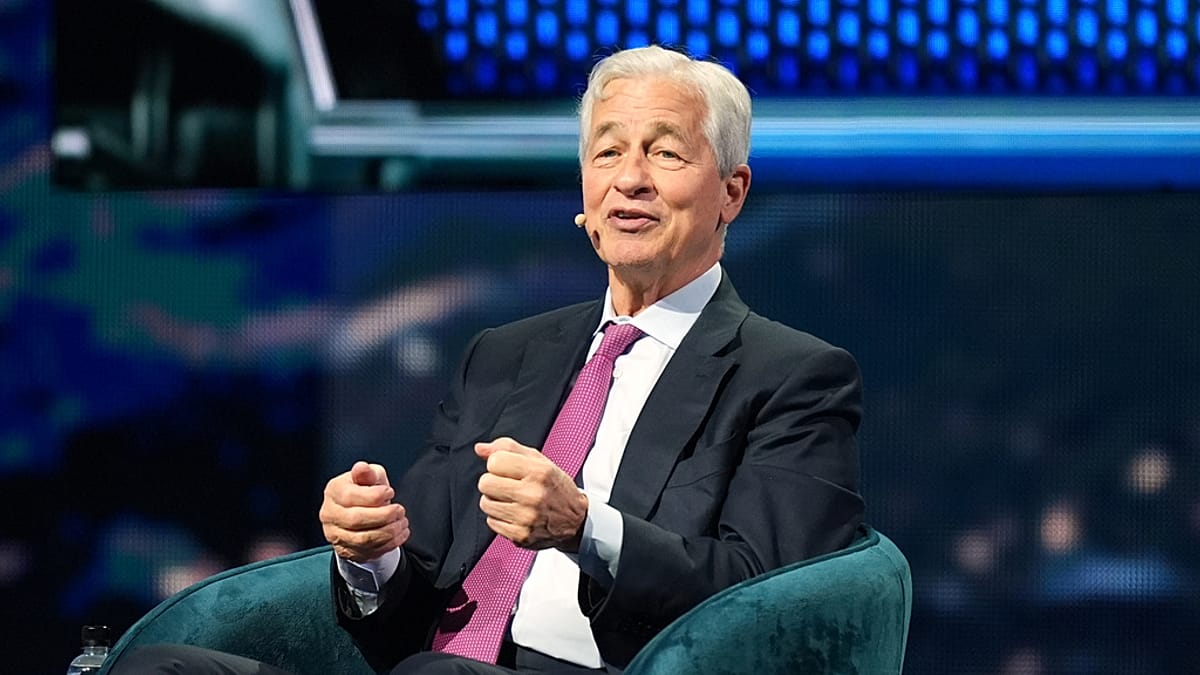
President Donald Trump sued banking giant JPMorgan Chase and its CEO Jamie Dimon for $5bn (€4.26bn) on Thursday over allegations that JPMorgan stopped providing banking services to him and his businesses for political reasons after he left office in January 2021.
The lawsuit, filed in Miami-Dade County court in Florida, alleges that JPMorgan abruptly closed multiple accounts in February 2021 with just 60 days’ notice and no explanation.
By doing so, Trump claims JPMorgan and Dimon cut the president and his businesses off from millions of dollars, disrupted their operations, and forced Trump and the businesses to urgently open bank accounts elsewhere.
“JPMC debanked (Trump and his businesses) because it believed that the political tide at the moment favoured doing so,” the lawsuit alleges.
In the lawsuit, Trump claims he tried to raise the issue personally with Dimon after the bank started to close his accounts, and that Dimon assured Trump he would figure out what was happening. The lawsuit then alleges Dimon failed to follow up with Trump.
Trump’s lawyers also say that JPMorgan placed the president and his companies on a reputational “blacklist” that both JPMorgan and other banks use to keep clients from opening accounts with them in the future.
In a statement, JPMorgan said it believes the suit has no merit.
“JPMC does not close accounts for political or religious reasons,” a bank spokesperson said. “We do close accounts because they create legal or regulatory risk for the company.”
This is not the first lawsuit Trump has filed against a big bank alleging that he was debanked. The Trump Organization sued credit card giant Capital One in March 2025 for similar reasons and allegations.
That lawsuit is still winding its way through the court system.
Feud over credit cards
Trump threatened to sue JPMorgan Chase last week at a time of heightened tensions between the White House and Wall Street.
The president said he wanted to cap interest rates on credit cards at 10% to help lower costs for consumers.
Chase is one of the largest issuers of credit cards in the country and a bank official told reporters that it would fight any effort by the White House or Congress to implement a rate cap on credit cards.
Bank industry executives have also bristled at Trump’s attacks on the independence of the Federal Reserve.
What is debanking?
Debanking occurs when a bank closes the accounts of a customer or refuses to do business with a customer in the form of loans or other services.
Once a relatively obscure issue in finance, debanking has become a politically charged issue in recent years, with a number of conservative politicians arguing that banks have discriminated against them and their affiliated interests.
Debanking first became a national issue when conservatives accused the Obama administration of pressuring banks to stop extending services to gun stores and payday lenders under “Operation Choke Point.”
Trump and other conservative figures have alleged that banks cut them off from their accounts under the umbrella term of “reputational risk” after the 6 January 2021 attack on the US Capitol.
Since Trump came back into office, the president’s banking regulators have moved to stop any banks from using “reputational risk” as a reason for denying service to customers.
Who else has been debanked?
UK far-right firebrand politician Nigel Farage had his accounts with Coutts (NatWest Group) ended in 2023, triggering a major UK “debanking” debate.
An independent review commissioned by NatWest found Coutts had a contractual right to close the account and that the decision was made in line with policies, but identified serious shortcomings in how the decision was communicated and said no adequate reasons were given to Farage.
The controversy contributed to senior resignations and, later, Farage and NatWest reached a confidential settlement in 2025.
Another European far-right leader, Marine Le Pen, had her accounts in Société Générale closed in late 2017.
According to the National Rally — then the National Front —, Société Générale told the party to take its business elsewhere, and HSBC closed Le Pen’s personal account, prompting her to claim political targeting.
The dispute escalated to the Banque de France, and the central bank ruled that the closures of Le Pen’s personal account and the party’s accounts did not violate regulations.
In September 2024, Deutsche Kreditbank also cancelled the accounts and cards of newly elected Alternative for Germany (AfD) Thuringia politician Sascha Schlösser shortly after his state election win.
In 2025, Volksbank closed the accounts belonging to the local AfD chapter, with the AfD district association in Minden-Lübbecke calling the decision “politically motivated”.
Are banks targeting ‘non-liberal’ clients?
Trump, Farage, Le Pen, and the AfD all claim their accounts were closed because of the seemingly left-leaning sympathies of lenders.
Banks involved in so-called “debanking” disputes consistently reject claims that accounts are closed on the basis of political views, arguing instead that decisions are driven by compliance obligations rather than ideology.
Under anti-money-laundering (AML), know-your-customer (KYC), and sanctions rules, banks are required to identify the ultimate source of funds flowing through accounts and assess whether those funds pose legal, regulatory, or reputational risks.
Where large or repeated inflows cannot be adequately explained, or where customers decline to provide documentation requested as part of enhanced due diligence, banks may be obliged to restrict or terminate relationships, regardless of the customer’s political affiliation.
In a number of high-profile cases, banks have pointed to concerns about unverifiable donors, opaque funding structures, or money linked to jurisdictions or individuals subject to heightened scrutiny, rather than to the political positions of account holders.
This could include funding from groups — including sanctioned countries — trying to use these politicians as a means to disrupt or influence a country’s political system.