
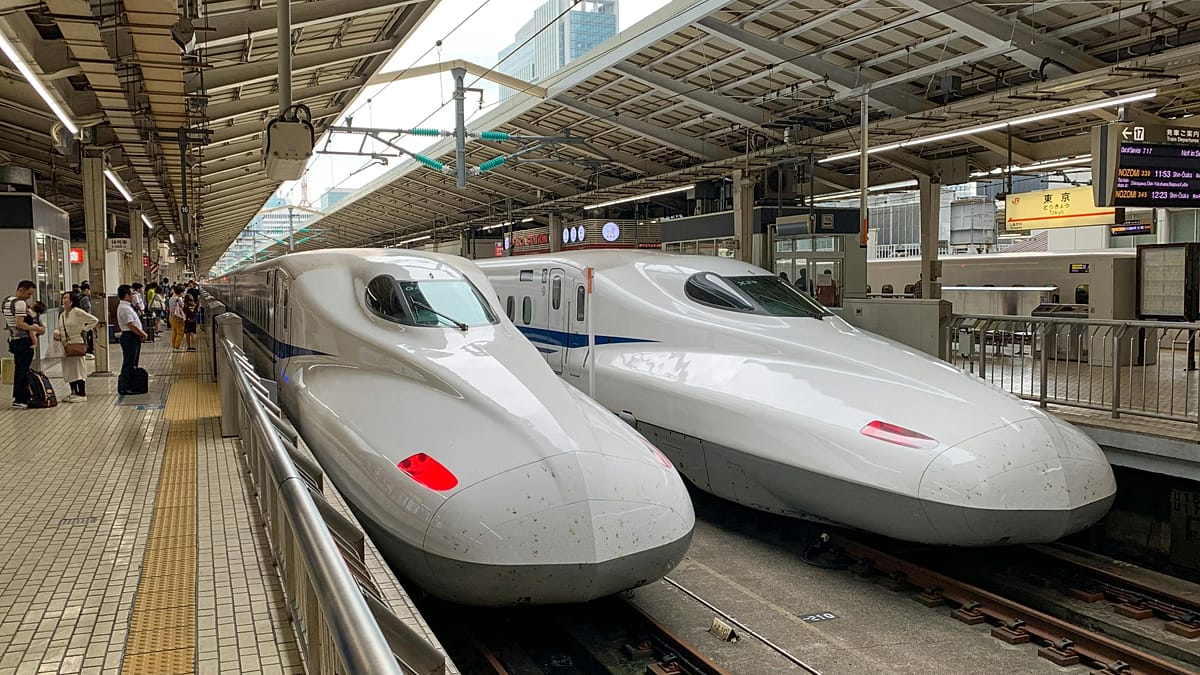
Japan is currently developing the world’s fastest train, the L0 Series, which is a Japanese maglev train being produced and tested by the Central Japan Railway Company (JR Central).
This train is expected to be able to reach speeds of up to 603.5kmh, far surpassing the only commercial maglev train in the world at the moment, China’s Shanghai Maglev, which goes up to 460.2kmh.
In contrast, Europe’s fastest trains, the French TGV and the Italian AGV Italo, have top operational speeds of between 306-354kmh.
Slashing travel time between Tokyo and Nagoya to mere minutes
Usually, a train from Tokyo to Nagoya can take anywhere between one hour and 26 minutes to two and a half hours or more, depending on whether travellers take the faster bullet train (Shinkansen) services, or the slower Kodama or Hikari ones.
However, the L0 Series’ Chuo-Shinkansen line being built at the moment, will likely cut this travel time down to only 40 minutes. A service between Nagoya and Osaka is also expected to be implemented down the line, which will then combine the three cities into a single larger serviceable region.
To give a Europe-based example, this train would reduce the journey time between London and Edinburgh to only 60 minutes – a journey that takes anywhere betweenfour to five hours and 45 minutes on current UK trains.
What makes the L0 Series so fast?
The L0 Series will use magnetic levitation (maglev), a technology that lifts the train above the tracks, allowing the carriages to be propelled forward by another electric motor.
Using both electricity and magnets, this method enables the train to glide through the air at previously unimaginable speeds.
Once deemed commercially operational, the L0 Series train will be able to travel from Tokyo to Osaka in one hour, a journey which currently takes anywhere from two hours 20 minutes to four hours.
Needless to say, this futuristic train needs massive investment, with costs coming up to around £52bn (€59.9bn) so far.
Originally scheduled for completion in 2027, the project has also already been delayed by eight years, with a more realistic inauguration date now likely between 2034 and 2035.
Could this train work in Europe?
Although train enthusiasts will be thrilled to hear about this new development, the real question remains: could this train work outside Japan, in markets like the UK or Europe?
Integrating such a high-speed train in the UK or European market could be a lot more challenging than it appears. This is because these markets typically focus equally, if not more, on user comfort, overall journey experience, luxury and accessibility on train journeys, which are usually prized for their slow, scenic beauty.
Unless linked to purely functional and business travel routes, such as London to Paris, or London to Brussels, this preference could put an ultra-high speed train at an immediate disadvantage in these markets.
Apart from this, a train like the L0 Series would require significant investment, as well as infrastructure support, as it would not be able to run on existing train lines. Most of the line also needs to be through tunnels, which would have to be excavated specially for this purpose.
It is also much more power-intensive than normal UK or European trains, which further bumps up costs. And it has a smaller capacity than most European trains, which would make it harder to break even in terms of costs.