
Uzbekistan will place one of the world’s most dramatic environmental transformations at the centre of its national pavilion at the 61st International Art Exhibition at the Venice Biennale.
Titled The Aural Sea, the project focuses on the Aral Sea, located in Central Asia between Uzbekistan and Kazakhstan.
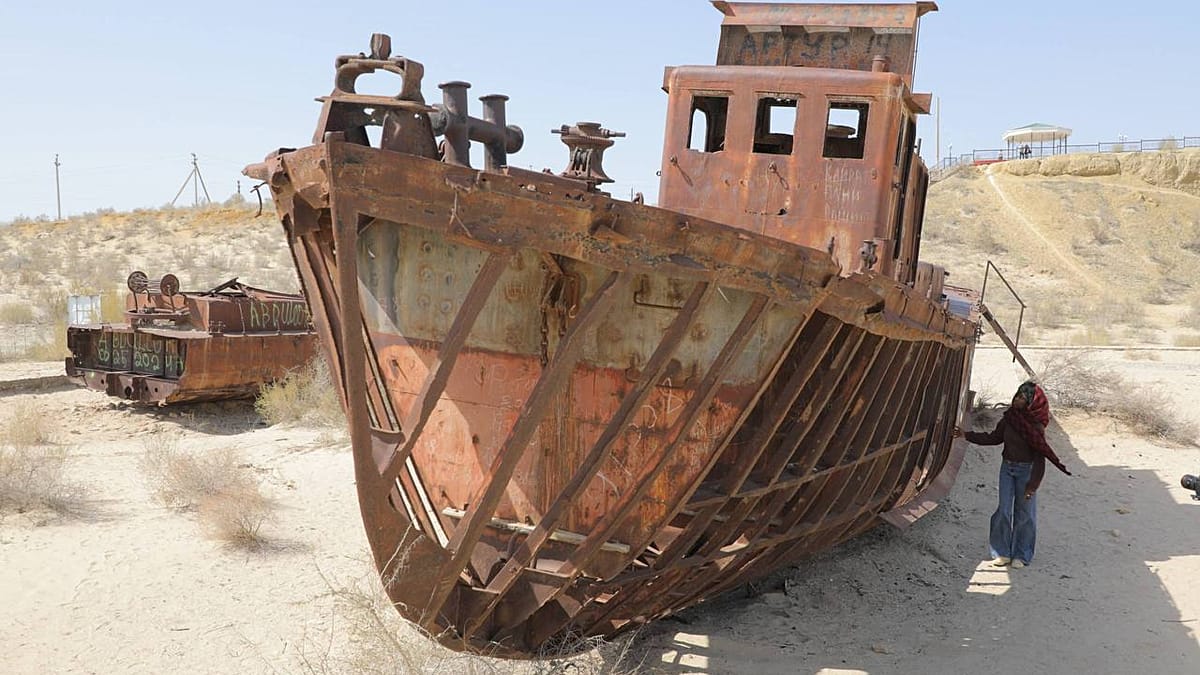
Once the fourth-largest inland body of water in the world, the sea has lost more than 90% of its volume since the 1960s after river diversion projects redirected the Amu Darya and Syr Darya for large-scale irrigation. What was once a vast fishing economy has largely become a desert.
Rather than revisiting the crisis solely through data and environmental loss, Uzbekistan’s pavilion approaches the Aral region as a cultural and imaginative landscape. Responding to the Biennale’s overarching theme, In Minor Keys, the exhibition invites visitors to consider listening to memory, to myth and to communities that continue to live with ecological change.
Beyond catastrophe
Commissioned by the Uzbekistan Art and Culture Development Foundation, the pavilion reframes the Aral Sea not only as a symbol of environmental collapse but as a site of knowledge and resilience.
The project centres on Karakalpakstan, the autonomous republic in north-western Uzbekistan where much of the former seabed now lies. Artists examine how folklore, oral histories and collective memory can help societies process environmental transformation and envision possible futures.
Uzbekistan’s participation marks its third appearance at the Venice Biennale and forms part of a broader cultural and research strategy focused on the Aral region. Initiatives such as the Aral Culture Summit and the interdisciplinary Aral School bring together artists, scientists and local communities to develop long-term cultural infrastructure and sustainable approaches for the region.
An international curatorial platform
The pavilion is curated by an international team formed within the Curatorial School of the Bukhara Biennial and led by artistic director Diana Campbell. Participating artists from Uzbekistan, China, Vietnam and other countries work across disciplines including scientific modelling, textile art and contemporary craft.
According to Gayane Umerova, Chair of the Uzbekistan Art and Culture Development Foundation, the pavilion reflects sustained investment in cultural research and interdisciplinary collaboration. By connecting emerging curators, local practitioners and international voices, the initiative seeks to shape both cultural and ecological conversations around the Aral basin.
In parallel with the national pavilion, artist Vyacheslav Okhunov will present an exhibition at Palazzo Franchetti as an official collateral event of the Biennale.
Why the Aral Sea matters now
The pavilion’s scenography and spatial design are being developed by young architects and students from leading Uzbek institutions, including the Tashkent Architecture and Construction Institute and Adju University, under the guidance of GRACE studio. The design aims to echo the changing character of the Aral landscape.
Although the Aral Sea’s shrinkage began decades ago, it remains one of the most cited examples of large-scale human impact on ecosystems. Its transformation has influenced climate patterns, public health, migration and regional economies. In recent years, restoration efforts in parts of the northern Aral have drawn renewed international attention.
By bringing the Aral Sea to Venice, Uzbekistan places a regional environmental history into a global cultural forum. The pavilion suggests that ecological crises are not only scientific or political questions, but also cultural ones.
The Aural Sea will be on view at the 61st International Art Exhibition of the Venice Biennale from 9 May to 22 November 2026.