
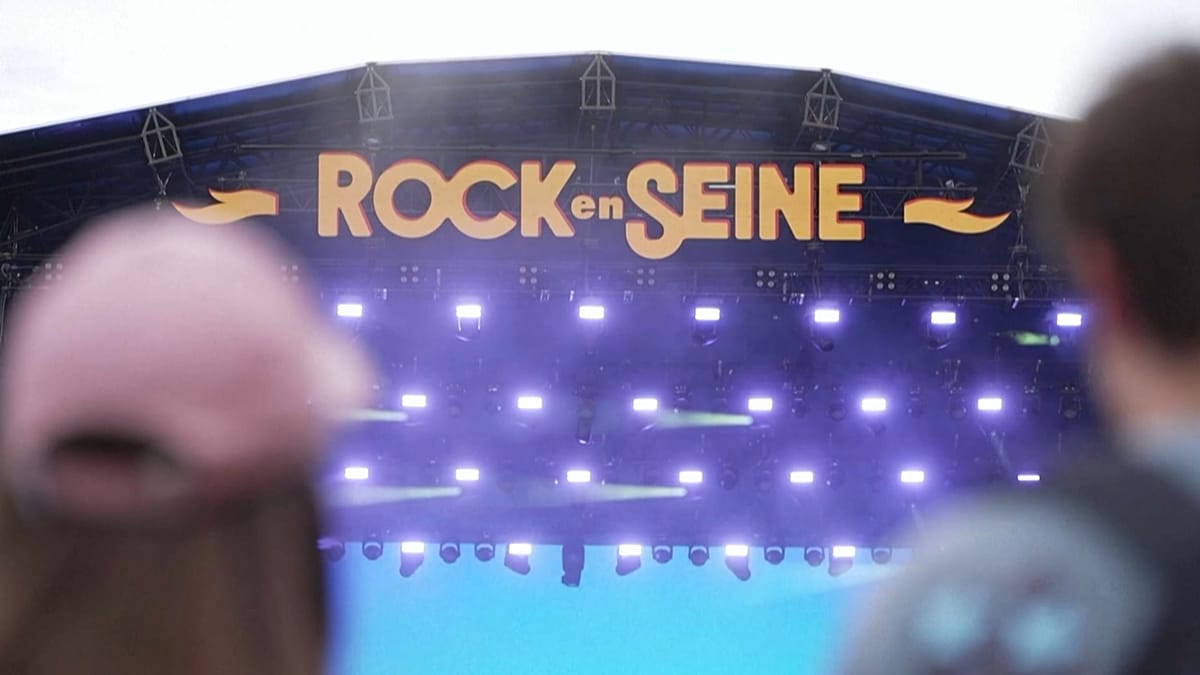
At the Rock en Seine festival (source in French), just outside Paris, music is not experienced only through the ears. The lights, the artists’ gestures, the way they move around, their expressions and the audience’s reactions all contribute to the experience of a concert. Visual elements that nonetheless remain inaccessible to blind or partially sighted spectators.
For the first time in its history, the festival is this year offering concerts with live audio description. One concert a day on the Grande Scène makes use of the system set up with the Valentin Haüy Association: Miki, Djo, Nick Cave & The Bad Seeds, Amyl & The Sniffers and The Cure.
On a dedicated platform, festivalgoers wearing headphones hear the voice of an audio describer live. But it is not about commenting on every second of the show. The job is to step in at the right moment, without covering the music or the lyrics.
“I am the eyes of spectators who cannot see“, explains Raphaëlle Valenti. A voice actor, writer and trainer in audio description, she founded the company ZeugmaConcepts, which is dedicated to developing this practice. She trains new audio description writers in particular and has been working for several years to make cultural content accessible.
“I mustn’t force myself on the audience, I mustn’t speak over a moment of emotion from the singer, for example“, she goes on. Her role is to seize the moments when she can intervene to convey the essential visual information: the artist’s movements, their position on stage, their expressions, their gestures. “I am going to say all that to convey the emotion.”
It requires intense concentration: she has to watch the stage, understand what is happening there and find the right words at the right moment. Audio description becomes a form of live narration, which must remain discreet so that the music can take up all the space it deserves.
A first experience that is proving very popular
For Saliha, a partially sighted spectator, the experience is a revelation. “She has a pleasant voice to start with… she was my eyes, I knew absolutely everything that was going on, it was brilliant.” But the exercise also requires finding the right balance: “On the one hand there is active listening to the description that is being given and on the other hand, if I want to listen to the lyrics, it’s complicated.”
A “gymnastics” that does not stop her enjoying her return to the world of festivals to the full. “It’s been so many years since I’ve been to a festival that now I fully intend to have a blast,” she smiles. “Because it’s a system that is just… wow!”
Audio description is therefore not meant to replace the music, but to convey what goes with it: a change of lighting, an artist moving across the stage, an expression, a gesture, an interaction with the audience. Everything that helps to make a concert a live performance.
On stage, the artists keep on singing, the lights dance and the audience continues to vibrate. In the headphones, a voice puts images to the music.
For those who cannot see them, the concert is told in a different way. But the emotion is still the same: being there at last with the rest of the audience and enjoying the show.