
Polish satellite maker Creotech Instruments plans to increase its production capacity tenfold by 2029, CEO Grzegorz Brona said in an interview with Reuters. He also warned that Europe will still need US rockets to launch its satellites into orbit for years.
The satellite maker is aiming to open a new factory in 2029 in Mazowieckie, Poland, capable of making 40 satellites a year across different models, or 100 of a single model. This compares with 10 at its current site in Piaseczno, just outside Warsaw.
The comments come at a time when Europe is trying to reduce its reliance on US technology.
Two days before the interview, reports emerged that Elon Musk’s SpaceX had been ordered to limit Ukraine’s access to Starshield, its military-grade version of the Starlink satellite network, by the White House.
Donald Trump has since said: “It wasn’t me, and I don’t think it was Elon. I don’t know if it was anybody. From what I understand, it’s the same as it’s always been.”
The lack of clarity over who was responsible for the decision is one concern. But for European leaders, the prospect of the Trump administration using US technology as political leverage against its allies is even more alarming.
Europe lags far behind the US in rocket launches, accounting for just eight of the world’s 324 orbital launches last year, compared with 193 by the US. Starlink alone accounts for more than 60% of active satellites, according to European Space Agency data.
Asked whether European industry could build an alternative to Starlink, Brona said the continent could produce thousands of satellites and still have no one to launch them.
“Launch vehicles are now becoming a means of political pressure on the European Union in the hands of [US President] Donald Trump’s administration,” he said.
Creotech, which does not build rockets, has kept US technology out of its satellites to avoid US arms export rules. Under these rules, Washington can block sales of satellites containing even a small American component.
Yet the company still relies on US rockets. SpaceX carried all four satellites Creotech built for Poland’s MikroGlob military programme into orbit.
Europe seeks to increase launch capacity
Europe is trying to expand its launch capacity in several ways.
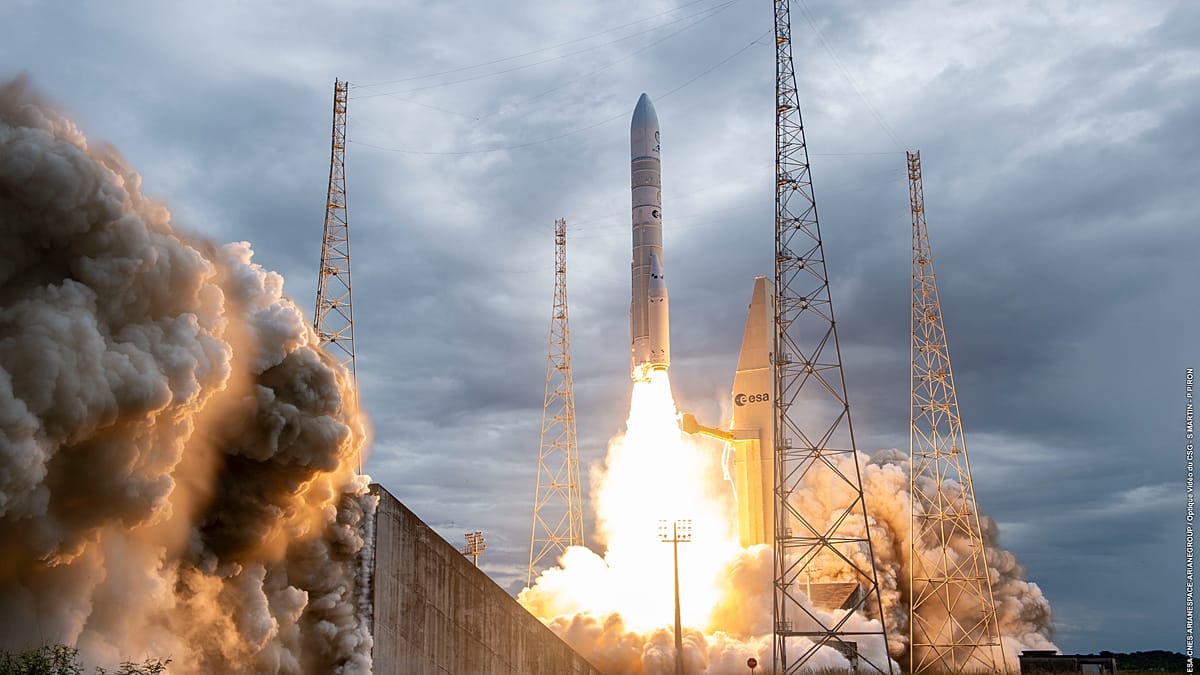
The European Space Agency (ESA) announced in September that it was considering increasing the number of launches of its Ariane 6 and Vega-C rockets in the coming years to overcome a potential bottleneck in satellite deployments.
ESA Director General Josef Aschbacher said a decision was needed soon ahead of an expected sharp rise in demand.
Arianespace, the operator of the Ariane 6 rocket, is planning nine or 10 launches a year from 2027.
Meanwhile, European Commissioner for Defence and Space Andrius Kubilius has said the EU wants to increase the number of government satellites from 80 to 630 and carry out 62 launches annually by 2034 from sites in Europe and Canada.
The plans are intended to meet anticipated demand from the EU’s Galileo navigation and Copernicus Earth observation satellite programmes.
Aschbacher has also proposed a €10 billion, 10-year plan to develop an independent European crew vehicle and launch recovery system before the International Space Station retires at the end of 2030 or early 2031.
In March, the ESA launched the European Launcher Challenge to support private companies and start-ups developing launch services.
These efforts include plans for commercial spaceports such as SaxaVord in Scotland and Andøya in Norway, while companies including Isar Aerospace and Rocket Factory Augsburg aim to expand small-to-medium-lift launch options.
Creotech plans further expansion
Creotech Instruments currently makes small satellites and microsatellites, typically weighing between 10 kg and several dozen kilos, using its proprietary Hypersat modular platform family.
Its satellites include the HyperSat Earth observation platform, its Seagull, Eagle 2.0 and Nano 2.0 models, the PIAST Constellation and the MikroGlob Constellation, built for the Polish Armament Agency and launched this month.
The company also works with the ESA and has contributed platforms and subsystems to missions including Comet Interceptor, JUICE (Jupiter Icy Moons Explorer), LISA (Laser Interferometer Space Antenna), the Plasma Observatory and the Twardowski lunar mission to map the Moon’s surface.
Brona added that Creotech would start opening subsidiaries in France and Germany in the coming weeks and was aiming to build 500 kg satellites by 2032.