
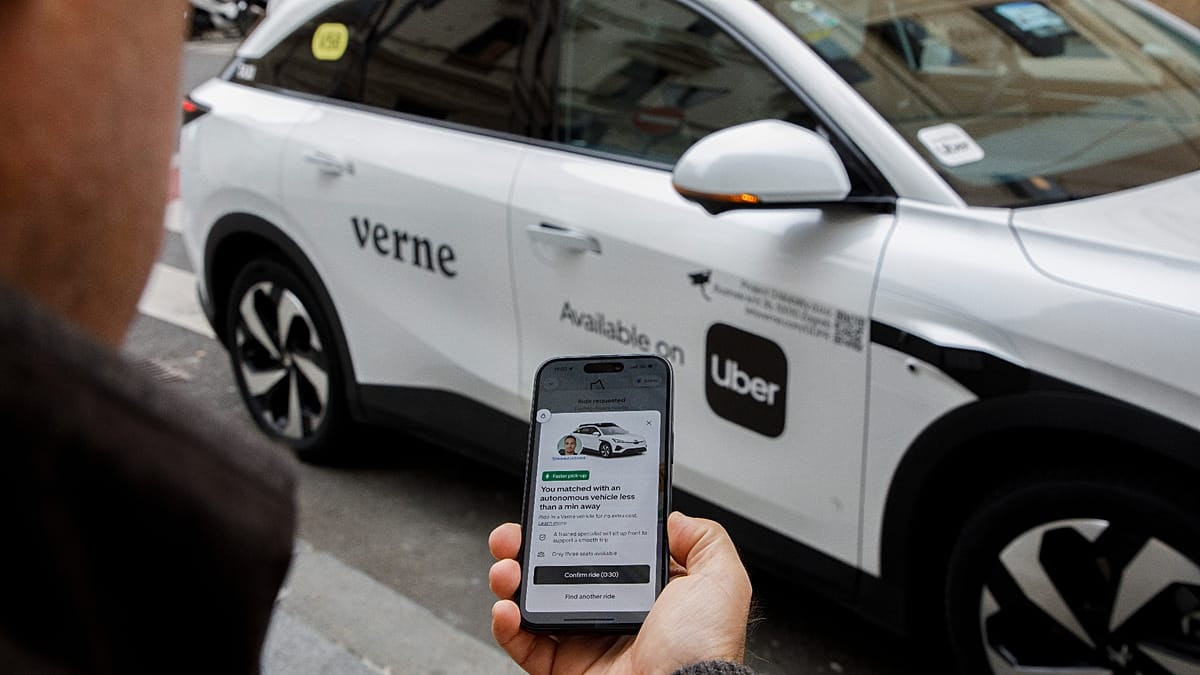
Uber launched a driverless taxi service in Zagreb, Croatia, earlier this year and has now unveiled plans to roll out a fully autonomous vehicle service in a host of European cities with partners across the continent, starting with Manchester.
The US tech company deployed driverless robotaxis on the streets of Zagreb in April in partnership with local service operator Verne and Chinese AI firm Pony.ai in a business model they want to scale up across the continent.
It is an odd partnership given the divergent philosophies at play in Europe, the US and China, with Europe being particularly cautious compared with the latter two. But the companies believe the partnership works thanks to their shared ambition to deploy autonomous vehicle taxi rides around the world.
The partnership is one of more than 30 Uber runs across Europe. Together with Verne and Pony.ai, Uber has begun tests in Manchester, and Pony.ai and Uber plan to launch in London, with many more cities in the pipeline.
The Zagreb partnership is the most advanced and was announced in March, in a move that aimed to bring driverless taxis out of testing grounds and onto the market in Europe for the first time.
Zagreb was a particularly appealing candidate city for Uber, as it is home to electric hypercar maker Rimac, whose founder Mate Rimac had already branched out into robotaxis through Verne. Verne has its own plans to roll out a “business class” form of autonomous vehicle mobility service.
In April, the partnership launched its robotaxi service, giving users in Zagreb the chance to order a driverless vehicle for their journey. These cars still have a human in the driving seat, known as a safety operator, who oversees the trip as a security measure. Safety operators are usually former taxi drivers.
The service’s vehicles have since clocked up 200,000 kilometres on Zagreb’s roads.
Now the partnership feels confident enough to take the next step and remove the operator from the car, leaving just you, the passenger, alone in the vehicle.
Europe’s first fully driverless trips began on 10 September, open to a limited number of invited users on a 22-kilometre route linking Verne’s headquarters with Zagreb’s Franjo Tuđman Airport.
‘Look, no hands’
Ordering an Uber with the currently available driverless ride service is just as simple as booking any other trip with the platform. Users can choose between human-driven and AI-driven robotaxi rides when requesting UberX or Comfort journeys.
Riders can unlock the car with their phone, get in and get comfortable, or as comfortable as possible in a car with no one driving, but with full access to Uber support should anything happen.
In Zagreb, riders travel in the BAIC Arcfox Alpha T5, a Chinese electric SUV. A human safety operator sits in the driving seat, and the front passenger seat has been removed to make more space for luggage.
Uber and Verne currently run about 30 autonomous vehicles in Zagreb, which return each night to a central hub called a “mothership” for cleaning and maintenance by the Croatian startup.
The current setup is what is known as a level 4 driverless car programme, which means the car can drive itself without human interference, but only in strictly controlled areas. Nowhere in the world runs a level 5 programme, which means unrestricted road access.
It is a strange feeling seeing a car drive itself for the first time. From the rear passenger seat, you can see the steering wheel spinning as the car makes a turn calmly and methodically, even while negotiating oncoming traffic.
The smooth ride puts you at ease, and after a while you forget that it is not a person but an AI driving you to your destination.
“We call it a little bit magically boring, meaning, you get in and first you’re like ‘oh, no one’s hands are on the wheel’ and then all of sudden you’re in a car like you normally would be,” said Annie Duvnjak, global head of autonomous mobility operations at Uber.
That is not to say the ride is free of interruptions. The car comes to a complete stop at every stop sign, even when the road is empty, and it pulls over to avoid overly aggressive human drivers trying to overtake.
It is a learning process for the partnership, which is testing fully driverless vehicles, its end goal, in a limited area of Zagreb.
A unique partnership
The partnership, launched in April, is a unique combination of an American mobility firm, a European startup and a Chinese AI company, with each organisation coming from regions with wildly differing approaches to mobility and AI.
Given these divergent approaches and the current geopolitical friction on issues ranging from trade and consumer rules to technological sovereignty and supply chains, it may seem surprising that these companies have joined forces.
But Uber says the model works because the three companies share a common goal of bringing autonomous taxis to more markets.
“You have Verne, which is an incredible local company in Zagreb, with fleet expertise and vehicle operations and then you Pony.ai, which has world-class AV technology, and you have Uber which helps bring that all together in terms of the mobility platform, rider experience,” said Duvnjak.
“So, it’s really everyone’s bringing the best of what they do coming together.”
Verne, the European partner in this venture, was co-founded by Mate Rimac and is named after the sci-fi writer Jules Verne. It has been working on robotaxis since 2019 and launched its own service in April.
Verne acts as the local service operator and fleet owner, managing the day-to-day operations of the robotaxi service. It also serves as the regulatory lead, talking to local, regional and national authorities to secure legal approval for autonomous vehicles on the road in these areas.
This is perhaps the biggest obstacle facing the partnership. Europe’s patchwork legal framework governing driverless cars has left the continent lagging far behind the US and China, where robotaxis have operated commercially for several years.
The partnership with Uber gives Verne the opportunity to scale up its operation by offering its services through the app and bring them to other cities across Europe as the roll-out expands.
“This is an important milestone not only for Verne, but also for Croatia. A service pioneered here in Zagreb is now available through the world’s largest mobility platform. The experience we are gaining every day in Zagreb will help us bring Verne to other European cities,” said Marko Pejković, the CEO of Verne.
In June 2024, the Croatian company unveiled its own autonomous two-seater concept car aimed at business travellers.
“We want people to be impressed when you arrive in one of these vehicles,” said Pejković.
It is a long, sleek vehicle with enough room for the seats to recline fully while driving. A huge dashboard screen entertains and informs passengers during their ride.
Despite its more luxurious appearance, the company says rides will not come at a premium, because removing the driver cuts costs significantly.
“We are introducing a completely new vision for the vehicle interior, one designed not as a concept for the distant future, but as something that can work in real service. It will help people use their time in a way that is more productive, more enjoyable, and more relaxing,” said Pejković.
The company plans to roll out the vehicle in future but, for now, uses the BAIC Arcfox.
A driving school for AI agents
The third partner in this venture is Chinese AI firm Pony.ai, which provides the artificial intelligence technology that drives the vehicles.
The company also brings a lot of experience in the sector. Pony.ai says it was the first autonomous vehicle company to secure a taxi licence in China, and it is one of the few companies globally operating fully driverless commercial vehicles.
In Zagreb, the Arcfox vehicles are equipped with Pony.ai’s Gen-7 autonomous driving system, its latest level 4 autonomous driving kit.
The kit includes 34 individual sensors. Among them are nine LiDAR sensors, 14 cameras and four millimetre-wave radars, as well as four microphones, two water sensors and one collision sensor. Together they give the vehicle considerable awareness of its surroundings and enough redundancy to reduce the chance of accidents.
Driving the car is the Pony.ai Virtual Driver, which treats the vehicle like a physical AI agent. But before an AI agent can hit the road, it must first drive in a virtual environment.
“It’s like a virtual training ground, that shows the AI how to drive. It’s like how humans learn to drive is how the AI drivers learn to drive in that environment. Then, after it graduates the ‘virtual driving school’, the AI drivers take control, so we don’t rely on any remote control,” said Dr Ludi Wang, director of global communications at Pony.ai.
Next steps
Uber announced this week that the partnership’s next city will be Manchester, in the UK. Tests are already under way in the city, and Uber says a service like the one in Zagreb will follow in the coming months.
In total, Uber is considering more than 30 cities and has schemes at various stages in London, Madrid, Munich and Zurich.
“And we hope to expand this model to other cities as well. So we’ve announced Manchester, where we’ll be coming next with this partnership, and so, more to come from there,” said Duvnjak.
But could Brussels be next?
“We’re actually talking to Brussels, we’re talking to 30 cities and Brussels is one of those cities. But we don’t want to roll out tests in a city if we don’t see it as an option in the future to fully roll out a driverless service as the end goal. But Brussels is definitely on the map,” said Pejković.