
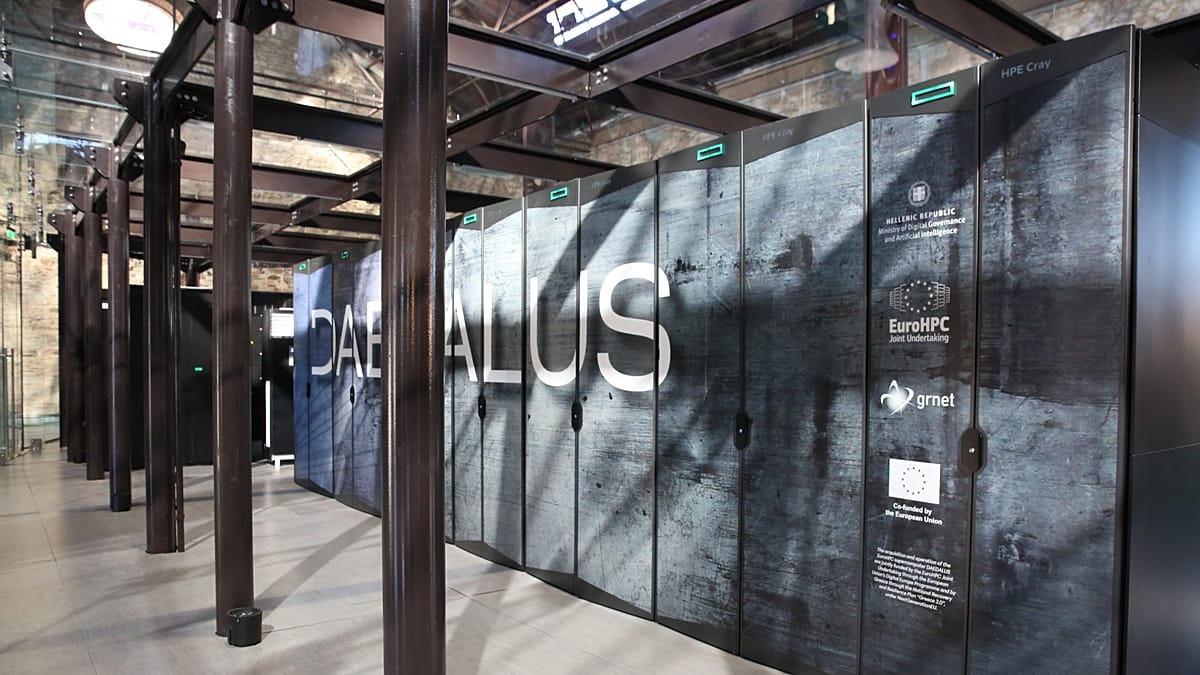
Greece is entering a new phase in the development of high-performance computing infrastructure with the launch of Daedalus, the most powerful supercomputer ever installed in the country.
Backed by an investment of 58.9 million euros and performance figures that, according to available data, place it 31st worldwide, the system inaugurated in Lavrio (Attica) aims to bolster domestic technology production and reduce reliance on overseas computing facilities.
The significance of the project goes beyond the power of the equipment. Daedalus creates the conditions for universities, research centres, businesses, public bodies and health organisations to develop and train advanced Artificial Intelligence (AI) models, process large volumes of data and carry out complex computing projects on infrastructure located in Greece.
Particularly important is the ability to process sensitive or confidential data within the country, under the prescribed security and personal data protection safeguards.
This feature could prove crucial for applications in medical research, public administration and sectors where data handling is subject to strict constraints.
Daedalus’ position in the European computing infrastructure
With a measured computing power of 85.69 petaflops, that is roughly 85.69 quadrillion floating-point operations per second, Daedalus is capable of supporting demanding AI model training, simulations and advanced data analytics.
Its global ranking is an indication of the country’s technological upgrade. However, assessing its position relative to other European supercomputers requires a distinction between systems of different scale and purpose.
Europe hosts extremely high-performance infrastructures, including exascale-class systems with power exceeding one exaflop, that is 1,000 petaflops.
Daedalus is not designed to compete directly with the largest European installations in terms of absolute computing power.
Its value lies mainly in giving Greece access to substantial computing resources, supporting specialised applications and integrating into a broader European ecosystem of AI infrastructures.
For the domestic research and business community, having such an infrastructure can lower barriers to accessing computing resources, facilitate the development of technology products and strengthen cooperation with European research networks.
At the same time, Greece gains greater capacity to set its own priorities in developing Artificial Intelligence applications.
The focus on energy efficiency is underscored by the fact that, according to the Green500 ranking of June 2026, Daedalus ranked 23rd worldwide among supercomputers on the basis of their energy performance.
Liquid cooling and Nvidia technology
The system is based on Nvidia Grace Hopper GH200 technology and uses liquid cooling, which helps manage the thermal loads generated by high-performance equipment during operation.
It has been installed in the historic building of the former power station at the Lavrio Technology and Cultural Park, which operates under the responsibility of the National Technical University of Athens.
The National Infrastructures for Research and Technology (EDYTE – GRNET) has taken on the management and technical operation of the system and is also responsible for delivering the project.
Hewlett Packard Enterprise supplied and installed the computing equipment under a budget of 41 million euros, while Mainsys carried out the electromechanical installations and configured the data centre, with a budget of 17.9 million euros. The amounts include VAT.
Funding comes from the Recovery and Resilience Facility and the European High-Performance Computing Joint Undertaking (EuroHPC).
Pharos AI Factory: bridging the gap to the market
A decisive role in bringing Daedalus to the business community is expected to be played by Pharos AI Factory, the Greek Artificial Intelligence factory, which is among the first seven similar initiatives selected by the European Union.
With a capacity of 85.69 petaflops, Daedalus opens up new possibilities for developing advanced Artificial Intelligence models in Greece.
Its position within Europe’s computing infrastructure, its ability to process sensitive data inside the country and its interconnection with Pharos AI Factory create a new space for research, innovation and entrepreneurship.
According to the current planning, broader service provision to businesses is scheduled to begin in March 2027, once the period of technical testing and system configuration has been completed.
Access will combine computing resources with advisory support and services that facilitate the transition from research to commercial exploitation.
Start-ups and small and medium-sized enterprises are expected to be able to use computing power without charge, within the limits set by European state aid rules.
For larger companies, charging based on the time spent using computing resources is being considered. The final access conditions, detailed services and pricing policy have not yet been finalised.
The planned service package includes guidance on adopting Artificial Intelligence, support for the commercial exploitation of applications, access to collaboration networks and business acceleration programmes.
It also envisages secure testing environments, infrastructure for deploying applications in production, access to AI models, selected datasets and open data.
For the commercial exploitation of the initiative, the company Hellenic AI Factory S.A. has been established, in which the Hellenic Corporation of Assets and Participations (the “Superfund”) holds a 70% stake, while the remaining 30% belongs to the Ministry of Digital Governance and Artificial Intelligence.
Planned actions include a training programme on developing AI agents, in cooperation with Endeavor Greece and Nvidia.
The programme, scheduled for 10 November, is expected to host 45 selected participants, who will be trained in creating digital agents, linking them to large language models and using related tools through practical exercises.
A second supercomputer in Western Macedonia
In parallel, planning is advancing for the development of a second supercomputer at the University of Western Macedonia in Kozani.
The EDYTE board has approved the launch of a public consultation on the tender for the supply and installation of computing equipment, storage systems and software, with a budget of 21.57 million euros, including VAT.
The amount concerns this specific sub-project and not the entire investment. For that reason, a revision of the budget and an update of the timetable are expected to be examined by amending the inclusion decision.
The new system is designed to operate in a green data centre, integrated into EDYTE’s RE-Cloud network, with an emphasis on Artificial Intelligence, cloud computing services and the analysis of sensitive data.
The plan envisages IT infrastructure with power of between 1.2 and 1.5 MW, as well as a photovoltaic installation with capacity of more than 2 MWp.
The sub-project is financed by the Just Development Transition Programme, and the planned duration of the contract’s implementation is 12 months from the date of signature.