
The general consensus right now is that AI is going to transform every industry across the world, improving outcomes and efficiency. But how will that manifest in health?
Can AI integrate seamlessly into our current healthcare models? And will our health and data be safe?
In this episode of The Big Question, Angela Barnes is joined by Dr Ricardo Baptista Leite, CEO of HealthAI, the global agency for responsible AI in health.
Can AI save healthcare from collapse?
“AI presents to us an opportunity to ensure that everyone can have access to the health they need,” Ricardo told The Big Question.
But it’s not quite as simple as just adding AI into workflows and everything suddenly works much better.
“If you retrofit AI into our current models of care, you have a risk of becoming very efficient at being inefficient.”
Current healthcare systems are reactive, focused on treating illness and disease. In many health policy discussions, not just around AI, there’s an argument towards shifting our focus to prevention and the improvement of general health. This would hopefully lead to a reduction in illness, days off work and lost productivity, therefore benefiting the overall economy.
According to Ricardo, we won’t gain the benefits of AI in reducing the burden of disease with this change in approach.
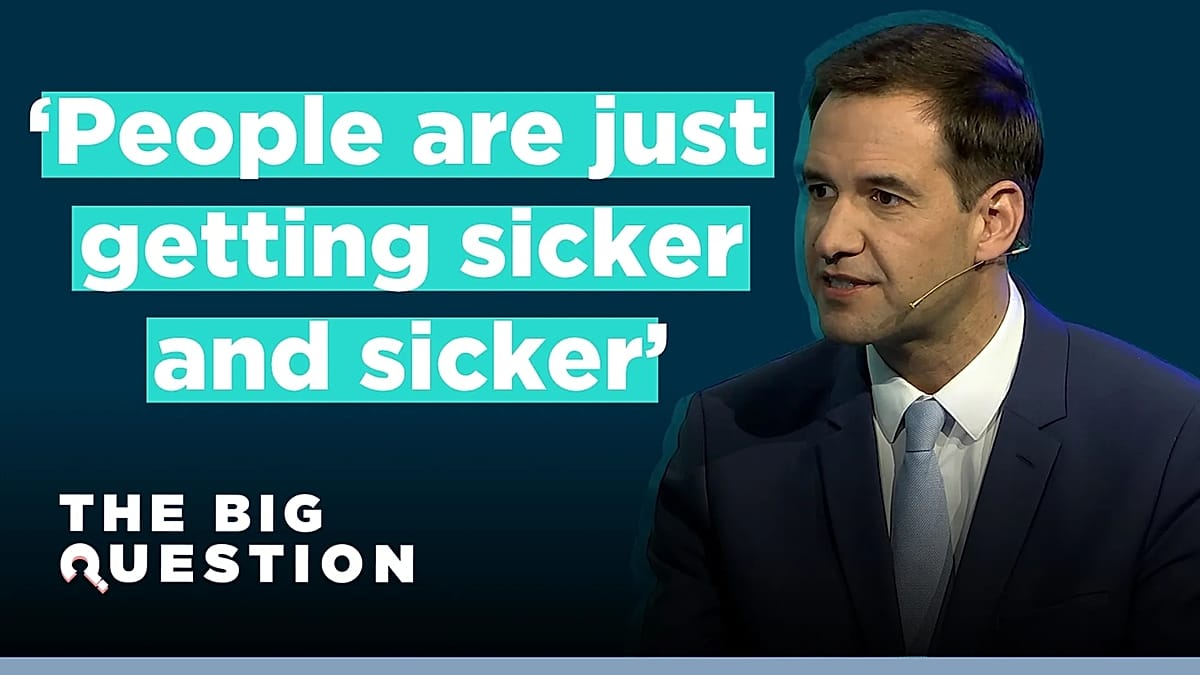
“If we don’t do anything, our health systems are going to collapse,” he said. “They are not sustainable. People are just getting sicker and sicker.
“We’re seeing a population that is getting older and with multiple morbidity. And so if we do not change the system completely, we will not be able to have the resources to make sure everyone will have access to the health they need.”
Where can AI help with healthcare?
Though Ricardo would like a greater systemic change to see real progress driven by AI, it’s not to say AI isn’t already creating waves in health.
“Even during COVID and the development of new vaccines, almost every company was using some forms of AI,” he explained.
“We’re seeing AI across the research and development, diagnostics, imaging technology – every field of imaging right now is using some form of AI – the treatments, robotics, and surgeries.
“When we think about virtual assistants – virtual scribes supporting doctors in clinical decision making – even when we talk about the non-clinical aspects of healthcare in terms of fraud detection, financial claims with insurances, all of these fields have the potential of improving in terms of outcomes, be it in terms of cost saving, but also in terms of efficiency, in terms of improving health outcomes.”
Who needs to invest in AI for greater healthcare outcomes?
“Billions are being invested in research and development, but who is going to pay?” Ricardo questioned.
“Well, if we want to make sure that this technology reaches everyone and not just a privileged few, health systems and insurances will have to step up.”
Where the healthcare industry in the US is driven through private investment and China’s is state-driven, Ricardo thinks Europe has an opportunity to hit a sweet spot of private-public partnerships.
He also stressed that assessment models for financial support need to be improved in order to ensure the technologies being funded will actually work.
“I met a company that had an amazing imaging technology to detect breast cancer. It had the capacity to detect imaging several years earlier than the human eye. And so we’re talking about saving lives here.
“The company went bankrupt and the reason was because the governmental regulator at the time responsible for reimbursement of the technology told them that they would take seven years to assess the technology before they could consider reimbursement.
“It’s not just about the technology, it’s making sure that you choose the technology that can transform the system but also creating a model in which it can scale and the reimbursement and health technology assessment is critical in that aspect.”
Who is accountable for AI in healthcare?
Improving health outcomes through AI also requires a lot of trust, from both patients and professionals.
“Where there is hesitancy in the adoption of artificial intelligence, almost consistently, it is the healthcare professionals who are not adopting the technology, either due to lack of trust – they don’t understand the technology and therefore they don’t trust the clinical decision support tools – or because they are fearful of legal liability,” he said.
In most jurisdictions, healthcare professionals are the ones liable for any errors and so Ricardo pressed that AI should be used to augment or compliment human work in most cases.
He explained, however, that for certain uses, the accuracy rating of AI usage is proving much higher than human-only intervention, particularly in the assessment of scans and imagery.
“This is a market where the technology will not scale if we do not trust it,” he said. “The only way to trust technology, especially for citizens and healthcare professionals, is if you have the proper regulatory environment in place, the proper governance in place.”
The Big Questionis a series from Euronews Business where we sit down with industry leaders and experts to discuss some of the most important topics on today’s agenda.
Watch the video above to see the full discussion with HealthAI’s Dr Ricardo Baptista Leite.