
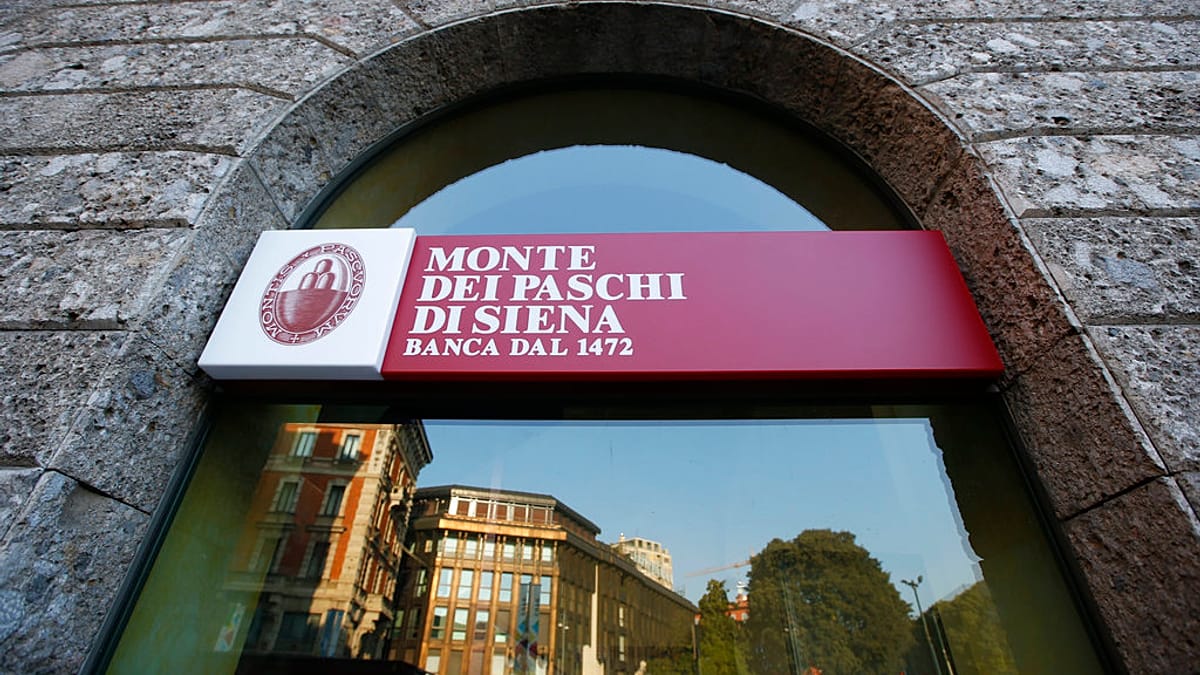
The story of Monte dei Paschi di Siena’s (MPS) takeover of Mediobanca — involving two of the main players in the Italian banking system — is a complex web of financial manoeuvres, political decisions, and judicial interventions.
The government’s support for the creation of a new banking powerhouse has sparked fierce political debate, accusations against the Ministry of Economy, and suspicions about the transparency of the operations.
In 2017, MPS was rescued with state funds, and regulations at the time prohibited it from using public money to buy other banks. The European Commission now says that restriction has ended, which legally allows MPS to attempt acquisitions like Mediobanca.
Prime Minister Giorgia Meloni declared in January that the takeover would lead to the birth of a third banking powerhouse in Italy, which could “play an important role in safeguarding Italians’ savings”.
A clear government endorsement, then, but the objectives may extend beyond protecting citizens’ assets. According to opposition parties, the state supported takeovers by groups seen as aligned with the ruling party’s interests, as Democratic Party secretary Elly Schlein has openly stated.
MPS’ dazzling recovery
A few years after MPS’ €5.4 billion state bailout, which gave the government a majority stake in the bank, MPS then surprised many observers by launching a takeover offer for Mediobanca in January. It now holds around 86% of the former Milanese rival’s capital.
Before it finally crossed the finish line, the operation initially raised doubts, especially given the size of the acquiring party. As of 2 September, MPS’s market capitalisation was €9.7bn, well below Mediobanca’s €16.5bn.
As Alessandro Messina, a banking economist, told Euronews, MPS’s share of the Italian banking system had also significantly declined, from about 8% of the loan market in 2008 to approximately 1.2% in 2023, serving mainly families and small businesses.
Banca Akros raises concerns
The operation was managed by Banca Akros, a relatively small investment bank. This choice raised further doubts and led to several parliamentary inquiries.
Senator Mario Turco from the Five Star Movement was among the first to intervene: “We raised political and EU market rule issues, but Minister of Economy Giancarlo Giorgetti never responded substantively. The issue concerns government involvement, also because it violated commitments made to the EU.”
Turco explained that when MPS was rescued, commitments were made to place the public stake on the market in the event of privatisation, with a deadline of December 2024. The ministry chose an extraordinary procedure, relying on Banca Akros, which is not particularly common in such operations. The transaction was extremely rapid — so much so that even UniCredit had shown interest but did not have time to submit an offer for Mediobanca.
UniCredit’s interest in Mediobanca
UniCredit, the Milanese bank led by Andrea Orcel, appears to have been excluded from the bidding, prompting it to turn to the administrative courts. Orcel was also heard in a Senate parliamentary inquiry into the banking system, but his testimony was classified.
Additional doubts arose over a potential conflict of interest in the ministry’s choice of Banca Akros, which is owned by Banco BPM, in which entrepreneur Francesco Gaetano Caltagirone holds a stake. Caltagirone, along with Delfin (the holding company of the Del Vecchio family), is a shareholder in both MPS and Mediobanca.
In fact, Caltagirone and Delfin both built up substantial stakes in MPS over the past year.
What do we know from Milanese prosecutors?
The Milan prosecutors suspect that Caltagirone, Italy’s seventh richest man, acted in collusion with Francesco Milleri (CEO of EssilorLuxottica and Delfin chairman) and MPS general manager Luigi Lovaglio.
Euronews contacted the Ministry of Economy for the rationale behind choosing Banca Akros, but received no immediate response.
The three suspects allegedly coordinated to purchase part of the shares to be sold by the Italian state in 2024. According to judges, they then bought Mediobanca shares secretly, without providing required information to regulatory bodies like Consob, the ECB, and the insurance watchdog IVASS.
Alessandro Volpi, a finance professor at the University of Pisa, told Euronews: “One wonders why regulators did not raise concerns given the obvious entanglement of the parties involved. The ownership of MPS and Mediobanca, as well as the roles of Delfin and Caltagirone, were clear.”
The European Commission told Euronews that it “prefers not to comment on ongoing national criminal investigations”.
It has nonetheless clarified that following its 2022 decision on state aid, MPS is no longer restricted from acquisitions, allowing it to pursue business interests. The Commission also excluded antitrust concerns, as the acquisition did not meet EU thresholds and was approved by the Italian competition authority in July 2025.
Alleged market manipulation and obstruction of oversight
The Milan prosecutors suspect market manipulation — which means spreading false information to influence stock prices — and the obstruction of regulatory oversight. The acquisition of Mediobanca is therefore alleged to have violated Italy’s financial intermediation law.
MPS, Delfin, and Caltagirone deny any wrongdoing.
According to Senator Turco, however, Lovaglio and Minister Giorgetti reportedly discussed MPS’s public stake placement, giving early notice that MPS intended to open the bid.
The suspicion is that the state received less than it could have from the MPS stake sale.
The government received €5.792 per share, totalling about €1.1bn, while the stock rose to €8.423 by May 14, signalling that the market valued the shares significantly higher.
According to judicial sources quoted by RAI, the Ministry of Economy is not formally under investigation, but played a “significant role” in one phase of the alleged secret agreement.
Was Generali the real strategic target?
While a lot of noise has been made about MPS and Mediobanca, judges suspect that the ultimate goal behind the manoeuvre is Generali, the Italian insurance giant. Mediobanca, as Generali’s main shareholder, could be used to gain indirect control of the firm. Transcripts from wiretaps included in a seizure warrant allegedly suggest as such.
Generali is one of the largest holders of Italian government bonds, making it pivotal to the country’s financial services industry.
PD Secretary Elly Schlein criticised the government’s opaque role and called for Giorgetti to report to parliament.
Although the EU is pushing for greater banking consolidation in Europe, building upon the 2024 Draghi report, the reality in Italy is proving complicated.
The MPS-Mediobanca saga underscores the interplay between business and political influence, with numerous actors pursuing their own interests behind the scenes.