
After two flights and more than 7,000 kilometres from Paris, we have been able to witness first-hand a launch that has put Europe at the forefront of global space technology: placing in orbit a cutting-edge satellite that speeds up mapping of the Earth’s surface to monitor disasters and help prevent floods and wildfires from continuing to devastate countries across the Old Continent.
The heart of Ariane 6’s launch system is not on the pad but in a windowless control room several kilometres away. That is where we are received by the deputy launch director, Frédéric – whose surname is withheld to reduce the risk of cyberattacks – and several engineers who walk us through the details of this milestone. The rocket that will carry the new European weather satellite into orbit was built around a very clear premise: to be cheaper and more versatile than its predecessor, Ariane 5, in an international market that is far more competitive than a decade ago.
The launcher: a rocket designed not to waste time in Kourou
The key, the engineers explain, lies in where each element is produced. Ariane 6’s main stage is fully manufactured and tested in France; the upper stage in Germany. Both arrive in Guiana already “ready to fly”, with no need for additional functional checks once they are unloaded from Canopée. Transport is handled by the dedicated cargo vessel Canopée, the striking ship with huge sails that has made the shipping company famous, which also picks up parts in Bordeaux and Rotterdam before completing the route to South America.
The solid-fuel boosters that help at lift-off, by contrast, are built in Guiana itself, at the Regulus and Europropulsion plants. “It’s much more practical and convenient to manufacture the boosters here than to ship that type of propellant from Europe,” the engineers sum up. Once all the components are on site, the ArianeGroup team needs only between seven and nine days to assemble the launcher’s central core and have it ready to fly.
“It’s not like turning up at a petrol station, filling the tank and driving off. Filling the launcher takes two hours, and then another hour and a half of thermal stabilisation, because the liquid oxygen is at about -150°C and the liquid hydrogen at -250°C,” Frédéric tells us.
The MTG-I2 flight also had two unusual technical features. It was the first time Ariane 6 had flown to a geostationary transfer orbit (GTO), the most distant orbit reached by the rocket to date, in its A62 configuration with two side boosters. And for the first time since the maiden flight, the mission had a two-hour-and-30-minute launch window rather than a fixed lift-off instant, giving the team some room for manoeuvre in the event of unforeseen issues.
The rocket’s upper stage, powered by the Vinci engine, can also be reignited in mid-flight thanks to a helium pressurisation system that settles the propellant at the bottom of the tank before each re-ignition: a capability Ariane 5 did not have and which Ariane 6 is debuting on missions of this kind.
The assembly: robots that build a rocket horizontally
The rocket is assembled horizontally, not vertically. Guided vehicles move the lower and upper stages into a common position, where the two sections are joined together with a precision of barely a millimetre. “It is not a fully automatic process; it is assisted: there are many steps that staff have to check and validate before triggering the next automatic sequence,” the experts emphasise.
From the moment the two stages arrive at the facility to the point when the central core is ready to be moved to the pad, around ten days elapse. The building has two parallel assembly lines, allowing work on the next rocket to begin as soon as the previous one heads for the launch platform. The programme’s goal is to reach a tempo of nine to ten launches a year from 2027.
The satellite: the most sensitive passenger ever to fly on Ariane 6
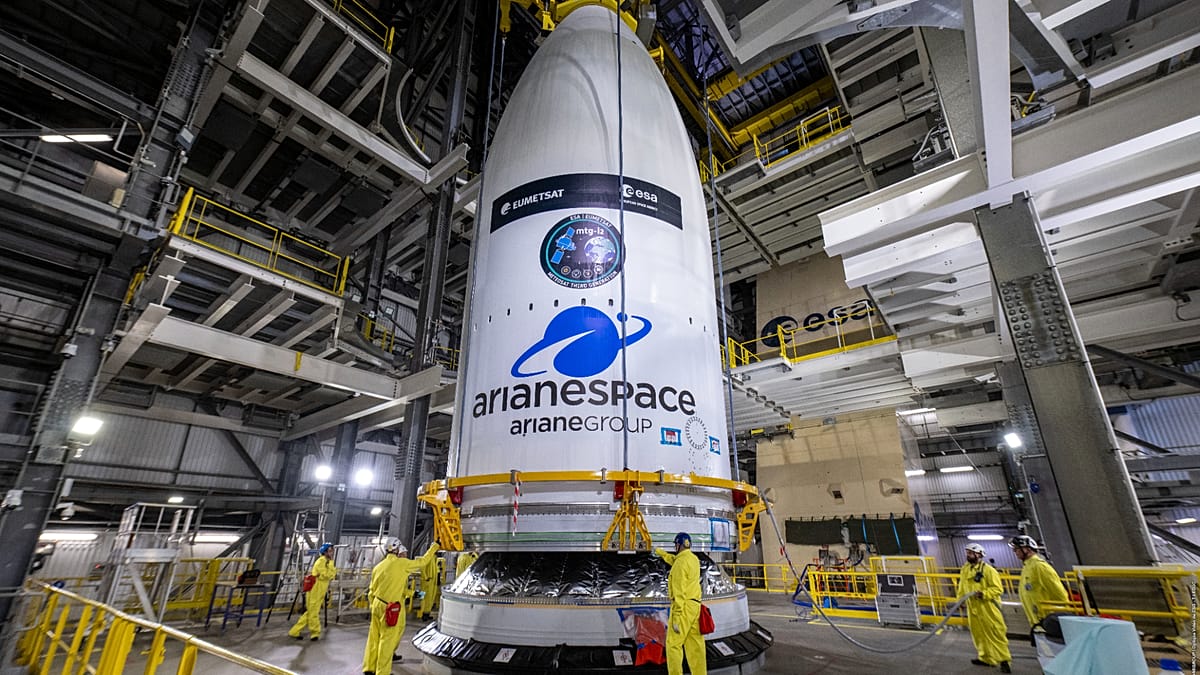
A few metres away, in the encapsulation building, the air is filtered, temperature-controlled and humidity-regulated in minute detail. It is the last room in which technicians have direct physical access to the satellite before it is sealed inside the rocket’s fairing. For MTG-I2, an optical weather-observation instrument that is extremely sensitive to contamination, that cleanliness is no minor detail: any stray particle could degrade the quality of its future images.
The procedure even includes a system of light traps for insects and birds: when the container with the satellite arrives at night and the building’s giant doors open to let it in, any animal that slips through could jeopardise the cleanliness of the payload. “We obviously can’t open the container and let it out with a bird inside,” explains one of the managers of the facility, who has spent almost a year coordinating this final stretch of the campaign alongside the spacecraft team.
The Jupiter control room: the countdown chain of command
Eleven hours before lift-off, the final timeline begins, and the centre of gravity shifts to the Jupiter control room at CNES, France’s National Centre for Space Studies. A large operations screen shows all systems in green, the planned trajectory and the countdown clocks.
At the centre sits Maxime André, launch operations director, responsible for coordinating safety across the entire launch range (people, assets, environment) and, together with the quality team and the measurements lead who oversees telemetry, radar and tracking, providing the voice and eyes that give the final go-ahead.
Right up to the last minute, the mission team remains connected to the satellite’s own control centre, located about four kilometres from the Jupiter room, to confirm that everything is still nominal and relay that confirmation, step by step, to the operations director.
The lightning veto: the weather that can halt a launch
A few metres from the launch complex, a small team watches the sky as closely as the engineers watch the rocket. François Laforge, meteorological analyst at the spaceport station, tracks two parameters above all others: lightning and wind. “Rain or temperature are not very important; what really matters are thunderstorms and wind, both at ground level and at altitude.”
The criteria are strict: no storm within a radius of ten kilometres around the base, either during preparation or during lift-off itself; and no cloud above 6,500 metres altitude within that same radius, because the rocket passing through such a high cloud could generate static electricity capable of triggering a lightning strike. To monitor this, the team combines radars that measure cloud height with a triangulation system of three antennas that pinpoint every electrical discharge in real time.
Weather balloons carrying radiosondes, released several times during the countdown, measure the wind profile at altitude, data that Leonard Bouchaillot, flight safety engineer, uses together with the rest of the team to ensure conditions remain safe so that the pre-calculated “launch corridor” – the area in which a possible mid-flight neutralisation of the rocket is simulated for safety – stays valid.
It is, he explains, a requirement enshrined in French space law to guarantee public safety. The final meteorological check comes barely ten minutes before lift-off. Once in the air, the nature of the risk changes: the rocket passes the speed of sound in under 50 seconds and 50 kilometres altitude in under two minutes, so wind ceases to be a real threat almost immediately. The real risk, they stress, is on the ground.
A €6 billion programme with benefits topping €61 billion
James Champion, MTG project manager at the European Space Agency (ESA), set out the 16 years of work behind the Meteosat satellite project. It has meant almost two decades of planning around technology that did not yet exist but would have to be available by the time MTG-I2 reached orbit.
The cost of the programme in today’s economic conditions has been around six billion euros; its benefits exceed 60 billion, once infrastructure is taken into account, not to mention the number of lives that will be saved thanks to satellite data that will help trigger evacuation plans, for example. This satellite family will be key to forecasting and preventing adverse weather phenomena.
Science: a ‘watchful hawk’s eye’ over Europe every 2.5 minutes
With the satellite just hours away from being placed in orbit, Cristian Bank, director of programme preparation and development at Eumetsat, sets the launch in its true context: that of a continent increasingly afflicted by extreme weather events. “Over the last five years we have racked up losses of €10 billion a year in damage in Europe and thousands of deaths. Fortunately, the number of fatalities is falling because our forecasts and alerts are improving, but the damage to infrastructure is still there. We need to be more resilient,” he warns.
MTG-I2 is the third piece in a complementary trio: the first satellite, launched in 2022, provides a hemispheric view – Europe, Africa, the Atlantic all the way to the Indian Ocean – feeding global weather models; the second, launched in 2025 and almost operational, measures the atmosphere in depth (humidity, temperature, wind, pressure); and the third, whose launch we have just witnessed, will focus on Europe and especially the Mediterranean region, which is hard hit by severe weather events, updating its data every two and a half minutes.
“That refresh rate is crucial for local weather forecasting in Europe and the Mediterranean, but also for civil protection: firefighters detecting forest fires, droughts, or the Mediterranean tornadoes that are becoming more frequent and more violent.”
Bank estimates that the new satellite will need around half a year of commissioning before it can be integrated and calibrated with its two siblings. From then on, probably around April 2027, the three will operate as a single system.
The technical spec: 500 million pixels every ten minutes
Graeme Mason, head of meteorological programmes at ESA, laid out the figures that make MTG-I2 one of the most advanced observation instruments ever placed in orbit. While the first satellite in the family scans the entire visible terrestrial disc every ten minutes at 500-metre resolution – around 500 million pixels per full sweep, spread across 16 channels – MTG-I2 focuses solely on the upper quadrant centred on Europe, and repeats it every 150 seconds.
Its second instrument, the lightning detector, operates in a very narrow band of the spectrum, the oxygen emission line at 777 nanometres, and takes 1,000 samples per second. To resolve details of 500 metres from an orbit 36,000 kilometres above Earth, the satellite needs extreme stability on all three axes.
This programme is a showcase of the strength of Europe’s space industry: involving more than 17 European countries and 70 companies; over 200 subcontracts; and more than 2,200 people working on the project.
“This imager is the best geostationary imaging instrument (“imager”) in the world. The lightning detector is the best lightning camera (“lightning imager”) in the world, a technology that is even ahead of that of the United States. In ten years, ESA expects to send the next family of satellites to continue leading the monitoring and analysis of the climate and its impacts.
Between the Ariane 6 control room, the satellite encapsulation bay and the meteorological station that watches every cloud over Kourou, the launch of MTG-I2 has in reality been the sum of dozens of technical decisions taken by teams that rarely share the spotlight with the lift-off itself.
With this satellite in orbit, Europe completes the first operational trio in its third-generation meteorological constellation, a system that is expected to support the continent’s climate monitoring at least well into the 2040s.