

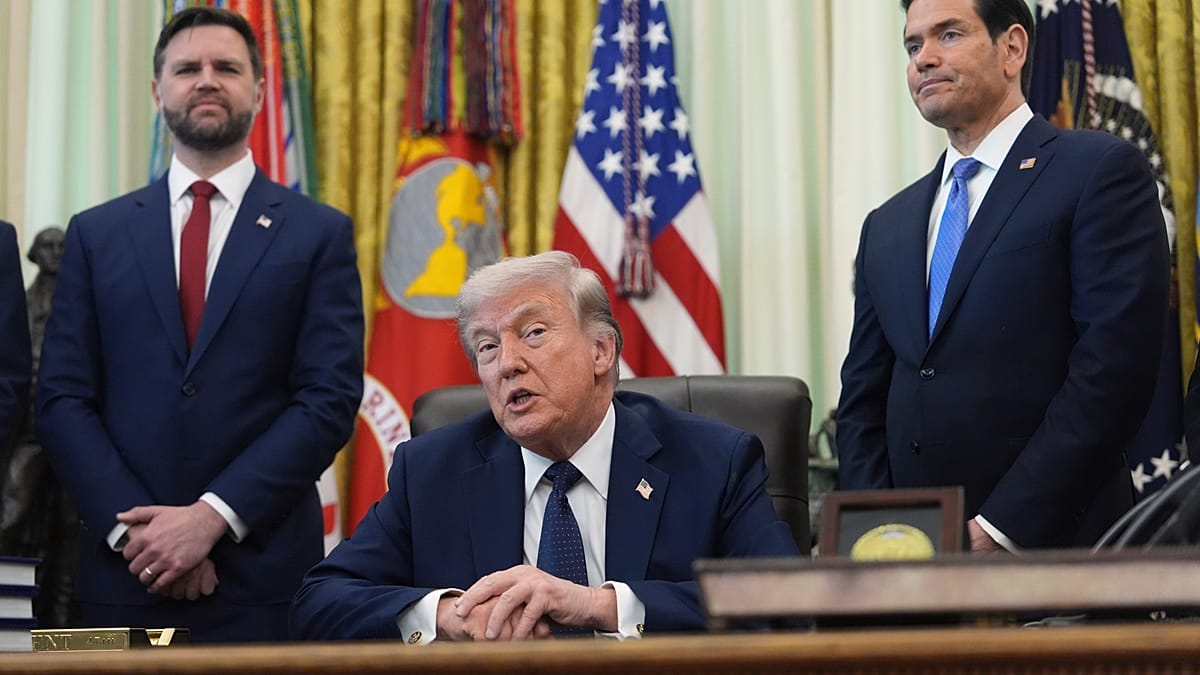
In the United States, the battle to inherit Donald Trump’s political movement is already underway — even though the 2028 Republican primary is still a long way off.
At present, the contest increasingly looks like a two-man race between Vice President JD Vance and Secretary of State Marco Rubio.
Both are seeking to position themselves as the natural successor to Trump, while embodying two very different visions of what a “post-Trump MAGA” (“Make America Great Again”) movement could become.
For now, Vance remains the frontrunner. He has the structural advantages that typically make vice presidents difficult to beat in presidential primaries: proximity to power, constant visibility, and an almost automatic claim to continuity.
At the Conservative Political Action Conference in February, Vance comfortably won a straw poll of potential 2028 Republican nominees with 61%.
Jim McLaughlin, the pollster who conducted the survey, said Vance won because he is “viewed as the closest thing to Donald Trump.”
That perception is key among MAGA supporters.
In addition, Vance also holds influence over fundraising as finance chair of the Republican National Committee (RNC), giving him a central role in the party’s money flow.
Trump has repeatedly suggested that JD Vance is the most likely heir to the MAGA movement, while stopping short of a formal endorsement.
“Vance became the heir apparent when Trump chose him as his running mate in 2024,” said Kyle Kondik, who tracks the Republican race at the University of Virginia Center for Politics. “But Trump can change his opinion in an instant.”
As several Republican members of Congress who have fallen out of favour with Trump have been reminded, a Trump endorsement can still make or break a candidate in a Republican primary.
Early Republican polling and conservative activist surveys continue to place Vance ahead of Rubio by a significant margin.
The vice president’s confrontational style closely mirrors Trump’s own instinct for political combat. In recent White House appearances, Vance has leaned into sharp exchanges with reporters and defended Trump’s most controversial policies without hesitation.
To many grassroots activists, that makes him the authentic heir: someone who believes in Trumpism rather than simply adapting it.
Vance’s weakness is that he is even less popular than Trump himself.
Yet according to a Pew survey conducted earlier this year, he remains far more recognisable to American voters than most other figures in the Trump administration — with only Trump himself and Health and Human Services Secretary Robert F. Kennedy Jr. more widely known.
Rubio’s rise over the past year has transformed what initially looked like a Vance coronation into a genuine contest.
As Secretary of State, Rubio has become one of the administration’s most visible figures, particularly during the Iran crisis and periods of broader geopolitical tension.
Republican donors and strategists who once assumed JD Vance was the inevitable successor are increasingly discussing Rubio as a serious alternative, according to an ABC News survey.
Donald Trump himself has fuelled speculation by publicly praising both men and even floating the idea of a “dream ticket” combining them.
The deeper question, however, is not simply who wins, but what kind of Republican Party emerges after Trump.
Vance represents an ideological MAGA in its purest form. He speaks the language of cultural grievance, populist nationalism and anti-elite sentiment more fluently than almost anyone else in the Republican Party.
Rubio, by contrast, represents an attempt to place MAGA on a more mainstream, institutional footing.
A decade ago, Rubio was seen as a conventional Republican internationalist and one of Trump’s fiercest rivals during the 2016 primaries, when Trump mocked the then-senator from Florida as “Little Marco”.
But over time, Rubio adapted to the new Republican coalition and became a key supporter of Trump’s foreign policy agenda.
Now he offers something different from JD Vance: Trump-style nationalism with a calmer, more polished presentation.
His appeal is strongest among donors, foreign-policy hawks, and Republicans who support Trump’s agenda but worry about electoral fatigue and political chaos.
“He is a politician who could appeal to a whole lot of Republicans who went along with Trump but were never overly enthusiastic about him,” said Whit Ayres, a Republican pollster who worked on Marco Rubio’s 2010 Senate campaign.
Rubio’s problem is that he is even less popular than Trump, and a large share of the American electorate has never heard of him.
In the end, it may come down to how the second half of Donald Trump’s final term unfolds.
If Trump leaves office politically strong — with a stable economy, controlled inflation, and a Republican base still energised by cultural issues — Vance would likely benefit most.
Republican primary voters could conclude that the movement should remain ideologically uncompromising and culturally confrontational.
In that scenario, Rubio risks appearing too cautious, and too reminiscent of the pre-Trump Republican establishment associated with George W. Bush and Mitt Romney.
But if Trump’s second term ends amid a weakened economy, foreign-policy overreach, or voter fatigue, Rubio’s argument would become significantly stronger.
He could position himself as someone who preserved Trump’s populist priorities while restoring discipline, competence, and broader electoral appeal.
Some Republican strategists already see him as potentially stronger than JD Vance in a general election against a Democratic opponent.
There is also a generational and stylistic dimension. Vance is closely associated with the populist online right — podcasts, alternative media, conservative influencers, and the ideological energy of the younger MAGA movement.
Rubio, by contrast, is more at ease in traditional political and diplomatic settings, though he has also become increasingly effective in conservative media.
Their recent appearances in the White House briefing room have, at times, resembled informal auditions for two competing visions of the Republican Party.
Still, one factor outweighs all others: Trump himself.
The Republican Party remains highly personalised around him.
Unlike past presidents, Trump has shown little interest in clearly designating a successor – at least for now.
Instead, he appears to maintain influence by keeping potential heirs dependent on his approval and competing for his favour.
He has continued to fuel speculation about the succession even as both Vance and Rubio publicly downplay their 2028 ambitions.
At a recent White House dinner, the president asked guests to weigh in on his potential successors.
“Who likes JD Vance?” he asked. “Who likes Marco Rubio?”
Both questions drew strong applause. Donald Trump then suggested the two men together would make a “perfect ticket”, while indicating it was still far too early to choose between them.
That uncertainty benefits Trump politically, as it helps preserve his dominance over the movement even as the succession battle begins.
The president is notoriously averse to anyone — friend or foe — who pulls attention away from him or dominates the media cycle, something any future Republican presidential candidate would inevitably do.
Ultimately, the 2028 Republican primary could become a referendum on what MAGA means after Trump: a permanent populist revolution under JD Vance, or a more disciplined, internationally minded version under Marco Rubio.
For now, Vance remains the favourite, but several questions still need to be answered, said Kyle Kondik of the University of Virginia Center for Politics:
“Is Vance strong enough with Trump voters to discourage others from running? When does he announce? And, most importantly, how will Trump react?”