
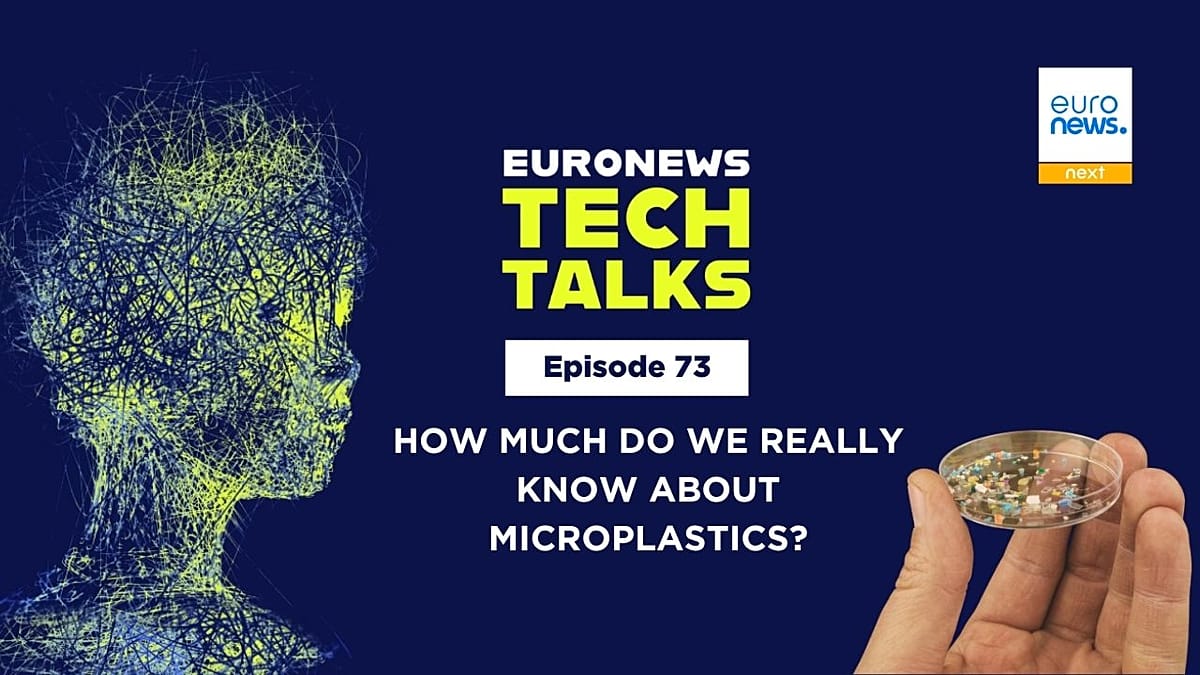
The word “microplastics” appeared for the first time in 2004, coined by Richard Thompson, now a marine biology professor at the University of Plymouth.
Over the past 22 years, microplastics have gained increasing attention from researchers eager to understand their impacts on the environment and the human body.
But how much do we actually know about microplastics?
Euronews Tech Talks collected this and more questions from the audience and posed them to Heather Leslie, an independent scientist from Amsterdam, and Francesco Regoli, vice rector for research at the Polytechnic University of Marche.
What are microplastics?
Microplastics are tiny plastic fragments less then 5 millimetres in diameter.
Overall, they can be divided into two main groups: primary microplastics, which are intentionally designed for industrial, commercial and personal care products; and secondary microplastics, which are generated by the breakdown of larger plastic products into smaller pieces.
Yet, these are not the only categories. “Another typology of microplastics is given by microfibers of textile origin,” Regoli explained.
According to him, this third group is particularly important, as the fast fashion industry, combined with the very limited textile recycling processes, represents a major source of microplastics pollution.
What impact do microplastics have on the environment?
Microplastics contribute to both marine and terrestrial pollution.
Specifically, the impact of microplastics on marine species depends on the size, shape and characteristics of the plastic fragments.
“In the smaller organisms, they [microplastics] can induce physical damage, mechanical blockage. They can stimulate immune responses. They can have genotoxic effects,” Regoli explained.
Also on land, microplastics can have significant consequences. Plastic pollution in soil can lead to changes in essential soil properties, affecting its fertility, plant health and crop production.
However, it is still difficult to assess the long-term consequences of environmental microplastic pollution.
What impacts do microplastics have on the human body?
Even more challenging is understanding the consequences of microplastics on the human body.
What is clear is that we are exposed to them. “They’re right in the very room you’re probably sitting in right now. And if you’re outside, they’re also in the outdoor air. They’re on our roads, coming off of car tyres, coming off from our clothes, they come off of plastic packaging,” Leslie told Euronews Next.
Yet what this means for human health is unknown: “We don’t have the weight of evidence yet to determine that such and such microplastics’ exposure will result in this sort of health outcome,” Leslie continued.
That being said, plastic can release and transport toxic chemicals like per- and polyfluoroalkyl substances (PFAS), some of which have been classified as carcinogens or likely carcinogens.
In addition, studies in animals and cells have linked microplastics to inflammation and immune system damage.
How to reduce microplastic exposure?
According to Leslie, there are two ways to curb microplastics exposure: “The long-term one is collective action, so getting together, being politically active, trying to put pressure on policy-makers,” she said.
The short-term approach, on the other hand, can be carried out individually by gradually replacing plastic objects in one’s daily life.
Despite the fact that many might think reducing plastic dependence requires a high budget, Leslie argues the opposite: “You save money every time you don’t buy an expensive coffee on the go in a plastic cup,” she said.
What will be the future impact of microplastics?
“Microplastics have become a great environmental issue. And I think it will remain for a long time a similar problem,” Regoli told Euronews Next.
He stressed that not only is plastic production still on the rise, but also that even if we could magically and drastically reduce it, the oceans are already full of it.
Despite this, Regoli has a positive mindset: “We must be optimistic because what we have learned in 10 years of intensive research is huge,” he told us.