
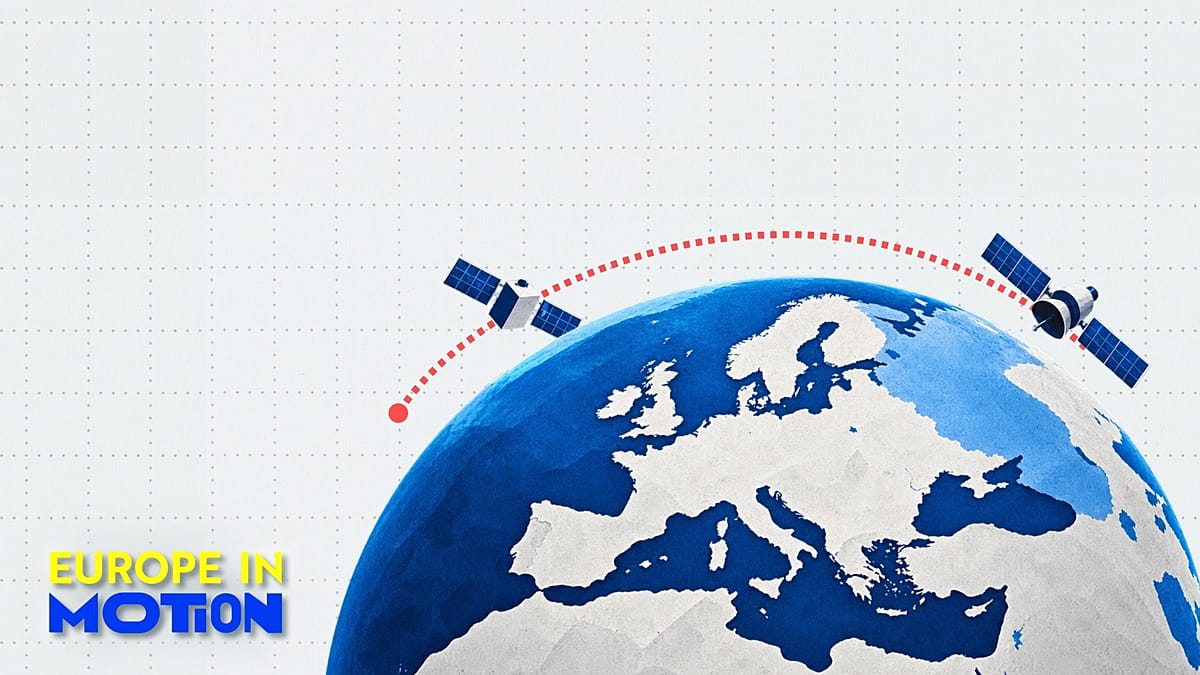
Once considered a niche, the space economy is now a major, mature industrial force supporting innovation, public policy goals, and services in Europe and beyond.
EU countries currently invest a bit more than 0.04% of their GDP in space, but some countries are moving faster than others.
Regarding civilian space projects, Italy now spends more relative to its GDP than any other European country except Luxembourg, overtaking France after a major spending boost over the past 15 years.
The OECD’s latest Space Economy at a Glance report claims that Rome’s space economy “is now a strategic high-value industrial and digital ecosystem, comparable to specialised niches in aerospace, electronics, telecommunications, software and advanced engineering”, with an estimated output of €8 million.
Japan has doubled its budget as well, becoming the top spender relative to GDP among OECD countries.
Another impressive growth, though on a smaller scale, took place in Luxembourg, which tripled its budget since 2010.
When it comes to overall public investments, however, France and Germany are Europe’s leading space-faring nations, according to new OECD data.
In 2025, they allocated up to €2.4 billion and €2.5 billion respectively in civilian space spending, followed by Italy with around €2 billion.
The number of activities funded by government space budgets varies greatly across countries and can include, for example, the manufacture and operation of space infrastructure, the use of satellite data, signals and equipment, and any associated research and development.
Military space: Germany on course to be Europe’s top investor
Paris and Rome are putting a lot into research, with space accounting for 14% of each government’s civil research and development funds in 2024.
That’s more than twice the OECD’s 6.3% average.
However, when it comes to military spending, it’s a different story. Alongside plans to become the most powerful army in Europe, Germany is by far the top spender.
Public demand is increasingly shaped by defence and security requirements, “although comparisons remain difficult as many programmes are classified or dual-use”, says the OECD.
Berlin plans to invest €35 billion in space-related defence capabilities by 2030, much more than France, which has allocated around €10.6 billion between 2024 and 2030, with a 25% rate of its government’s space spending in 2025.
For a cross-Atlantic comparison, the US spent 46.3% last year.
As for China, the report says Beijing’s spending remains “particularly difficult to estimate, as civilian, commercial and military activities are closely integrated under the country’s military-civil framework”, adding that rough estimates suggest it could be the world’s second-largest government space spender, but the “figures remain indicative”.
Satellites: UK far ahead in Europe thanks to navigation market
France, however, boasts a large satellite fleet, with 104 compared to Italy’s 80 and Germany’s 65, the report says.
The largest one, though, belongs to the UK, with 757 satellites in orbit as of June.
The industry already plays a significant role in the British economy, underpinning around 18% of UK non-financial GDP in 2022, compared with 16% in 2021.
“The largest estimated contribution came from industries relying on positioning, navigation and timing services provided by navigation satellites, at 14% of GDP, followed by industries supported by meteorological satellite services at 11%, and by satellite communications and earth observation services, each supporting around 7% of GDP”, says the report.
The overwhelming majority (98%) of British satellites belong to the private sector.
Speaking of which, Europe has some serious private space players, but the reality check on the big picture is pretty stark.
In 2025, only about 12.8% of global private space investment went to European recipients, compared to 67% directed to the US.
This gap is significantly wider when it comes to satellite launches.
Last year, the US attempted 181 orbital satellite launches. Europe managed just eight, well behind China at 92.