
Kazakhstan and China have successfully launched the joint Di’er-5 nanosatellite (Yao-8 mission) for scientific research from China’s Jiuquan Satellite Launch Centre aboard a Kuaizhou-11 rocket.
The Di’er-5 nanosatellite was developed at Al-Farabi Kazakh National University in partnership with China’s Northwestern Polytechnical University.
“This nanosatellite is designed to test high-precision motion, attitude control, and elements of autonomous processing for Earth observation data,” says Lazzat Abdizhalilova, a student of Electronics and Astrophysics and participant in the satellite development programme.
According to Al-Farabi Kazakh National University, instead of relying solely on ground stations, the nanosatellite can recognise and analyse remote sensing imagery directly in orbit.
“The nanosatellite is built for speed. Its high responsiveness enables rapid data transmission to Earth, making it especially valuable for time-sensitive applications such as environmental monitoring, emergency response, and security analysis,” said Lazzat Abdizhalilova.
One of its core functions is highly stable, manoeuvrable target tracking, allowing it to follow objects of interest with a high degree of accuracy while in orbit.
Earlier, students and researchers from Kazakhstan had already gained hands-on experience through the Al-Farabi-1 and Al-Farabi-2 satellite missions.
“While the previous satellites were mainly educational and research-focused, the Di’er-5 is part of an international experimental mission with far more complex objectives,” added Abdizhalilova.
For Kazakhstan’s scientists, China has emerged as a key partner in long-term space collaboration.
“Our next step is the launch of a new satellite, scheduled for 2026. Kazakhstan and China are exploring new joint initiatives in space technology, from developing scientific payloads and training specialists to projects in Earth observation and AI,” said Nursultan Meirambekuly, Head of the Farabi Space Centre for Space Technologies.
In July 2024, Kazakhstan joined the Russian-Chinese International Lunar Research Station (ILRS). The country is now preparing for the joint launch of a lunar-orbit telescope and moving forward with initiatives in astronomy and space technology.
Kazakhstan’s Fesenkov Astrophysical Institute is already conducting early-phase studies for the mission. The lunar-orbit telescope is currently scheduled for launch in 2029. One of the main practical goals of the vehicle will be monitoring the space around the Moon to detect orbital debris.
According to experts at the Kazakhstan Institute for Strategic Studies (KISI), China provides support not only on the technological side but also institutionally through scientific grants, academic exchange programmes, and the training of engineering personnel.
“Meanwhile, Beijing is steadily extending its influence, integrating a space dimension into its Belt and Road Initiative (BRI) as it works to develop its own space industry and connect it with other nations,” Zhadyra Asetkyzy, Senior Expert of the Department of Asian Studies.
As part of a techno-economic cooperation deal last year, Kazakhstan was awarded a 100 million yuan (about €12 million) grant to support the development of its space sector.
When will Kazakhstan see the Soyuz 5/Sunkar launch?
Historically, Kazakhstan has been closely linked to the Russian space programme, primarily through the Soviet-era Baikonur cosmodrome, located in Kazakhstan. However, China’s growing activity in space may indicate that Astana is no longer relying on a single partner.
Russia has reduced its orbital launches over the past decade. In 2015, it conducted 29 launches, compared with just 17 in 2025. At the same time, China has become the second-most active spacefaring nation after the United States, launching 93 rockets last year.
Kazakhstan continues its close cooperation with Russia in space. In 2021, the Kazakh Parliament extended Russia’s lease of the Baikonur Cosmodrome until 2050.
For more than twenty years, Kazakhstan and Russia have been developing the joint Baiterek Space Complex. During President Tokayev’s visit to Russia last November, the two sides signed a protocol aimed at giving the Baiterek project a ‘fresh boost’.
However, the Soyuz-5 rocket (also known as Sunkar), initially scheduled for launch before the end of 2025, has been postponed. Now, Roscosmos assures that the historic launch will take place at the end of March 2026.
Kazakhstan at the heart of regional space cooperation
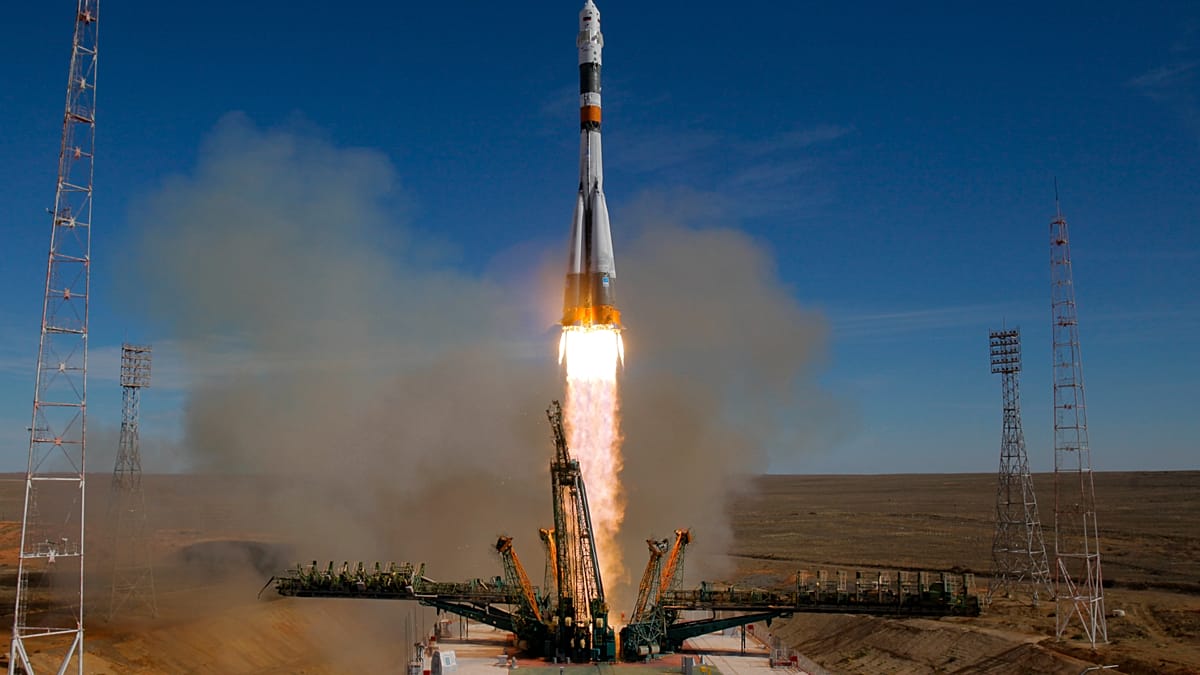
Kazakhstan holds one of the most iconic pieces of space history, the Baikonur launchpad, from which humans first left Earth for space.
The country is not aiming for crewed missions, instead focusing on practical space projects. From communications satellites and Earth observation to environmental monitoring, security, and data collection.
These initiatives are turning Kazakhstan into a regional hub for space technology and education, bringing together technology, knowledge, and talent under one roof.