
Close Menu
Daily Guardian EuropeDaily Guardian Europe
  • Home
  • Europe
  • World
  • Politics
  • Business
  • Lifestyle
  • Sports
  • Travel
  • Environment
  • Culture
  • Press Release
  • Trending
What's On

Venice Biennale’s international jury resigns as Italy’s government opposes Russia’s participation

April 30, 2026

Germany’s Merz loses hard-won favor with Trump – POLITICO

April 30, 2026

Nigel Farage: Germany’s AfD is a ‘mixed bag’

April 30, 2026

UK raises terror threat level to severe after two Jewish men stabbed in north London

April 30, 2026

Trump’s threat to pull troops out of Germany crashes into reality – POLITICO

April 30, 2026
Facebook X (Twitter) Instagram
Web Stories
Facebook X (Twitter) Instagram
Daily Guardian Europe
Newsletter
  • Home
  • Europe
  • World
  • Politics
  • Business
  • Lifestyle
  • Sports
  • Travel
  • Environment
  • Culture
  • Press Release
  • Trending
Daily Guardian EuropeDaily Guardian Europe
Home»Lifestyle
Lifestyle

ESA satellite finds ‘inside-out’ planetary system that challenges formation theories

By staffFebruary 13, 20263 Mins Read
ESA satellite finds ‘inside-out’ planetary system that challenges formation theories
Share
Facebook Twitter LinkedIn Pinterest Email
By&nbspRoselyne Min&nbspwith&nbspAFP

Published on
13/02/2026 – 12:57 GMT+1

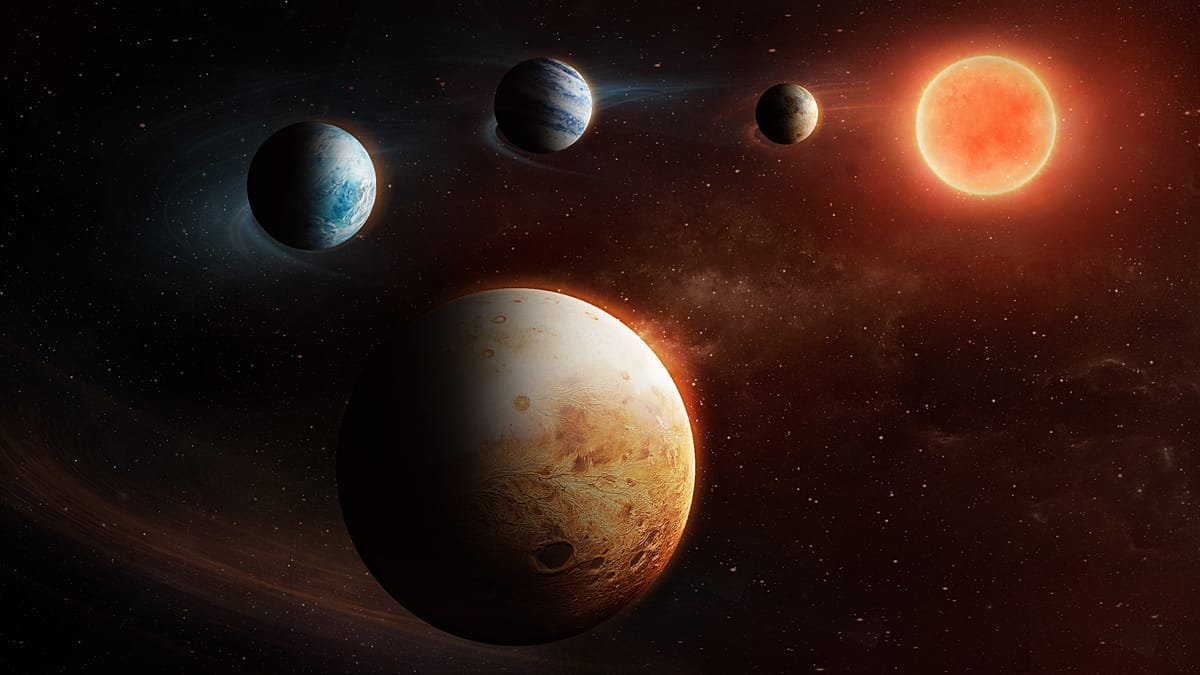
Astronomers say they have discovered a distant planetary system with planets arranged in a surprising order, challenging long-standing ideas about how planets form.

In our Solar System, the four planets closest to the Sun are small and rocky, while the four farther away are large gas giants. Scientists have long believed this pattern — rocky planets near the star and gaseous planets farther out — was common across the universe.

However, a star called LHS 1903 discovered in the Milky Way’s thick disc suggests otherwise.

In a collaborative effort involving researchers across Europe, astronomers analysing data from several telescopes had already identified three planets orbiting the red dwarf star, which is cooler and dimmer than our Sun.

The closest planet to the star was rocky, followed by two gas giants. That is the order scientists expect.

But digging into observations made by the European Space Agency (ESA)’s exoplanet-probing Cheops space telescope revealed a fourth planet farther from the star. Surprisingly, this outermost planet also appears to be rocky.

“That makes this an inside-out system, with a planet order of rocky-gaseous-gaseous-and then rocky again,” Thomas Wilson, the lead author of the study and a planetary astrophysicist from the University of Warwick in the United Kingdom, said in a statement with ESA.

“Rocky planets don’t usually form so far away from their home star,” Wilson added.

One planet after another

Inner planets are expected to be small and rocky because intense radiation from the nearby star blasts most of the gas away from their rocky core.

But farther out in the cold reaches of the system, a thick atmosphere can form around cores, creating gas giants.

Trying to explain the unusual LHS 1903 system, researchers tested several possibilities before proposing a new idea: the planets may have formed one after another rather than all at once.

According to the currently most widely accepted theory, planets form simultaneously in a massive ring of gas and dust called a protoplanetary disc.

This involves tiny dust grains clumping together, then snowballing into cores that eventually evolve into mighty planets.

But in this system, scientists believe LHS 1903 may have formed after most of the gas had already disappeared.

“Yet here is a small, rocky world, defying expectations,” Wilson said.

“It seems that we have found the first evidence for a planet which formed in what we call a gas-depleted environment,” he added.

Since the 1990s, astronomers have discovered more than 6,000 planets outside our Solar System, called exoplanets, mostly by spotting slight changes in brightness as they cross in front of their star.

“Historically, our planet formation theories are based on what we see and know about our Solar System,” said Isabel Rebollido, a planetary disc researcher at ESA.

“As we are seeing more and more different exoplanet systems, we are starting to revisit these theories.”

Share. Facebook Twitter Pinterest LinkedIn Tumblr Email

Keep Reading

‘Virtual rape’: AI and deepfakes are silencing women in public life, UN report

EU finds Meta in breach of digital rules over children on Instagram and Facebook

Nearly half of London jobs at risk of AI disruption and women will be hardest hit, new report finds

Inside Woven City: Japan’s real-life sci-fi town where robots share the streets with humans

China blocks Meta from buying AI startup Manus

OpenAI just changed its principals. Here’s what’s changing

Which country in Europe has the most data centres driving the AI boom?

Can Europe keep its industrial champions in the AI era?

China’s DeepSeek releases new AI model V4. Here’s everything to know as the AI race speeds up

Editors Picks

Germany’s Merz loses hard-won favor with Trump – POLITICO

April 30, 2026

Nigel Farage: Germany’s AfD is a ‘mixed bag’

April 30, 2026

UK raises terror threat level to severe after two Jewish men stabbed in north London

April 30, 2026

Trump’s threat to pull troops out of Germany crashes into reality – POLITICO

April 30, 2026

Subscribe to News

Get the latest Europe and world news and updates directly to your inbox.

Latest News

Spain’s ‘humane migration policy’ is ‘model for Europe’, minister says

April 30, 2026

Man accused of trying to kill Trump at correspondents’ gala agrees to remain jailed

April 30, 2026

Don’t beg Moscow, EU’s top diplomat warns – POLITICO

April 30, 2026
Facebook X (Twitter) Pinterest TikTok Instagram
© 2026 Daily Guardian Europe. All Rights Reserved.
  • Privacy Policy
  • Terms
  • Advertise
  • Contact

Type above and press Enter to search. Press Esc to cancel.