
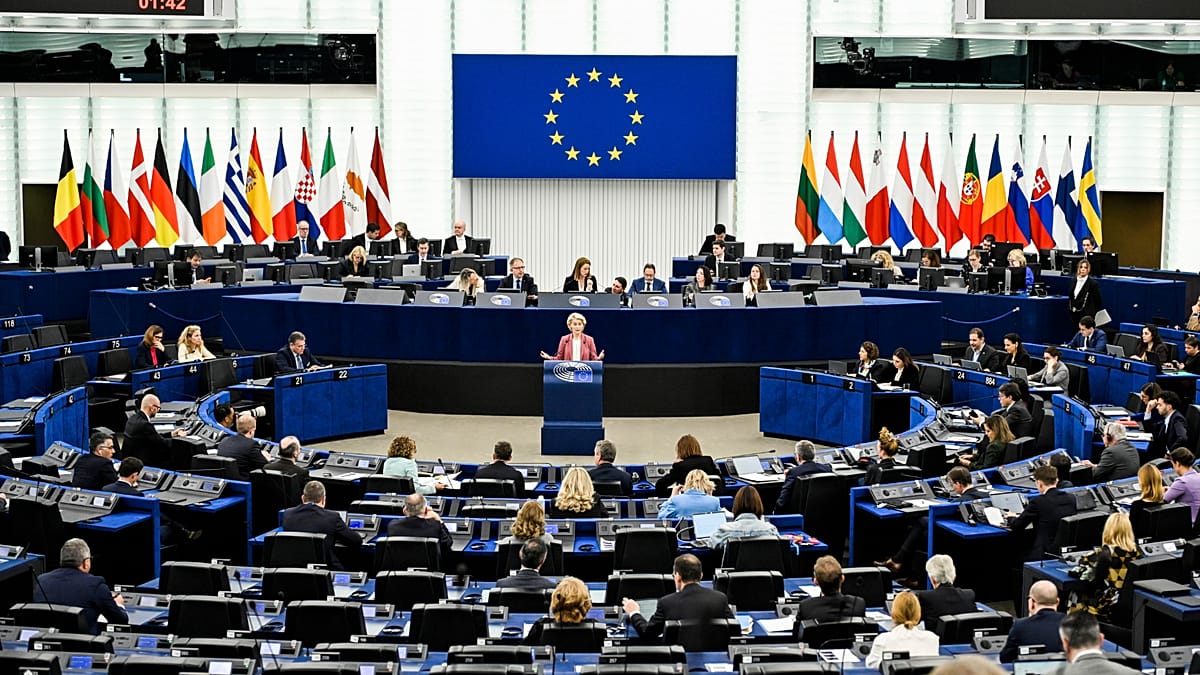
The demand is sparking a clash between the Parliament and Ursula von der Leyen’s strict 1.26 per cent GNI spending cap – the budgetary mechanism that limits a government’s spending to a percentage of its total Gross National Income. Net contributors like Germany and the Netherlands argue it’s already too high.
The Commission wants to fund new defence and AI priorities by streamlining existing funds. The Parliament insists that these needs mustn’t come at the expense of farmers or regional aid. Following a vote (370 to 201), Parliament demands a 10 per cent budget increase, seeking 1.27 per cent of GNI. This specifically excludes the massive costs of repaying pandemic debt, which MEPs argue should be accounted for separately to avoid “suffocating” future investment.
If most MEPs vote to reject the current proposal’s trajectory, they could effectively freeze the entire €2 trillion plan, delaying the start of the 2028 funding cycle.
What is the Multiannual Financial Framework?
The Multiannual Financial Framework (MFF) defines how much money goes into the specific policy areas. It funds programs that benefit European citizens across sectors such as research, climate, agriculture, culture, defence, and environment.
EU treaties are the basis of Europe’s budgetary procedure. They decide how the budget is defined, prepared, adopted, and negotiated to guarantee transparency.
The Commission proposes the budget while the Council and the Parliament examine and amend it together before adopting it. The co-legislators negotiate and adopt the annual budget every year within the overall MFF ceilings.
Unlike national governments, the EU does not directly levy taxes on EU citizens and businesses. It finances its expenses through the so-called “own resources”. These include GNI contributions, consumption tax (VAT), import taxes, and non-recycled plastic packaging waste. To meet its more ambitious proposal, the Commission suggested “new own resources” estimated at €58.2 billion annually (2025 prices), starting from 1 January 2028.
The Commission implements the MFF in three ways: direct management by the Commission itself or its agencies, indirect management through international or national partners, and shared management with member states.
The proposed 2028-2034 budget amounts to €1816.89 billion (current prices). The Commission defines it as “larger, smarter, and sharper” compared to the current one. It reduces the number of programs from 52 to 16 to respond more effectively, simplify processes, and focus on core EU priorities.
The Parliament supports the budget’s flexibility and simplification, but rejects power cuts to regional and municipal authorities, says Carla Tavares, MFF rapporteur and Member of the European Parliament of the Group of the Progressive Alliance of Socialists and Democrats.
“I am in favour of simplification of course. But simplification cannot mean recentralisation and bypassing territories”, said Marie-Antoinette Maupertuis, President of the European Alliance Group at the European Committee of the Regions, President of the Corsican Assembly, and President of the CPMR Islands Commission.
‘Winners’ of the new budget
The 2028–2034 budget proposal pivots toward “hard power,” with increases toward industrial and military security.
The MFF’s first pillar (44 per cent of the total budget) allocates €409 billion to National and Regional Partnership Plans (NRPPs). These merge previously separate funds, including Cohesion Policy and the Common Agricultural Policy, into a single framework. Funding is conditional on meeting targets and respecting the rule of law.
The second pillar accounts for 21 per cent of the budget, allocating €409 billion to the European Competitiveness Fund (ECF) (€234 billion) and Horizon Europe (€175 billion). The ECF aims to reduce reliance on foreign fossil fuels and secure green energy supply chains, leveraging up to €350 billion in investment through a mix of EU and private funding.
Defence is another major winner, with the European Defence Fund and military mobility projects receiving a “tenfold increase” in response to Russian aggression. Funding would rise from around €1.7 billion to more than €17 billion to improve the rapid movement of troops and equipment across Europe.
Artificial intelligence and high-tech innovation would also benefit from a planned €200 billion research allocation aimed at keeping the EU competitive with the US and China. Much of this would support the “AI Factories” initiative, giving European start-ups access to supercomputers to train large-scale AI models.
The third pillar allocates €200 billion to Global Europe, linking external action spending with internal interests and covering enlargement, neighbourhood partnerships, migration management, and international aid, including support for Ukraine.
Sectors left behind
Funding for civil society and independent journalism is being squeezed into broader, rigid “National Partnership Plans”: 200 billion (10 per cent) is split between Erasmus+ and AgoraEU. The remaining €293 billion flows into various projects, including Connecting Europe Facility, the Civil Protection and Health, and the Single Market and Customs Programme. This risks displacing democratic oversight and cultural diplomacy.
“If governance becomes too concentrated at national level, there is a real risk that local realities, smaller territories and civil society actors progressively lose visibility and influence within the decision-making process”, said Maupertuis.
The geographic split
Spending priorities have split member states into two distinct camps. Eastern European states, led by Poland and the Baltics, aggressively lobby for a security-first budget that maintains high levels of cohesion funding, to bridge the economic gap with the West.
The “frugal” countries (including Germany, Sweden, Austria, and the Netherlands) are demanding fiscal restraint and a budget cap closer to 1.1% per cent of GNI.
To the East, the budget is an existential shield against Russia though the EU must “live within its means” and prioritise private investment over public debt. At the April EU Council summit in Cyprus, Germany and the Netherlands, the largest net contributors, warned that a €2 trillion budget is “unrealistic” given national fiscal constraints.
Under the current draft, net contributors such as Germany and the Netherlands are arguably “left with nothing” in direct benefits, facing higher contributions without past rebate protections.
Southern states like Italy and Spain, and smaller member states like Bulgaria and Romania, also risk being sidelined, as the proposed merger of regional funds into national plans could bypass the local authorities that traditionally manage these resources.
What the Parliament wants
The Parliament asks for an increase of €175.11 billion (2025 prices) or €197.30 (current prices) beyond von der Leyen’s 2025 proposal. It warns that the budget should remain an “investment tool” for Europe and its citizens, rejecting a performance-driven model that downsizes regional and local authorities.
The Commission needs to double down on investments to ensure Europe maintains a geopolitical and strategic position in today’s international landscape, said Tavares.
The Commission’s NRPPs proposal to draw on the Recovery and Resilience Facility (RRF) tool would make “national plans overwhelmingly state-centred, while territorial specificities progressively disappear from the programming logic”, Maupertuis told Euronews.
Europe should work collaboratively with its territories rather than using a top-down approach. She proposes a “European Partnership Pact based on multilevel governance, territorial impact assessments, active subsidiarity, and the direct involvement of local and regional authorities from the very start”.
MEPs ask for €888.86 billion (2025 prices) for the first pillar, compared to the Commission’s €797.1 billion, with a reinforced common agricultural policy (CAP) of €385.12 billion and €274.34 billion for cohesion policy.
Tavares emphasises that Parliament has difficulty accepting a shift in funding from traditional policies towards defence and competition.
Maupertuis warns about the Commission’s underestimation of these policies, as they “are not simply budgetary instruments [but] essential political tools ensuring territorial balance, economic resilience and equal opportunities across Europe”.
The Parliament agrees on a total increase of €62.08 billion for competitiveness, including €26.6 billion for the ECF. For Global Europe, an additional €21.24 billion beyond the Commission’s proposal (€190 billion) should strengthen enlargement, aid for Ukraine, multilateral cooperation, and humanitarian support.
It also warns that the Commission’s simplified structure undermines transparency and accountability. The parliament calls for greater participation in the works, with a broader scope for its budgetary and discharge functions.
“We are the budgetary authority”, Tavares said, warning that the current budget proposal should be more transparent for all parties involved, including final beneficiaries.
MEPs back the Commission’s plan for a “basket” of different “new own resources”, including taxes on large corporations and tobacco imports and exports. “We need a strong budget that is prepared to face new challenges, and for this, we need a solid base”, Tavares said.
The proposed new own resources are “a good beginning”, according to Tavares, but additional revenue streams are needed to reach €60 billion in annual revenues. The Parliament suggests extending the carbon border adjustment mechanism, a digital services levy, an online gambling levy, and a levy on crypto-asset capital gains.
Increasing new own resources is the only way to finance a more ambitious budget, as reducing the number of EU-financed policies is not an option, Tavares told Euronews.
Major disagreements with the Commission arose over NextGenerationEU, the bloc’s €800 billion post-COVID-19 pandemic recovery instrument. While the Commission integrates the €168 billion NGEU grant repayment into the 2028-2034 budget, the Parliament wants to keep costs outside the budget ceilings.
June summit cliffhanger
At the April plenary in Strasbourg, Piotr Serafin, Commissioner for Budget, Anti-Fraud and Public Administration, said that the Commission “stands ready to act as an honest broker”. But clashes among member states over budget size, who pays, and where the money is spent threaten to delay the budget adoption.
“Our position is to work together with the Council”, said Tavares. Parliament is set to vote on its position on 18 May. A positive turnout would set a clear red line ahead of negotiations with the Commission and the Council, signalling MEPs’ readiness to push budgetary ambitions without trade-off and forcing the Council into a more accommodating position ahead of the 18-19 June summit.