
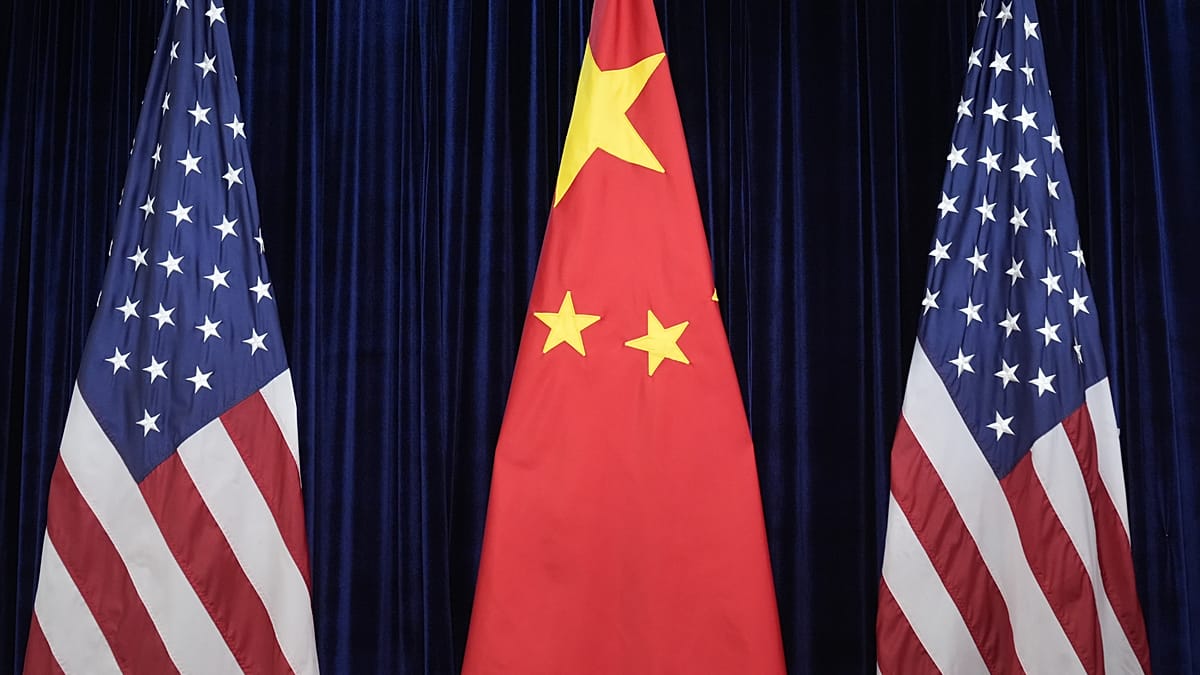
For Europe, the Trump-Xi summit is not just about US-China relations.
It’s about whether the European Union ends up squeezed between two superpowers cutting tactical deals over trade, technology, energy and security – while European interests are treated as secondary (if at all).
In fact, Europe might be watching the summit from a lose-lose position.
The most immediate concern in Brussels and Berlin is probably nothing less than industrial survival – and it comes in the form of rare earths.
China still dominates the supply chain for these critical minerals used in a wide range of goods from electric vehicles to semiconductors, from green tech products to defence systems.
European officials fear a US-China arrangement could prioritize American access to Chinese rare earths while Europe remains vulnerable to shortages and export restrictions — effectively making it collateral damage.
German and Japanese industries have reportedly already been badly affected by Chinese controls on heavy rare earths.
“China appears to be selectively licensing exports while preserving leverage over supply chains considered strategically sensitive, particularly where defence or advanced technology applications are involved,” said Ilya Epikhin from the consultancy firm Arthur Little.
Germany and Japan are already investing in alternative supply chains and projects to diversify away from China.
However, full replacement of China is still years away, according to David Merriman, a research director at Project Blue, another consultancy firm.
“The situation looks set to get worse before getting any better,” he added.
European efforts to gain even a modicum of economic independence from Chinese rare earths seem slow.
A report by the EU Institute for Security Studies (EUISS), Brussels’ official think tank, is blunt.
“Europe is lagging behind. It may have set ambitious local production targets under the Critical Raw Materials Act in 2023, and designated 60 strategic projects to deliver on them, However, it has not adopted the policies needed to make these financially viable in the face of China’s state-sponsored competition,” the study reads.
For Europe, the summit nightmare scenario is that Trump, who travelled to Beijing under the darkest economic clouds of his political career, strikes some sort of “managed trade” deal with Beijing that sidelines the EU, leaving it to absorb the fallout as collateral damage.
As a consequence, Chinese overcapacities in electric cars (EVs), batteries and industrial goods could flood European markets and intensify the pressure on EU industries.
Already, Chinese EVs are between 25% and 50% cheaper to produce than European models.
By way of comparison, the Chinese compact SUV MG4 starts at around €30,000, whereas comparable European models like the Volkswagen ID.3 start at around €40,000.
Experts don’t want to exclude a transactional deal between Trump and Xi with a negative outcome for Europe.
“Realistically, the Trump-Xi talks are becoming very bilateral,” said Jonas Parello-Plessner, a visiting fellow in the Indo-Pacific programme of the German Marshall Fund (GMF). “And one thing is certain: Trump will only speak for himself.”
And the US president already threatens to introduce new tariffs, including on Chinese goods, to replace the levies the US Supreme Court struck down earlier this year.
After struggling to decipher the unpredictable Trump in his first term, Chinese officials have learned to wield their economic leverage, reportedly warning US business leaders recently that they will retaliate “each and every time” Washington acts on trade or investment.
The prospect of worsened economic relations between Washington and Beijing is also not something that Brussels relishes.
“If the Chinese play hardball with Trump, Europe will have nothing to gain,” said Parello-Plessner.
A renewed US-China trade war or sanctions escalations could hit European industries through weaker global demand, disrupted supply chains and financial volatility.
Brussels is already preparing for the worst.
Trade Commissioner Maroš Šefčovič told Euronews last month that the EU would stand ready to strengthen the bloc’s industrial policy.
He also warned that the EU will not hesitate to defend its industries and will “fight tooth and nail for every European job, for every European company, for every open sector, if we see they are treated unfairly”.
But despite that rhetoric, the summit in Beijing is a reminder that many aspects of Europe’s future are in the hands of the world’s two dominant powers – neither of which seems inclined to make any concessions to the old continent.