
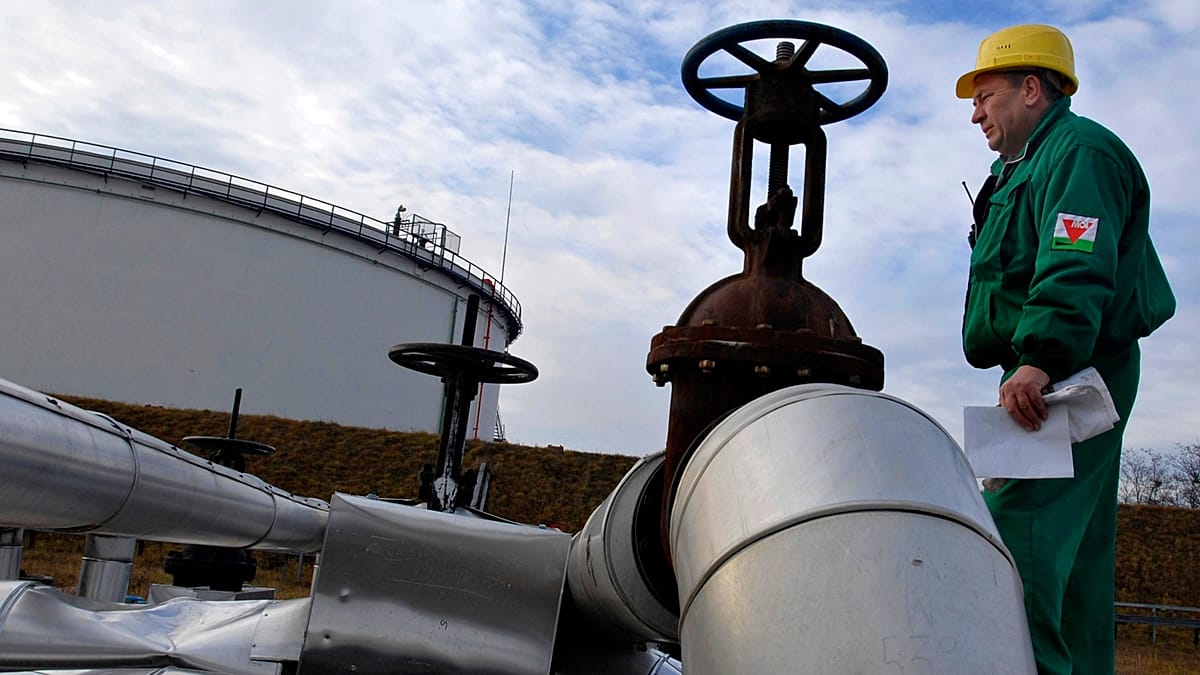
The European Commission has asked Ukraine to accelerate repair works on the Druzhba oil pipeline to defuse the crisis triggered by Hungary’s double veto, which has paralysed a €90 billion loan for Kyiv and a fresh round of sanctions against Russia.
At the same time, the Adria pipeline, also known as JANAF, which begins in Croatia and connects several Central European countries, has emerged as the most viable alternative to ensure that Hungary and Slovakia continue to receive oil supplies.
“As a strategic energy hub of the European Union and the only secure crude oil supply route for Central Europe, JANAF is prepared to meet the full annual needs of refineries in Slovakia and Hungary,” the operator saidon Wednesday.
A similar conclusion was reached in Brussels after a meeting of technical experts from all member states specifically convened to address the dispute over Druzhba.
The Soviet-era pipeline was severely damaged on 27 January by an attack attributed to Russia. Last week, both Hungary and Slovakia, which receive Russian crude through Druzhba thanks to an open-ended sanctions exemption, accused Ukraine of “blackmail” over the interruption of supplies. Budapest took it further by announcing its double veto.
Since then, the two landlocked countries have released their emergency oil stocks, which under EU law are meant to cover at least 90 days of net imports.
“At this stage, there is no immediate risk to the EU’s security of supply,” a Commission spokesperson said on Wednesday after the experts’ meeting.
“There is an alternative supply route that can be used by Hungary and Slovakia, and this is the Adria pipeline from Croatia. Croatia confirmed at the meeting that non-Russian crude oil is being transported through the Adria pipeline to Hungary and Slovakia.”
While the Adria pipeline has sufficient capacity to meet the annual oil needs of Hungary (5.75 million tons) and Slovakia (4.66 million tons per year), the two countries have insisted on their right to receive the signficantly cheaper Russian crude they have contracted through the Druzhba pipeline.
According to the Commission, Croatia is looking into the possibility of “whether it can lawfully accept Russian crude at its port, both under the EU and US sanctions”, but no decision in that direction has been made yet.
“At the end of the day,” the Commission spokesperson added, “what matters is that there will be oil that can be supplied to Hungary and to Slovakia to meet their demands. And if we can find alternatives to Russian oil, the better, and then we don’t have an issue with sanctions.”
Unclear timeline
The dispute over the Druzhba pipeline and the Hungarian vetoes largely overshadowed Commission President Ursula von der Leyen’s visit to Kyiv on Tuesday to mark four years since Russia launched its full-scale invasion of Ukraine.
Von der Leyen was expected to announce the final approval of the €90 billion loan and the 20th package of sanctions. In the end, she did neither.
“The Russian attacks on the Druzhba pipeline have had a direct impact on European energy security,” the Commission president said. “We ask for the repairs on the Druzhba pipeline after the Russian attacks to be accelerated.”
Speaking by her side, Ukrainian President Volodymyr Zelenskyy did not commit to a timeline for repairs. Instead, he warned of the risks on the ground.
“When you renovate, Russia attacks again,” Zelenskyy said.
“You know how Russia uses these attacks on our critical civil infrastructure. And that’s why people have been wounded. So for what? To renovate for what? To lose (more) people? I think this is a very big price. That’s it.”
Ukraine did not take part in Wednesday’s meeting, but provided a document, seen by Euronews, saying that it was “actively carrying out repair and restoration works”.
“Security and stabilisation measures continue amid daily threats of new missile attacks,” the document said. “The Ukrainian side is interested in restoring transit as soon as possible within the available legal framework.”
The document also denounced “the unacceptability of ultimatums and political pressure” by Hungary and Slovakia, “which play into the hands of the aggressor”.
Last week, Budapest and Bratislava announced a halt in diesel exports to Ukraine. Bratislava also said it would cut off emergency electricity supplies.
On Wednesday, Hungarian Prime Minister Viktor Orbán said he would deploy soldiers to protect oil infrastructure and establish a no-drone zone near the border with Ukraine.
“This unprecedented shutdown has political rather than technical causes,” Orbán said on social media. “Hungary cannot be blackmailed!”
The clash has put Brussels in an exceptionally complicated position.
On the one hand, the Commission is bound to safeguard the energy security of all member states. On the other hand, it is determined to swiftly provide Ukraine with the €90 billion loanagreed by EU leaders in December.
Adding a new layer of drama is the buildup to Hungary’s general election on 12 April, where Orbán is trailing in the opinion polls by double digits. Opposition to Kyiv and Brussels is a prominent theme of Orbán’s campaign.
EU officials have expressed sympathy for Ukraine’s plight under constant Russian bombardment and sub-zero temperatures, which makes it impossible for the country to commit to a reparations timeline, while hoping that, beyond the public statements, pragmatism would prevail to ensure the pipeline is fixed and the loan is unblocked.
Kyiv needs a fresh injection of foreign aid as early as April.