
The top leadership of the European Union has sharply accused Hungary of breaching the bloc’s principle of sincere cooperation after the country unexpectedly decided to veto a €90 billion loan to Ukraine over an unrelated energy dispute.
The financial assistance programme was agreed in December by heads of state and government after gruelling negotiations. It was in the very last stage of the legislative process, with the first disbursement expected to be made in early April.
Hungary, Slovakia and the Czech Republic secured an opt-out from the scheme.
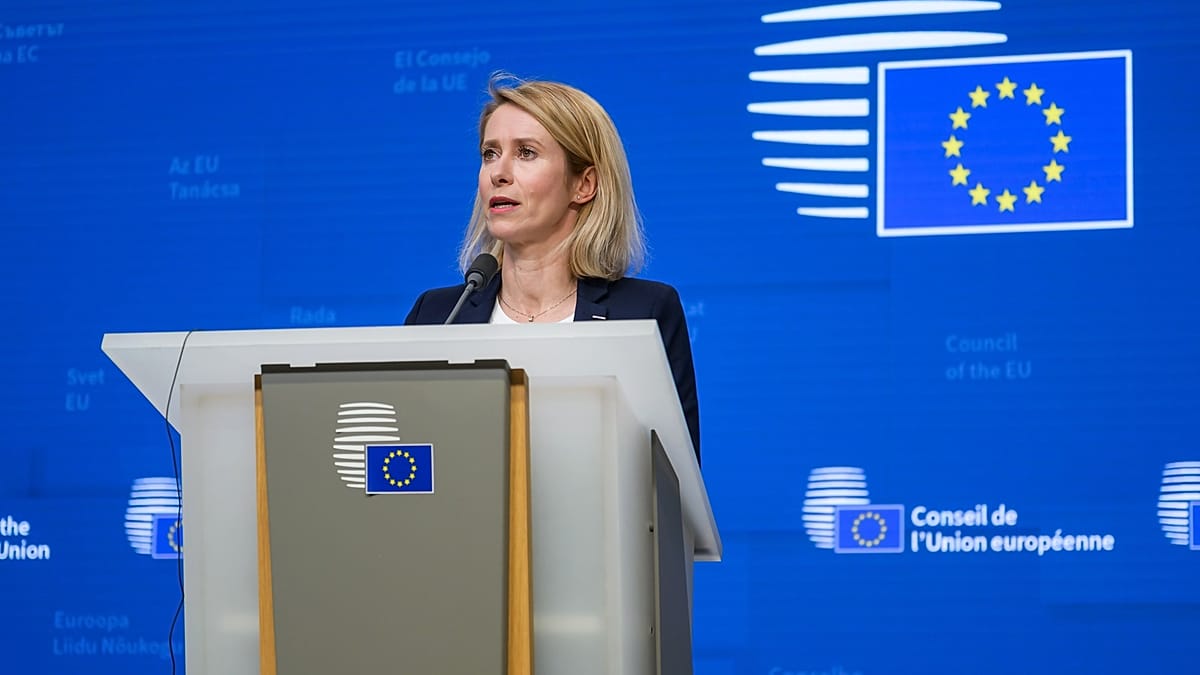
“It’s really regrettable,” High Representative Kaja Kallas said at the end of a meeting of foreign affairs ministers on Monday. “It’s not really in accordance with the sincere cooperation clause that we have in the (EU) treaties.”
Separately, António Costa, the president of the European Council, told Hungarian Prime Minister Viktor Orbán that decisions blessed by the 27 leaders “must be respected”.
“When leaders reach a consensus, they are bound by their decision. Any breach of this commitment constitutes a violation of the principle of sincere cooperation,” Costa said in a letter sent to Orbán on Monday and seen by Euronews.
“No member state can be allowed to undermine the credibility of decisions taken collectively by the European Council.”
Speaking in Paris, French President Emmanuel Macron echoed the sentiment.
“I am confident when I say I am determined, because I know that the political commitments and the promises made at the last European Council will be honoured. It cannot be otherwise,” Macron said.
The dispute relates to the Soviet-era Druzhba pipeline, which crosses Ukraine and brings Russian crude oil to Hungary and Slovakia thanks to a sanctions exemption. The conduit was severely damaged in late January by a drone attack attributed to Russia. However, both Hungary and Slovakia have blamed Ukraine for the subsequent halt in deliveries.
“Since mid-February, Ukraine refuses to restore the transfer of crude oil via the Druzbha pipeline to Hungary due to political considerations and in violation of its international obligations,” Orbán wrote in his letter to Costa.
“This is an unprovoked act of hostility that undermines the energy security of Hungary.”
Kyiv has said emergency repair works are ongoing, but cautioned that the relentless Russian bombardment is complicating the efforts. It has also proposed setting up an alternative route through the Odesa-Brody pipeline to bring in seaborne crude.
“The Hungarian and Slovak ultimatums should be directed only to the Kremlin. These two countries cannot hold the entire EU hostage. We call on both to engage in constructive cooperation and responsible behaviour,” Ukrainian Foreign Minister Andrii Sybiha said.
‘Exploitation of unanimity’
On top of the €90 billion loan for Ukraine, Hungary has also vetoed a new round of sanctions against Russia, which Brussels wanted to have approved by 24 February, the fourth anniversary of the full-scale invasion.
The outrage was tangible on Monday as foreign affairs ministers, wearing lapel pins in the colours of the Ukrainian flag, made their way into the meeting.
“I am astonished by the Hungarian position,” said Germany’s Johann Wadephul.
“I don’t think it is right if Hungary betrays its own fight for freedom and European sovereignty. So we will once again come to the Hungarians with our arguments, in Budapest but of course also here in Brussels, for them to reconsider their position.”
Speaking to Euronews, Lithuania’s Kęstutis Budrys called for an overhaul of the voting rules to avoid what he described as “the exploitation of the principle of unanimity”.
Hungary has blocked one of the three elements of the €90 billion loan that amends the EU budget rules and depends on unanimous consent. The other two regulations, which outline the structure and conditions of the assistance, were approved on Friday.
“We cannot be disrupted each time by these vetoes,” Budrys said.
Meanwhile, Sweden’s Maria Malmer Stenergard said the double Hungarian veto was a “disgrace” and a “shame”.
“We need to make sure Ukraine gets that money. Around two-thirds of their budgetary needs for two years will be covered by this loan, and they need this, so we must find a way,” Stenergard told Euronews.
Regarding the timing of Hungary’s decision, the Swedish minister believes it might be tied to the general election in April, a key vote in which Orbán is trailing in polls by double digits.
“I don’t think that it is a coincidence that elections are coming up,” she said.
Asked about this possible connection, Kallas trod more carefully, saying that discussions should continue to find a workable solution. The European Commission has convened a meeting of the Oil Coordination Group for Wednesday.
“We know that there are elections coming in Hungary, but it’s very hard for me to see, considering and knowing the history of Hungary, that people of Hungary would actually support not helping the people of Ukraine that are in need,” Kallas said.
“I find it very hard to believe that it will bring you any bonus points in the diselections.”