
Close Menu
Daily Guardian EuropeDaily Guardian Europe
  • Home
  • Europe
  • World
  • Politics
  • Business
  • Lifestyle
  • Sports
  • Travel
  • Environment
  • Culture
  • Press Release
  • Trending
What's On

Who’s left on the barricades – POLITICO

April 22, 2026

Hangbags at dawn: Rare double-signed Hermès Birkin to headline major luxury auction

April 22, 2026

Costa steps up pressure to break EU budget deadlock – POLITICO

April 22, 2026

Reusing places and spaces: EUmies Awards honour sustainable architecture and design

April 22, 2026

EU attempts to outmaneuver Iran rollercoaster with emergency energy plan – POLITICO

April 22, 2026
Facebook X (Twitter) Instagram
Web Stories
Facebook X (Twitter) Instagram
Daily Guardian Europe
Newsletter
  • Home
  • Europe
  • World
  • Politics
  • Business
  • Lifestyle
  • Sports
  • Travel
  • Environment
  • Culture
  • Press Release
  • Trending
Daily Guardian EuropeDaily Guardian Europe
Home»World
World

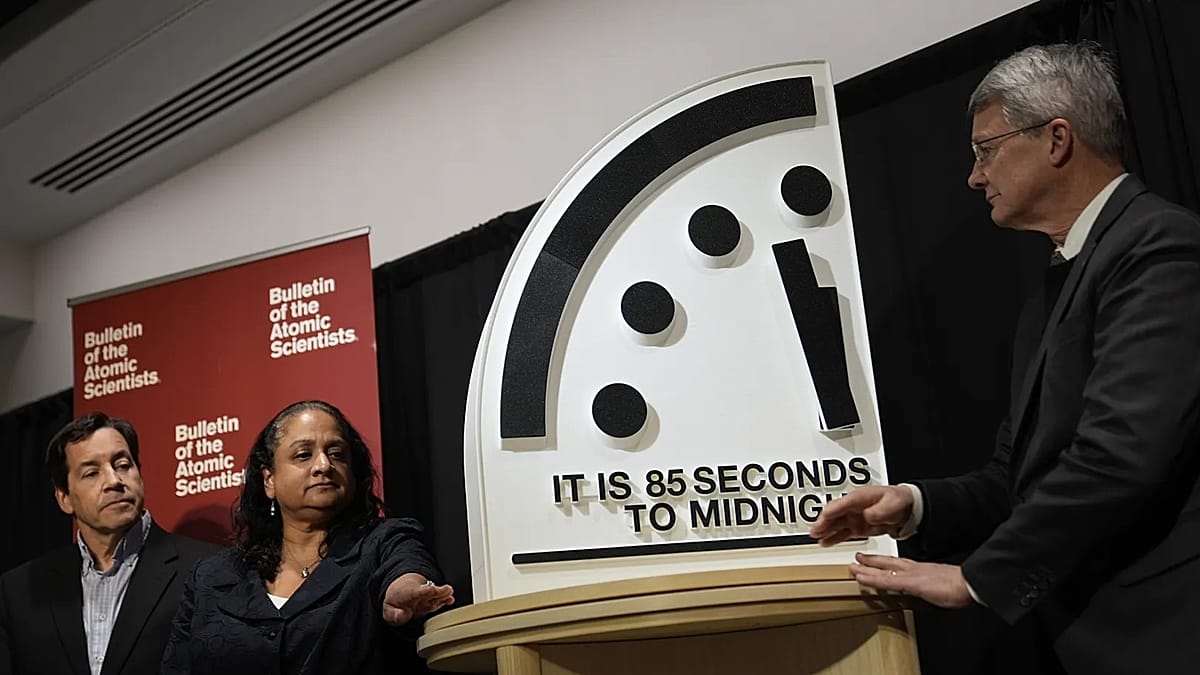
‘Doomsday Clock’ set at 85 seconds to midnight, Bulletin of the Atomic Scientists says

By staffJanuary 27, 20263 Mins Read
‘Doomsday Clock’ set at 85 seconds to midnight, Bulletin of the Atomic Scientists says
Share
Facebook Twitter LinkedIn Pinterest Email

Published on
27/01/2026 – 17:30 GMT+1

The “Doomsday Clock” which represents how near humanity is to catastrophe moved closer than ever to midnight on Tuesday as concerns grow over nuclear weapons, climate change and disinformation.

The Bulletin of the Atomic Scientists, which set up the metaphorical clock at the start of the Cold War, moved its time to 85 seconds to midnight, four seconds closer than a year ago.

The announcement comes a year into US President Donald Trump’s second term in which he has shattered global norms including by ordering unilateral attacks and withdrawing from a slew of international organisations.

Russia, China, the US and other major countries have “become increasingly aggressive, adversarial and nationalistic,” said a statement announcing the clock shift, determined after consultations with a board that includes eight Nobel laureates.

“Hard-won global understandings are collapsing, accelerating a winner-takes-all great power competition and undermining the international cooperation critical to reducing the risks of nuclear war, climate change, the misuse of biotechnology, the potential threat of artificial intelligence and other apocalyptic dangers.”

The Doomsday Clock board warned of heightened risks of a nuclear arms race, with the New START arms reduction treaty between Washington and Moscow set to expire next week and Trump pushing a costly “Golden Dome” missile defence system that would further militarise space.

The group also highlighted droughts, heat waves, and floods linked to global warming, as well as the failure of nations to adopt meaningful agreements to address it.

“We are living through an information Armageddon – the crisis beneath all crises – driven by extractive and predatory technology that spreads lies faster than facts and profits from our division,” said Maria Ressa, the Filipino investigative journalist and Nobel Peace Prize winner.

Board members have further warned of fracturing global trust. “If the world splinters into an us-versus-them, zero-sum approach, it increases the likelihood that we all lose,” said Daniel Holz, chair of the group’s science and security board.

The Bulletin of Atomic Scientists was founded by the likes of Albert Einstein, Robert Oppenheimer and other Manhattan Project nuclear scientists such as Eugene Rabinowitch and Hyman Goldsmith in late 1945.

Starting in 1947, the advocacy group used a clock to symbolise the potential and even likelihood of people doing something to end humanity.

At the end of the Cold War in 1991, it was at its farthest point ever, at 17 minutes to midnight. Over the past few years, to address rapid global changes, the group has shifted from counting down the minutes until midnight to the seconds.

The group said the clock could be turned back if leaders and nations worked together to address existential risks.

Additional sources • AP, AFP

Share. Facebook Twitter Pinterest LinkedIn Tumblr Email

Keep Reading

Video. Latest news bulletin | April 22nd, 2026 – Morning

Trump extends ceasefire with Iran indefinitely at Pakistan’s request to allow for diplomatic efforts

Israeli army jails two soldiers for smashing head of Jesus statue in southern Lebanon

Six stand trial in Istanbul over insecticide poisoning deaths of Turkish-German family

Qatar backs ceasefire as uncertainty surrounds US-Iran peace talks in Islamabad

Russia and North Korea connect road bridge ahead of summer opening, Moscow says

Video. Latest news bulletin | April 21st, 2026 – Midday

Video. Marijuana smokers celebrate 420 in New York

Video. Timelapse footage shows maritime traffic around Gulf, Straight of Hormuz

Editors Picks

Hangbags at dawn: Rare double-signed Hermès Birkin to headline major luxury auction

April 22, 2026

Costa steps up pressure to break EU budget deadlock – POLITICO

April 22, 2026

Reusing places and spaces: EUmies Awards honour sustainable architecture and design

April 22, 2026

EU attempts to outmaneuver Iran rollercoaster with emergency energy plan – POLITICO

April 22, 2026

Subscribe to News

Get the latest Europe and world news and updates directly to your inbox.

Latest News

EU Trade Chief heads to Washington hoping to unlock steel talks

April 22, 2026

Video. Latest news bulletin | April 22nd, 2026 – Morning

April 22, 2026

Iran crisis and Strait of Hormuz disruption drive Wall Street shift to 24/7 tokenised markets

April 22, 2026
Facebook X (Twitter) Pinterest TikTok Instagram
© 2026 Daily Guardian Europe. All Rights Reserved.
  • Privacy Policy
  • Terms
  • Advertise
  • Contact

Type above and press Enter to search. Press Esc to cancel.