
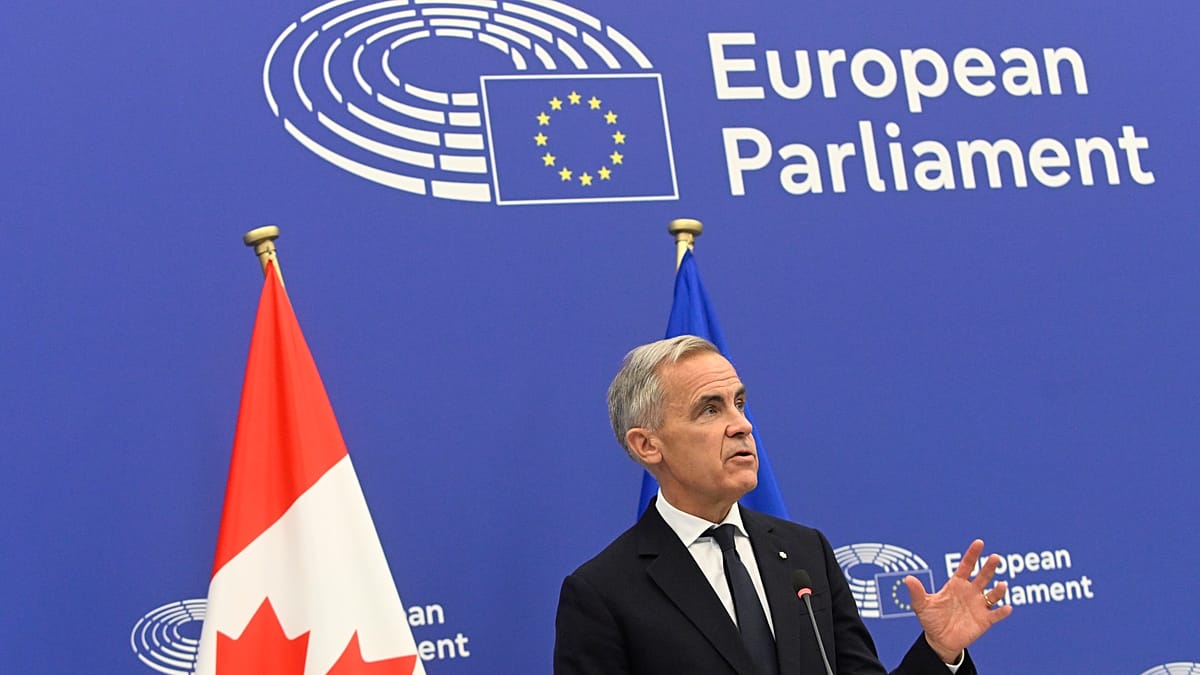
With tariffs, export controls and politics turning trade into a geopolitical lever, the EU seems to be shopping for partners it can count on. Canada, a like-minded economy already tied to the bloc by a free-trade agreement, is pitching itself as one.
Ahead of the EU-Canada summit at the end of October, the two sides are discussing a partnership beyond the Comprehensive Economic and Trade Agreement (CETA).
Prime Minister Mark Carney proposed exploring an integrated market for financial services, alongside cooperation on payments, strategic minerals, energy, AI, and defence production. Nothing has been agreed on financial passports, mutual recognition of licences, or bank access.
Fabian Zuleeg, Chief Executive and Chief Economist at the European Policy Centre, says the summit must deliver more than words. “So by the time we get to the summit, we should really be concrete,” he says.
A trade order under strain
The EU’s problem is dependence. It relies on the US for technology and security, on Chinese supply chains for critical inputs, and on outside suppliers for energy, at a time when trade access is increasingly used as leverage.
Canada offers economic gains, Zuleeg says, in areas like financial markets and technologies CETA does not fully cover. “The more important argument is political, and it’s geopolitical.”
The existing EU-Canada partnership is CETA, provisionally applied since 2017. It removed 98% of tariff lines immediately, rising to 99% by 2024. Trade in goods and services reached €130 billion in 2025, up 80% from €72.1 billion in 2016, according to Commission figures.
But that model has run its course. Erik van de Merel, chief economist at the European Centre for International Political Economy (ECIPE) and associate professor at the Université Libre de Bruxelles, notes that “tariffs among developed countries and between Canada and the European Union are fairly low.”
The next gains lie elsewhere, “in the area of services, technology collaboration, all these sort of intangible activities that are important for future growth,” he says. Negotiations on a Digital Trade Agreement began in March 2026.
What each side wants
For the EU, the appeal is security of supply. Canada says it holds deposits of more than 34 critical minerals and is a leading producer of 10 considered essential to the energy transition. Europe needs them for batteries, grids and defence.
“We are very dependent, in particular on China, at the moment,” Zuleeg says. Reducing that reliance, he argues, matters less for prices than for keeping European industry running during a dispute. Cheaper energy is possible too, he adds, but not overnight.
For Ottawa, the logic is diversification. The US takes roughly seven in ten Canadian exports, while the EU was Canada’s second-largest goods-trade partner in 2024 with 7.9% of its global goods trade. Canada also wants easier access to European customers and investors for its clean-energy, mining, AI, and defence firms. Canadian pension funds could co-finance mineral-processing and infrastructure projects.
Defence is already a test case. In June 2026, Canada became the first non-European country included in the EU’s €150 billion SAFE defence instrument, a possible template for sector-by-sector integration.
The rule-taker question
The hardest issue is regulation. Canada wants better access to European banking, insurance, and professional services such as law, accountancy, and architecture.
Van de Merel expects the EU to ask for something in return. “The new rules that we are going to develop, to some extent, you would have to take them over,” he says. If Canada wanted to set its own banking and professional rules without European oversight or harmonisation, he argues, it would have to think again because deeper market integration is a core EU goal.
Alignment, he says, is the test of whether the project works. He adds that “one has to have regulatory alignment and I think that’s going to be really key and a challenge whether this is going to be a success or not.” It will not be quick. The EU’s single market in services remains unfinished after decades, so a newcomer seeking the same benefits faces a long catch-up.
Zuleeg is less worried about Canada becoming a mere rule-taker. Iceland follows single-market rules because it sits in the European Economic Area, he notes, but Canada would not be joining the single market. In his view, it would keep a distinct voice, for example on foreign policy. He doubts the deal would require treaty change and considers “associate membership” a misnomer. A tailored association agreement under Article 217 of the Treaty on the Functioning of the EU looks the more likely legal route.
Practical steps are already under way. In March 2026, a joint EU-Canada committee agreed to pursue regulatory alignment on motor vehicles and conformity assessment and to widen mutual recognition in pharmaceuticals.
The politics could still bite. In Ottawa, the question is how much EU regulation Canada can accept without a vote in EU institutions. In Brussels, candidate countries undergoing lengthy reforms may ask why Canada should get privileged access. Van de Merel is also watching the UK, which could object if Canada obtains terms it never had after Brexit.
Limits and risks
The idea should not be oversold. Canada cannot replace China’s role in manufacturing and mineral processing or the scale of the US economy. Mines, refineries, and ports take years to build, and the Atlantic is a logistical hurdle. Canada’s exposure to Washington means a US–Canada crisis could spill into its production and investment.
Then there is CETA itself. As of mid-September 2026, ten member states, including France, Italy, Poland, Belgium and Ireland, had still not ratified it, so its investment-protection provisions are not in force. The EU is discussing an unprecedented new tier while its flagship trade deal with Canada remains only partly ratified.
Van de Merel warns that without institutions behind it, the initiative could fizzle. “Otherwise it’s just an idea that is very symbolic and without any sort of political institutional consequences,” he says.