
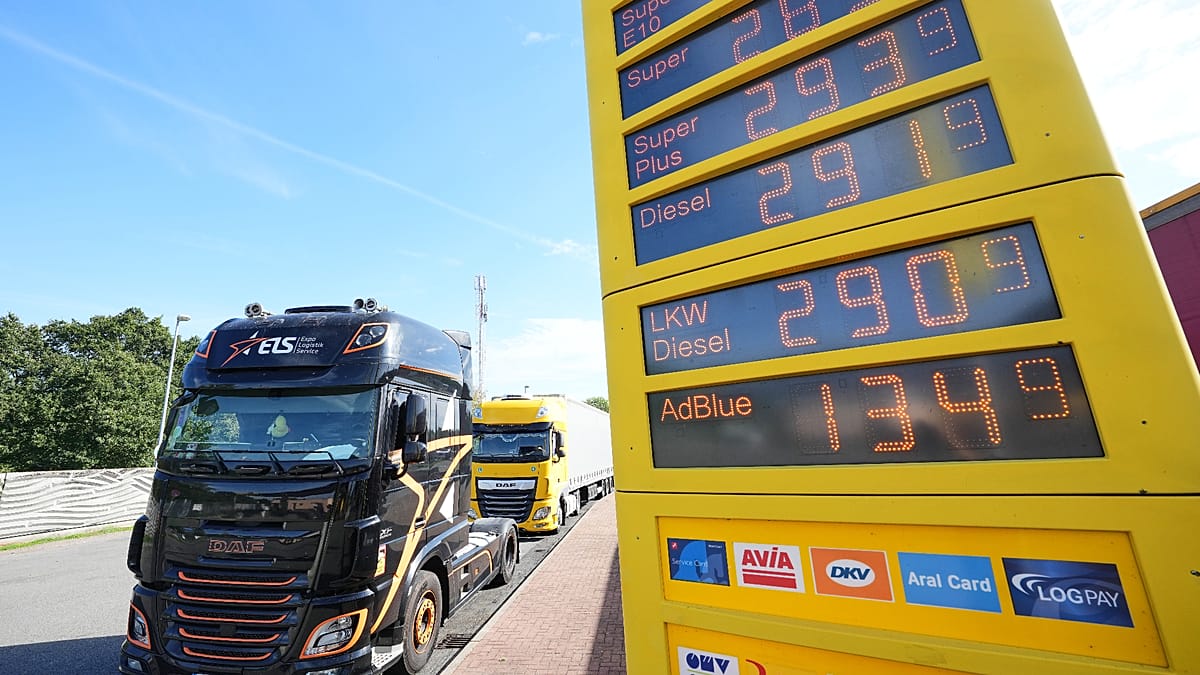
The cost of filling a 50-litre diesel tank now takes 15.4% of Bulgaria’s gross monthly minimum wage, up from 9.9% before the Iran war began, highlighting the growing pressure on workers in Europe’s lowest-paid countries.
Fuel prices have risen significantly since the Israeli-US joint attack on Iran resulted in effectively blocking the Strait of Hormuz, an essential route for one-fifth of global oil to pass through.
In the EU, average consumer diesel prices rose by 40% between 23 February, before tensions in the Middle East escalated, and 21 September, according to the EU Weekly Oil Bulletin.
Rising fuel prices affect many people both directly and indirectly, particularly low-paid workers and those earning the minimum wage.
Asked why lower-income households are particularly affected, Torsten Müller, senior researcher at the European Trade Union Institute, told Euronews Business: “Because they spend a larger proportion of their income on essentials such as housing, food and transport than high-income households.”
So, how much of the monthly minimum wage is needed to fill a 50-litre tank across Europe? And how much has that share increased since the war began?
On 23 February 2026, the average price per litre in the EU was €1.637 for Euro 95 petrol and €1.594 for diesel. By 21 September, these had risen to €2.092 and €2.226 respectively. This represents increases of 27.8% for petrol and 39.6% for diesel.
The table above shows all the details, including minimum wages and fuel prices across 22 EU countries and Turkey, an EU candidate country, for these two periods.
The comparison uses gross monthly minimum wages, before tax and social security deductions.
Minimum wages remained unchanged in most countries over this period, while Estonia recorded the largest increase in the eurozone at 6.8%, between the first and second halves of 2026.
In some countries, the rise in petrol prices exceeded 30%, while diesel prices rose by 50%. Malta was the only country in the comparison where fuel prices remained unchanged.
As of 21 September, the percentage of the monthly minimum wage needed to fill a 50-litre petrol tank ranged from 3.3% in Luxembourg to 13.4% in Bulgaria.
It was also above 10% in Latvia (12.8%), Turkey (11.5%), Romania (11.5%), Greece (10.2%), Czechia (10.2%), Estonia (10.1%) and Slovakia (10.1%). The percentage was below 5% in Ireland (4.1%) and Belgium (4.4%).
Among the major economies, Germany had the lowest figure, as minimum wage earners needed to spend 5% of their monthly minimum wage to fill a 50-litre petrol tank.
Torsten Müller noted that the large differences between countries in these shares can largely be explained by the wide differences in minimum wages.
“One litre of diesel is only marginally cheaper in Bulgaria while the minimum wage is less than a fourth of the one in Luxembourg,” he said.
He underlined that the large differences are still reflected in the value of minimum wages in purchasing power standards (PPS), which take differences in price levels into account. In Luxembourg, the minimum wage in PPS is still twice as high as in Bulgaria.
Workers in countries with lower minimum wages face a heavier burden, as they now need to allocate a larger share of their salaries to fuel than before the conflict. In Bulgaria, for example, the share rose by 3.6 percentage points for petrol, followed by Turkey (3.1) and Latvia (3).
Filling a tank takes more than 10% of the monthly minimum wage
A 50-litre diesel tank takes a bigger share of the monthly minimum wage where diesel costs more per litre than petrol. The share of the monthly minimum wage needed to fill a 50-litre diesel tank ranged from 3.8% in Luxembourg to 15.4% in Bulgaria.
“When the average cost of rent is already more than a third of the minimum wage, spending another 15% of your entire wage on fuel is just not possible,” Esther Lynch, general secretary of the European Trade Union Confederation, told Euronews Business.
She warned that people would be forced to give up their jobs, particularly in areas where there are no reliable public transport links. She said this would be bad for both workers and companies already facing labour shortages.
The country rankings are broadly similar for diesel. Minimum wage earners needed to allocate more than 10% of their monthly minimum wage to fill a 50-litre tank in several countries. The share was 13.9% in Latvia, 13.8% in Turkey, 12.7% in Romania, 11.2% in Czechia and Estonia, 10.8% in Hungary, 10.4% in Greece and 10.3% in Portugal.
Workers in Ireland (4.3%), Germany (5.2%), Belgium (5.3%) and the Netherlands (5.5%) needed to spend among the lowest shares of the minimum wage to afford a tank.
Where does the minimum wage buy more fuel?
The two charts above for petrol and diesel also show how much fuel a monthly minimum wage can buy in each country. A smaller share needed to fill a 50-litre tank means the minimum wage buys more fuel, while a larger share means it buys less.
For example, as of 21 September, a minimum wage earner could buy 324 litres of diesel in Bulgaria, compared with 1,311 litres in Luxembourg.
Fuel costs hit Central and Eastern European countries hardest
Compared with February, the shares needed for a diesel tank rose sharply in Bulgaria (5.5 percentage points) and Turkey (5.3 percentage points). Workers in Latvia, Czechia and Estonia were also hit hard by fuel inflation, as the share of their minimum wage needed for a tank rose by more than 3 percentage points.
Pointing to the gap in minimum wages between Western European countries and Central and Eastern European (CEE) countries, Müller said it is mainly in CEE countries that minimum wage earners have to spend the largest share of their salaries on petrol.