
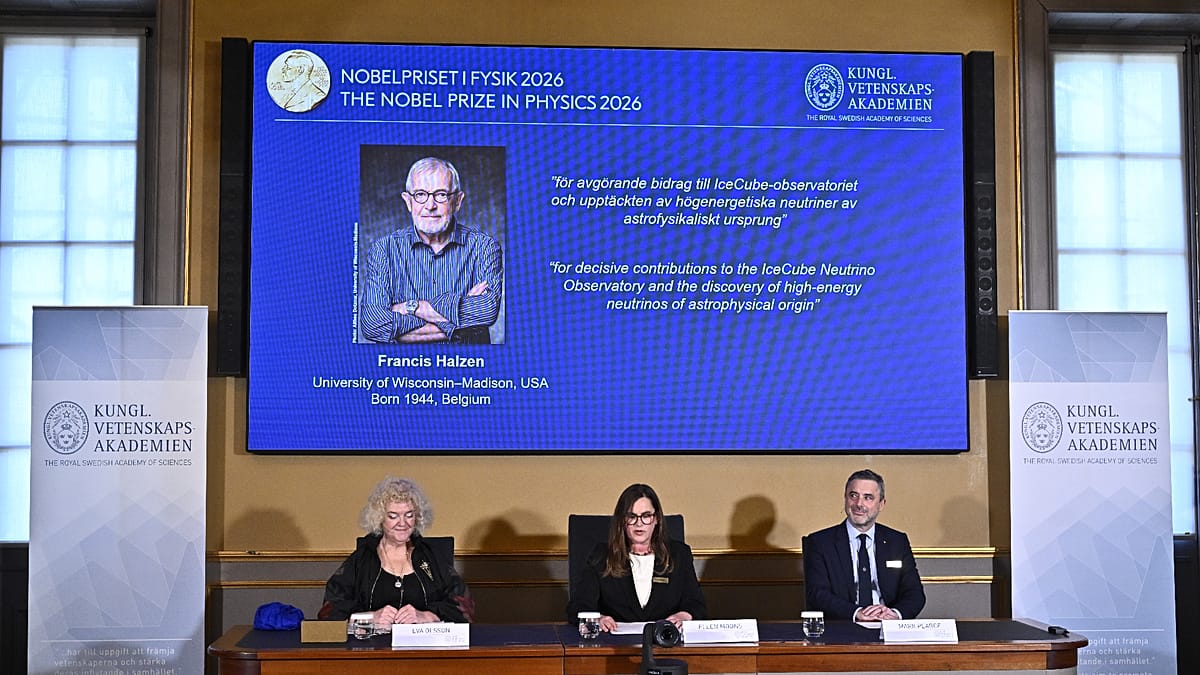
Buried deep in the ice at the South Pole sits a detector the size of a cubic kilometre, built to catch some of the most elusive particles in the universe. On Tuesday, the man who dreamt it up won the Nobel Prize in Physics.
Belgian physicist Francis Halzen won the 2026 Nobel Prize in Physics on Tuesday for pioneering work that uses Antarctic ice to capture neutrinos from the far reaches of the cosmos.
“This year’s prize is about ghostly messengers from space,” Ellen Moons, secretary general of the Royal Swedish Academy of Sciences, told a news conference in Stockholm.
The jury honoured Halzen “for decisive contributions to the IceCube Neutrino Observatory and the discovery of high-energy neutrinos of astrophysical origin”.
The academy said his work had been fundamental to the observatory, which it described as “a cubic kilometre of ice that is equipped with light sensors,” and that it had “paved the way for a new kind of astronomy”.
The detector lets researchers capture neutrinos, rare subatomic particles, “from extremely energy-rich processes in the distant universe”.
Halzen, 82, was born in Tienen, Belgium, and is a US citizen. He is a professor at the University of Wisconsin–Madison, where he directs the Institute for Elementary Particle Physics.
Speaking to the news conference by phone from Italy shortly after the announcement, he said, “it was a great surprise, and I obviously didn’t expect it.”
“But it’s a great pleasure to hear about this prize,” he added.
A giant eye in the ice
High-energy neutrinos form in the same violent cosmic environments as other particles. Unlike the others, though, they travel through space in a straight line and arrive intact.
“Neutrinos reach us without changing direction or losing energy. This means they can provide information that is not available in any other way,” the academy said in a statement.
The catch is that they are fiendishly hard to spot. “Cosmic neutrinos with extremely high energies are very rare, so an enormous volume of ice is needed to observe an adequate number of collisions,” the jury said.
Halzen first floated the idea of the observatory in 1988, and it quickly won over other researchers. Preliminary tests followed a few years later, but the detector was not completed until 2011.
He has served as principal investigator of IceCube, located at the Amundsen-Scott South Pole Station in Antarctica and the world’s largest neutrino detector.
“For me, the main pleasure of it, besides winning the Nobel Prize, is that I hope this reflects on the really courageous people who joined me in the beginning of this project,” Halzen said.
From Leuven to Antarctica
Halzen earned a master’s degree in physics from KU Leuven in 1966 and a doctorate in 1969.
Since the 1970s, he has been a leading figure in cosmic ray and astroparticle physics, publishing research on cosmic ray anomalies and quark matter.
He has also sat on advisory committees including those of the Sudbury Neutrino Observatory in Canada and Germany’s Max Planck Institutes.
Halzen’s award is the second Nobel of the season. On Monday, the medicine prize went to US psychiatrist and neurologist Karl Deisseroth and German scientists Peter Hegemann and Georg Nagel for their pioneering work in optogenetics, which uses light to control nerve signals.
The chemistry prize follows on Wednesday, with the literature laureate due on Thursday. The most closely watched award, the peace prize, will be announced on Friday.
US President Donald Trump lobbied hard for it last year, and Venezuelan opposition leader María Corina Machado, who won it, later gave him her Nobel medal. The committee is aware he will be watching closely again.
The economics prize closes the Nobel season on Monday 12 October.
Each Nobel comes with a diploma, a gold medal and 12 million Swedish kronor (€1.1mn), shared if a prize has more than one winner.
The laureates will receive their awards at a formal ceremony on 10 December, the anniversary of the death in 1896 of Alfred Nobel, who created the prizes in his will.