
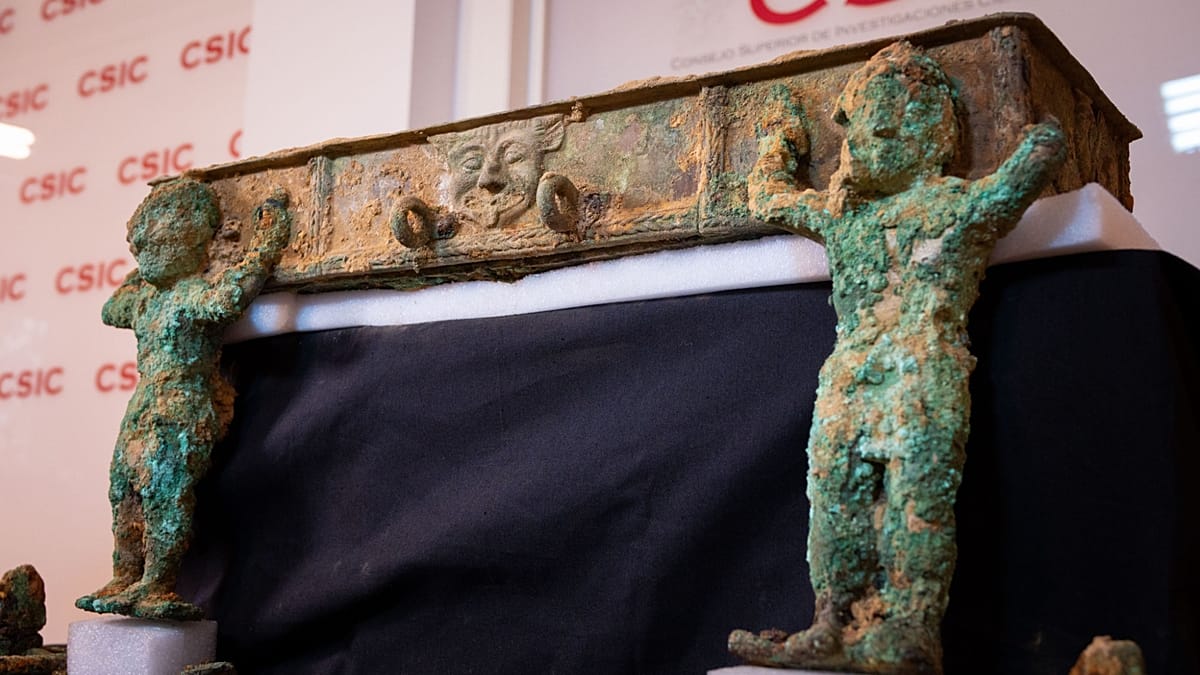
Inside the burial mound of Casas del Turuñuelo, in the town of Guareña (Badajoz), in the Vegas Altas del Guadiana region, the eighth excavation campaign of the Building Tartessos project has brought to light a bronze chariot with no known equivalent in the Iberian Peninsula.
The piece features a box decorated with figures in relief: at the front, an Achelous, a river deity associated with the underworld; on the sides, two griffins with eagle heads and lion bodies; and at the ends, two human figures with their arms raised, supporting the structure, which rests on two equally ornate wheels.
“It is one of the most significant finds made to date at this Tartessian site,” stressed Esther Rodríguez, co-director of the excavations.
The piece was recovered in the southern sector of the main building, whose excavation began in 2015. The research team from the Institute of Archaeology of Mérida, a joint centre of the Spanish National Research Council (CSIC) and the regional government of Extremadura, points out that the only documented parallels belong to the Etruscan civilisation, which reached its peak in central Italy between the 8th and 5th centuries BC.
This detail reinforces the hypothesis that the object reached the south-west of the Iberian Peninsula through the same exchange networks that linked Tartessos with the rest of the Mediterranean. As for its use, co-director Sebastián Celestino suggested that it could be associated with banquet rituals: the chariot appeared next to the room where the Turuñuelo community is thought to have held a final feast before deliberately sealing the building at the end of the 5th century BC.
Greece, Egypt and the East in the same site
Alongside the chariot, the archaeologists recovered a set of imported materials that considerably expands the map of Tartessos’s external relations. Among the objects found are pottery from Greek Attica, an alabaster vessel of Egyptian origin and several ivories decorated with depictions of warriors and with animal and plant motifs that point to workshops in the eastern Mediterranean.
“These materials are providing us with exceptional information to understand the trade relations between the East and the Iberian Peninsula. We are documenting imports and unique pieces that help to reconstruct these exchange networks,” Rodríguez explained.
The 2026 campaign, carried out in April and May, also broadened knowledge of the building itself. Work in the northern and southern sectors of the mound, which measures 90 metres in diameter and six in height, made it possible to identify new rooms and circulation spaces.
In the northern sector, two braziers and a bronze cauldron were also uncovered. The volume of pottery, by contrast, was lower than in previous campaigns, something the researchers attribute to the nature of the areas explored this year, whose function has not yet been clearly established.
Ten years of digs and a second phase ahead
The site of Casas del Turuñuelo has amassed a decade of discoveries that have progressively redrawn the image of Tartessos. In 2017 the remains of the largest animal sacrifice known in the western Mediterranean were documented. In 2023 the first human representations of that culture came to light.
A year later, a slate plaque with scenes of warriors and an alphabet in southern Palaeohispanic script added another dimension to the record. And in 2025, the site yielded the oldest Greek marble altar in the western Mediterranean.
With the field campaign concluded, the project is now entering its laboratory phase. The restoration, documentation and analysis of the pieces are being carried out at the Service for Conservation, Restoration and Scientific Studies of Archaeological Heritage (SECYR) at the Autonomous University of Madrid, a partner in the project since its inception.
“The second phase of any archaeological excavation is indispensable. A crucial piece of work is now beginning that will allow us to better understand the function of the spaces, the trade relations and, ultimately, the lives of those who inhabited this place,” Rodríguez noted.
The project brings together around thirty institutions and a hundred national and international researchers, and has the backing of the Provincial Council of Badajoz and Guareña Town Council, as well as the institutional support of the CSIC (source in Spanish) and the regional government of Extremadura.