
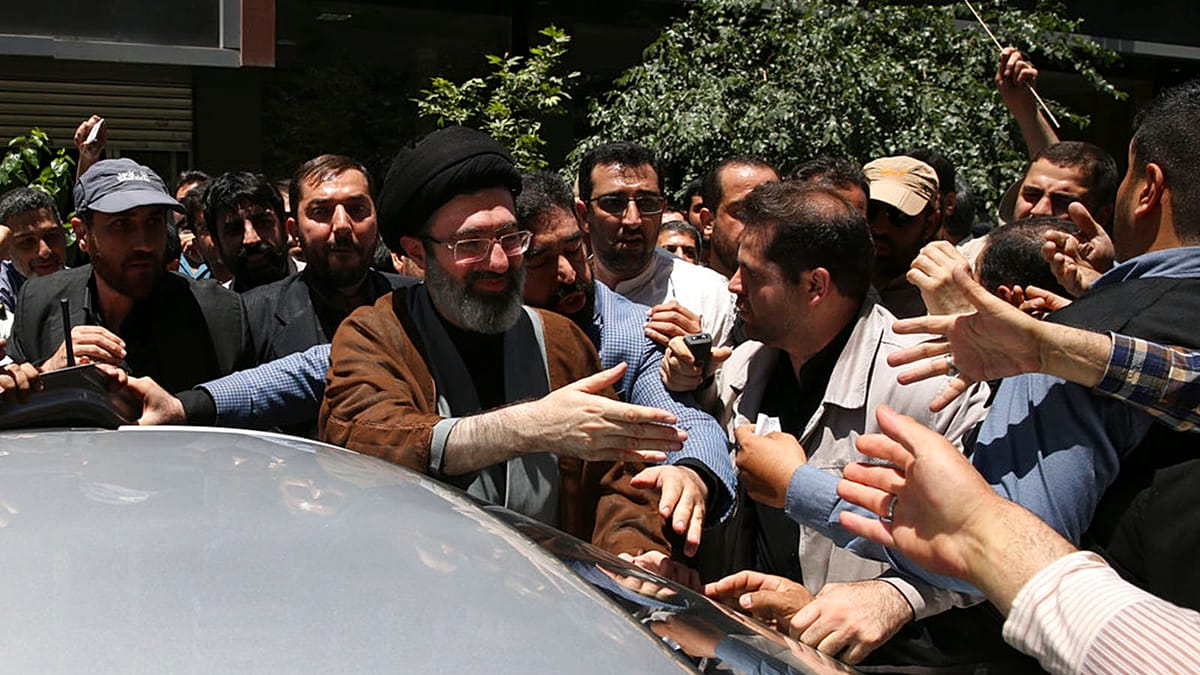
Iran’s Assembly of Experts has formally announced that Mojtaba Khamenei has become the successor to Ali Khamenei and the third Supreme Leader of the Islamic Republic — an appointment made in the midst of an escalating Iran war.
A secretive figure within the Islamic Republic, Mojtaba Khamenei has not been seen publicly since Saturday, when the Israeli airstrike targeting the supreme leader’s offices killed his 86-year-old father.
Also killed were the younger Khamenei’s wife, Zahra Haddad Adel, who came from a family long associated with the country’s theocracy.
Born in 1969 in the city of Mashhad, Mojtaba Khamenei followed what many analysts describe as a strategic path—from teenage years spent on the battlefields of the Iran-Iraq war to the highest religious and security circles of the Islamic Republic.
This trajectory strengthened his ties with the military establishment and commanders of the Islamic Revolutionary Guard Corps (IRGC), helping him cultivate a network that later played a crucial role in consolidating his position at the apex of power.
What distinguishes the 56-year-old Mojtaba from his older brother Mostafa Khamenei and his younger brothers Masoud Khamenei and Meysam Khamenei is that he moved beyond the conventional role of “the supreme leader’s son.”
While his brothers largely remained within the relatively safe confines of cultural or administrative roles linked to their father’s office, Mojtaba’s name has become associated in public discourse with hidden power networks and sensitive security institutions.
The question of Mojtaba Khamenei’s wealth and financial resources has also drawn attention from some Western media outlets in recent years. In a number of these reports, he has been described as a “billionaire” with access to vast financial resources, extensive property holdings in European cities such as London and Vienna, and a broader network of assets.
The precise ownership or management of these holdings, however, is difficult to verify because of the limited financial transparency surrounding economic structures linked to Iran’s leadership.
Inside Iran, Mojtaba Khamenei has never been publicly known as a “billionaire” or as a businessman.
Analysts instead tend to view his influence over economic networks not as the result of private commercial activity but as a consequence of his political position and his close ties to powerful state institutions, economic foundations connected to the leadership, and the IRGC.
His political orientation, meanwhile, remains something of a “black box”. His near-complete silence on major policy issues has divided analysts: some see him as a guiding force for security-sector hardliners, while others argue that the absence of an executive record and public positions makes it impossible, for now, to judge his true ideological direction.
From the front lines of war
In the mid-1980s, during the final years of the Iran–Iraq War, Mojtaba Khamenei—then a teenager of around seventeen—was sent to the front lines.
He served in one of the most well-known IRGC units, the Habib ibn Mazaher Battalion of the 27th Mohammad RasulullahDivision, a formation that at the time drew many young, ideologically committed fighters.
The battalion later gained particular notoriety because a number of those who fought within its ranks went on to become prominent commanders and security figures in the Islamic Republic.
Among those associated with the broader formation and its affiliated units were commanders such as Qasem Soleimani, Hossein Hamedani, and Ahmad Kazemi, as well as figures like Hossein Taeb, who would later rise within Iran’s security apparatus.
Although Mojtaba Khamenei’s time at the front was relatively brief, analysts believe that the experience — and the relationships formed with fellow IRGC fighters — played a significant role in shaping his later connections with Iran’s military and security circles.
Beyond that, wartime participation carried symbolic significance for many figures of his generation.
The Iran-Iraq war occupies a central place in the political memory of the Islamic Republic, and many senior officials have drawn legitimacy and prestige from their wartime credentials.
The ayatollah in the shadows
Mojtaba, the second son of Ali Khamenei, entered the Qom seminary after graduating from the Alavi School in Tehran. He studied under prominent clerics, including Mohammad‑Taghi Mesbah‑Yazdi, Mahmoud Hashemi Shahroudi, and his father.
Throughout his clerical studies he sought to build the religious credentials necessary for a role within the upper echelons of the Islamic Republic.
For more than 15 years he taught dars-e kharej—the highest level of seminary instruction in Islamic jurisprudence and principles.
Teaching at this level traditionally serves as a prerequisite for attaining the rank of marja and, by extension, the religious legitimacy often associated with Iran’s Supreme Leadership.
According to reports by the Qom seminary’s news agency, he reached the clerical rank of Ayatollah in 2022.
Yet in October 2024 he unexpectedly announced, in a video message, that he would suspend his classes.
While he described the decision as “a matter between myself and God,” analysts interpreted the move as a political manoeuvre — possibly aimed at reducing sensitivities surrounding a hereditary transfer of power or preparing for the operational phase of leadership succession.
Strategic marriage and political visibility
In 1999 Mojtaba Khamenei married Zahra, the daughter of Gholam‑Ali Haddad‑Adel, creating what many observers viewed as a strategic alliance between the office of the supreme leader and a conservative technocratic-cultural faction within the political establishment.
At the time, Haddad-Adel himself was entering a pivotal stage in his political career. Already known as a prominent cultural figure, he was emerging as a key player in the nascent conservative movement seeking to counter Iran’s reformist camp.
During the parliamentary elections for Iran’s sixth parliament, he ran as a candidate aligned with conservative factions and, after a contentious vote recount and annulment of some ballots by the Guardian Council, entered parliament as the final representative from Tehran.
His political ascent continued, culminating in his election as speaker of parliament in 2004.
Mojtaba Khamenei’s name first surfaced prominently in national politics during the heated presidential election of 2005.
Mehdi Karroubi, one of the losing candidates, wrote an unprecedented letter to the Supreme Leader, accusing his son of direct involvement in organising and engineering votes in favour of Mahmoud Ahmadinejad.
The allegation cast light on Mojtaba’s perceived influence within the middle ranks of the IRGC and the Basij militia, reinforcing an image of him as a behind-the-scenes architect of the emerging conservative power structure.
Four years later, during the protests that followed Iran’s disputed 2009 presidential election, his shadowy presence became a direct target of public anger.
Demonstrators chanted slogans condemning him and rejecting any prospect of his eventual succession, reflecting a perception among many protesters that he played a central role in the state’s response to the unrest.
Re-engineering the leader’s office
After the 2009 protests subsided, Mojtaba Khamenei did not retreat from the political arena. Instead, his influence within the Supreme Leader’s office deepened.
During this period, the institution evolved from a largely administrative advisory office into what has been described as a centralised command hub overseeing Iran’s military, security and economic networks.
Many observers argue that Mojtaba played a central role in this transformation. In their view, he functioned as a strategic link between the ayatollah’s office and the upper and middle ranks of the IRGC, particularly its intelligence organisation and the Basij. Through this role he is believed to have cultivated a network of loyal commanders whose fortunes became tied to the continuity of the system.
Although Mojtaba Khamenei has rarely appeared in diplomatic settings, analysts believe he has exerted strategic influence behind the scenes in coordinating Iran’s regional policies in countries such as Syria, Iraq, Lebanon and Yemen.
Some analysts also argue that over the past two decades, his imprint can be seen in a gradual generational shift within the state—one in which first-generation revolutionaries were replaced by a new cohort of clerical technocrats and second-generation IRGC commanders.
US sanctions and exposure of ‘black box’
For years Mojtaba Khamenei attempted to maintain a low public profile. Yet in the late 2010s his name began appearing in official documents of Western governments. These records increasingly portrayed him not merely as the supreme leader’s son but as an influential figure within Iran’s decision-making structure.
In 2019 the US Department of the Treasury placed him under sanctions as part of a broader package targeting the office of Ali Khamenei.
US officials stated at the time that Mojtaba played a role in transmitting his father’s authority and advancing his policies through political and security networks.
For many observers, the inclusion of his name in the sanctions list signalled a growing recognition in Washington that this relatively low-profile cleric wielded significant influence within the Islamic Republic’s power structure.
The ‘inevitable’ succession
Mojtaba Khamenei’s rise as the leading candidate for succession was driven by several strategic factors.
Supporters within the Islamic Republic’s power structure point to what they describe as his unmatched command over the “hidden network of power.”
After two decades at the heart of the system’s decision-making core, he is widely seen as both a repository of sensitive state knowledge and a figure with deep ties to the IRGC’s leadership ranks and the security services.
Others emphasise the role of what they describe as a “vacuum of rivals”.
Over the past decade, the Iranian political landscape has witnessed the disappearance — whether through death, political decline or marginalisation — of many figures who might have challenged his ascent.
Among them were the deaths of Akbar Hashemi Rafsanjani and Ebrahim Raisi, along with the earlier passing of Mahmoud Hashemi Shahroudi and the political weakening of Sadegh Larijani.
These developments, some analysts argue, gradually cleared the field. In the eyes of many within the system’s loyalist base, Mojtaba eventually came to be seen not merely as the strongest candidate but as the only viable one capable of preventing internal fragmentation.
Paradox of hereditary power
Yet Mojtaba Khamenei’s ascent also exposes one of the Islamic Republic’s deepest contradictions.
The 1979 revolution was built on the rejection of hereditary rule. The possibility of a son succeeding his father presents a profound ideological dilemma for a system founded on the repudiation of monarchy.
To overcome this challenge, Mojtaba must persuade both the political establishment and the broader public that his leadership represents not a return to dynastic rule but the continuation of a revolutionary system based on religious and managerial qualifications.
Among segments of Iran’s traditional clerical establishment, scepticism remains strong. Many senior clerics have long emphasised that the founders of the Islamic Republic — including Ruhollah Khomeini — explicitly rejected hereditary succession.
Leader in the shadow of war
Internationally, Mojtaba Khamenei remains something of an enigma.
Unlike his father, who served as president before becoming Supreme Leader and had years of experience in international diplomacy, Mojtaba has never held a formal executive position or held public meetings with foreign officials.
As a result, little is known about his worldview regarding major issues such as Iran’s nuclear negotiations, its relations with Israel or its strategic orientation toward global powers.
For foreign capitals, this absence of a diplomatic record represents both uncertainty and risk.
His leadership also collides with the confrontational posture associated with US President Donald Trump, whose administration openly opposed any hereditary consolidation of power in Iran and signalled that Washington would not recognise the legitimacy of such a transition.
The war in which Mojtaba Khamenei assumes power places him in a paradoxical position.
On one hand, external pressure and confrontation with Washington and Israel may rally hard-line factions and military institutions around him, strengthening internal cohesion in the name of national defence.
On the other hand, the same confrontation may raise the cost of his rule for factions within the establishment seeking an exit from sanctions and conflict.
His leadership begins under extraordinary circumstances that could either cement his authority as a wartime commander or undermine his fragile legitimacy under the strain of military and economic pressure.
There has been only one other transfer of power in the office since the Islamic Revolution. Ali Khamenei succeeded Ayatollah Ruhollah Khomeini, who died at age 86, after serving as the figurehead of the revolution and leading Iran through its eight-year war with Iraq.